

Success Cases: Real Examples of Startups within Corporations
- American Success Stories: From Accidental Discoveries to Billion-Dollar Products
- Gmail: The Power of Google’s “20% Rule”
- Post-it Notes: The “Failed” Discovery at 3M
- European Innovations: From Gaming Consoles to Corporate Accelerators
- PlayStation: An Internal Entrepreneur Changes Sony’s Fate
- UQBATE: Deutsche Telekom’s Talent Incubator
- Airbus BizLab: A Runway for Innovation
- Key Success Factors for Intrapreneurial Projects
- Corporate Culture that Encourages Innovation
- Resource Support
- Tolerance for Failure
- Structured Intrapreneurship Programs
- Conclusion
American Success Stories: From Accidental Discoveries to Billion-Dollar Products
Intrapreneurship – entrepreneurship within existing companies – has become a powerful innovation tool for corporations worldwide. Unlike traditional corporate innovation models, intrapreneurship allows employees to act as entrepreneurs while retaining the advantages of corporate structure and resources. This approach not only facilitates breakthrough products and services but also helps companies retain talented employees who wish to realize their creative potential. In this article, we will examine the most striking real examples of successful intrapreneurial projects in American and European companies.
Gmail: The Power of Google’s “20% Rule”
One of the most famous examples of successful intrapreneurship is the creation of Gmail at Google. This story is directly connected to the renowned “20% time” rule, according to which Google employees were allowed to dedicate a fifth of their working time to projects that, in their opinion, “would bring the greatest benefit to Google,” as stated by company founders Larry Page and Sergey Brin.
Paul Buchheit, a Google engineer, took advantage of this opportunity in the early 2000s to work on a revolutionary email service. At that time, existing email services had significant limitations in storage capacity and search functionality. Inspired by the “80/20” principle, Buchheit began developing a project that would transform electronic mail.
“I created Gmail because I personally wanted better email,” Paul Buchheit later said.
Despite initial skepticism within the company (some doubted the necessity of such large email storage and the unconventional use of labels instead of folders), Google’s management recognized the potential of their employee’s idea and gave him full support. Launched on April 1, 2004, Gmail became one of the company’s most successful products.
Today, Gmail has more than 1.8 billion active users and is one of the core services in Google’s portfolio. Notably, this is not the only successful project born thanks to the “20% rule” – Google News and Google AdSense also emerged through this policy, bringing the company billions of dollars in revenue.
Post-it Notes: The “Failed” Discovery at 3M
The story of the famous Post-it Notes at 3M is a classic example of how a “failure” can turn into an innovative breakthrough with the right corporate culture. In 1968, Spencer Silver, a 3M scientist, was trying to develop a super-strong adhesive for the aerospace industry. Instead, he accidentally created a weak adhesive that could easily be removed from surfaces without leaving traces.
The project was initially registered as a failure, and for several years, Silver unsuccessfully tried to find an application for his invention. “They started calling me Mr. Persistent because I wouldn’t give up,” Silver later recalled.
The breakthrough occurred only six years later when another 3M employee, Art Fry, faced a problem: every Wednesday at church choir practice, he used small pieces of paper to mark pages in his hymnal, but by Sunday, they had all fallen out. He needed a bookmark that would stick to the pages without damaging them.
Remembering Silver’s adhesive, Fry experienced what he now calls a “eureka moment” – an insight accompanied by an adrenaline rush. The partnership between Silver and Fry led to the development of a product initially called Press’n Peel, launched in 1977. However, the first launch was unsuccessful – customers didn’t know how to use the product.
Only two years after the initial launch, in 1979, 3M decided to give the product a second chance with a free sample campaign for businesses. The new approach proved successful, and Post-it Notes became an essential office tool worldwide. An interesting fact: the yellow color of the notes was not the result of market research – it was simply the only colored paper available in the laboratory.
European Innovations:
From Gaming Consoles to Corporate Accelerators
PlayStation: An Internal Entrepreneur Changes Sony’s Fate
The creation of PlayStation at Sony is perhaps one of the most striking examples of successful intrapreneurship in Europe. It all began with Sony engineer Ken Kutaragi, who bought a Nintendo game console for his daughter but was dissatisfied with the sound quality.
With experience and education in electronics, Kutaragi began working on improving Nintendo while continuing to work at Sony. Eventually, he convinced Sony’s management of the prospects of developing their own gaming console, which led to the creation of PlayStation.
This case is particularly remarkable because the idea initially met significant resistance within the company. However, thanks to Kutaragi’s persistence and belief in his idea, Sony entered a completely new market, which subsequently became one of the company’s key business areas.
UQBATE: Deutsche Telekom’s Talent Incubator
In 2011, Deutsche Telekom employee Johannes Nünning developed UQBATE – an intrapreneurship program aimed at supporting employees in developing ideas for new businesses within the company.
UQBATE is a three-month intrapreneurship accelerator that helps transform employee ideas into viable projects. The program begins with an initial design phase, where participants freely think through their ideas, receive feedback, and learn to present their innovations. If their idea is selected, they move to the fellowship stage, which includes intensive training on lean startup methodology, bootcamps, and regular coaching sessions.
“When I read that I could start my own startup without risk within Deutsche Telekom, I immediately got excited,” says Sebastian Stoll, a Deutsche Telekom employee from Leipzig who presented his “BeOn Track” project as part of the program.
Since the program’s creation, UQBATE has tested 400 ideas with the participation of more than 600 employees. Successful projects include Zuqi, an online platform for specialized service providers, and MyComoda, a virtual wardrobe. An important feature of the program is that Deutsche Telekom supports entrepreneurial freedom: any startup born within UQBATE allows the entrepreneur to initially own 100% of the shares.
Airbus BizLab: A Runway for Innovation
Airbus BizLab is an aerospace accelerator that works closely with both external startups (entrepreneurs) and Airbus’s own internal innovation projects (intrapreneurs) to accelerate the transformation of innovative ideas into valuable businesses.
The first BizLab was established in Toulouse, France, followed by two more such “hybrid” accelerators – in Hamburg, Germany, and Bangalore, India. The program is designed not only for aerospace startups – Airbus BizLab welcomes any startup whose innovation can be adapted for the aerospace sector.
“In large companies, one department doesn’t always know what other departments are working on, let alone have visibility into innovations happening outside the company,” explains the BizLab concept.
Over the past three years, the accelerator has incubated 50 startups and 40 internal Airbus projects within BizLab in Toulouse, Hamburg, and Bangalore. In the first season in Madrid, 5 startups (Recogn.ai, Daisho, Urban Data Eye, Botslovers, and Unblur) and 3 internal projects (Fly-up, Back to Fly, and Chainbus) were incubated.
The program offers a safe space where entrepreneurs can develop their projects through support from special coaches and mentors, weekly training sessions, access to prototyping space, and a Demo Day with company professionals, partners, and venture capitalists.
Key Success Factors for Intrapreneurial Projects
Analyzing the presented cases of successful intrapreneurship, several key factors can be identified that contribute to the success of internal startups:
Corporate Culture that Encourages Innovation
In all the examples considered, companies have created a culture that not only allows but actively encourages innovative thinking among employees. Google’s “20% time” policy, Spencer Silver’s persistence at 3M, and the intrapreneurship programs at Deutsche Telekom and Airbus are all examples of how companies have institutionalized innovation.
Resource Support
Successful intrapreneurial projects receive the necessary resources for development. This can be time (as in Google’s case), funding (as in the UQBATE and BizLab programs), or technical resources and access to expertise (as in the case of PlayStation at Sony).
Tolerance for Failure
The Post-it Notes story particularly vividly demonstrates the importance of a corporate culture that views failures not as defeats but as opportunities for learning and new discoveries. The initial “failure” in developing a super-strong adhesive ultimately led to the creation of one of 3M’s most successful products.
Structured Intrapreneurship Programs
UQBATE from Deutsche Telekom and BizLab from Airbus show how formalized intrapreneurship programs can systematize the process of supporting internal innovations, providing employees with training, mentoring, and opportunities to develop their ideas.
Conclusion
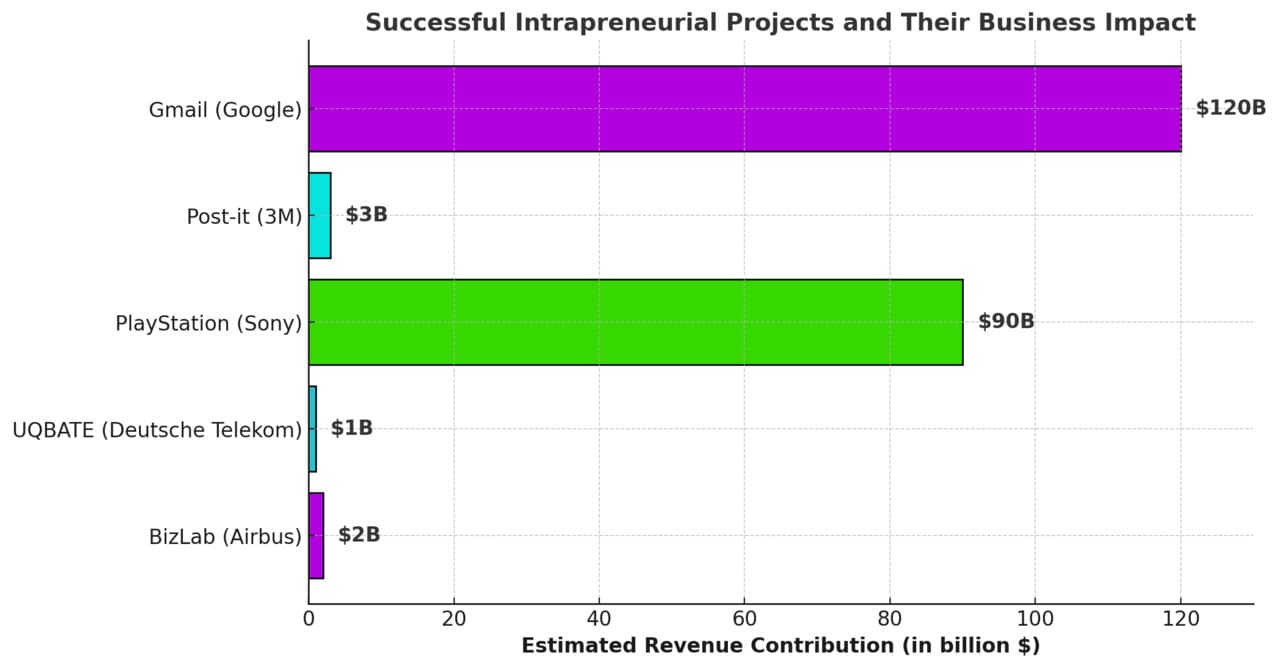
The examined examples of successful intrapreneurial projects from the US and Europe clearly demonstrate that internal entrepreneurship can be a powerful driver of innovation for large corporations. From Gmail and Post-it Notes to PlayStation, UQBATE, and BizLab – these stories show how individual employees’ ideas can transform into revolutionary products and services, opening new markets and growth opportunities.
The key success factor in all these cases is creating a corporate environment that not only allows but actively supports innovative thinking among employees. Companies that invest in intrapreneurship programs receive a dual benefit: they not only create new revenue sources and market opportunities but also increase the engagement and satisfaction of their employees by giving them the opportunity to realize their creative potential.
In a world where the pace of technological change is constantly increasing, a company’s ability to encourage and support internal innovation becomes a critical factor in competitiveness. Intrapreneurship offers a proven path to creating a culture of innovation that can help companies not just survive but thrive in a rapidly changing business environment.
References
- Leveraging innovation & intrapreneurship as a source for organizational growth
- Practitioner Perspectives Of Information Technology Industry Intrapreneurship: An Exploratory Study
- Effect of Innovative Culture on Intrapreneurship