

Retention without Pressure: Designing Motivation for Gig and Hybrid Workers
- Why Traditional Retention Metrics No Longer Apply
- What Actually Retains Flexible Workers?
- Project Thinking: The Shift from Role to Contribution
- A Practical Model: The 3 Pillars of Pressure-Free Motivation
- Fear vs. Fit: What Kind of Retention Are You Designing For?
- Final Challenge
When people can leave at any moment — why do they choose to stay?
This question defines the new challenge for forward-thinking HR leaders. In an era where project work and hybrid setups are the norm, the traditional toolbox of retention — linear careers, annual bonuses, strict KPIs — is rapidly losing relevance.
For CHROs and Heads of People in the Nordics, the Netherlands, and Germany, where flexibility and trust are cultural foundations, the issue isn’t new — but the response must be. Loyalty no longer stems from contracts. It grows from meaning, respect, and safety. If your goal is to build a culture people want to stay in — even if they could leave tomorrow — the focus must shift from pressure to participation.
Why Traditional Retention Metrics No Longer Apply
Classic retention strategies were built for stable, linear careers. They assume a worker is a long-term asset to be developed within one company. But gig work and hybrid roles break this logic.
Eurofound’s 2024 report notes that flexible roles demand a new social contract — one built not on promises, but on the quality of the current experience. A KPI set for 12 months often feels irrelevant to someone working in agile sprints or rotating projects. For these contributors, visible impact and reputation matter more than titles or long-term planning.
Applying old models to new formats often backfires: more control leads to less autonomy — and eventually, attrition. As the IZA Institute of Labor Economics confirms, knowledge workers thrive on autonomy. It’s not a reward — it’s a prerequisite.
| Traditional Retention | Soft Motivation |
|---|---|
| KPI & annual bonus-driven | Real-time contribution visibility |
| Focus on vertical promotion | Focus on peer impact & influence |
| Top-down feedback | Peer-to-peer recognition |
| Culture of control | Culture of trust and inclusion |
| Retention by obligation | Retention by choice |
What Actually Retains Flexible Workers?
If not career ladders or job titles, then what? The answer lies in building the invisible infrastructure of trust.
Demos Helsinki calls this “soft infrastructure of trust”: an environment where professionals feel valued, safe, and respected — even if they’re not permanent employees.
- Soft Visibility — My impact is seen by peers, not just managers.
- Peer Trust — I rely on others, and they rely on me.
- Culture of Respect — My voice matters, regardless of contract.
- Recognition without Hierarchy — Appreciation flows across, not just from the top.
Finnish Institute of Occupational Health reinforces this view, stating that intrinsic motivation — linked to meaningful work and mutual recognition — consistently outweighs extrinsic rewards in modern teams.
Project Thinking: The Shift from Role to Contribution
Project-based work rewires motivation. People align around purpose, not permanence.
- They choose temporary teams over permanent departments.
- They prioritize collective outcomes over personal advancement.
- They stay where they can do their best work — and be seen for it.
As noted by Copenhagen Business School, psychological safety — not hierarchy — is what sustains performance in hybrid teams.
A Practical Model: The 3 Pillars of Pressure-Free Motivation
Let’s move from principle to practice. Here’s a lightweight framework based on Nordic research and real team behaviors.
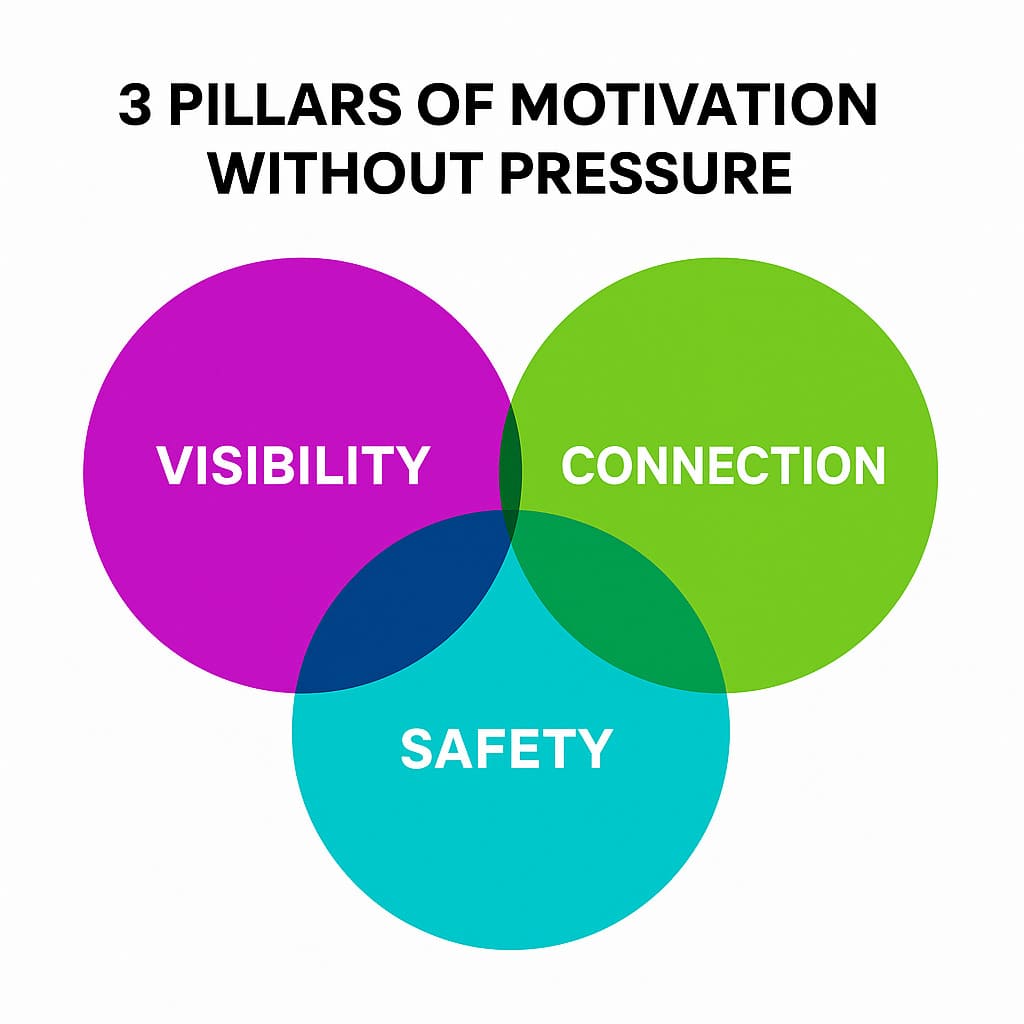
- Visibility
- Not tracking, but reflecting impact.
- Enable peer-to-peer feedback and asynchronous recognition.
- ✦ Tools like AlbiCoins help teams highlight value without gamified incentives.
- Safety
- Normalize temporary engagement and exits without stigma.
- Give voice to flexible contributors — through rituals, retros, shared planning.
- CBS studies show safety fosters idea-sharing and loyalty.
- Connection
- Belonging happens in teams, not org charts.
- Create shared rituals: informal calls, joint demos, debriefs.
- Dutch HR trends show that team identity boosts gig retention more than brand affinity.
Fear vs. Fit: What Kind of Retention Are You Designing For?
There are two kinds of retention:
- Fear-based: “Hit the KPI or lose the project.”
- Fit-based: “Your contribution matters. We designed a culture where you can thrive.”
The first leads to burnout, silence, and exit. The second leads to belonging, pride, and return.
Retention without pressure is not about avoiding performance. It’s about creating ecosystems where people choose to stay — not because they have to, but because it makes sense to.
Final Challenge
Work has changed. Flexibility is not a trend — it’s the new operating system.
If your culture only retains the permanent, are you ready for the future of work?
References:
- Work Will Form (Soft Infrastructure of Trust) — Demos Helsinki
- From Insights to Action: Understanding and Mitigating Organizational Errors — Sara Blasco Román (Copenhagen Business School)
- Psychological Safety – What, Why and How? — Amy Edmondson
- The Role of Psychological Safety in Promoting Software Quality in Agile Teams — Adam Alami, Mansooreh Zahedi & Oliver Krancher
- FIOH Life Course Management Concept as a Good Practice — Finnish Institute of Occupational Health