

The Context Velocity Paradox: Mitigating the €2.7M Risk of Executive Failure in Nordic Leadership Models
- Executive Summary: The Invisible Deficit in Senior Integration
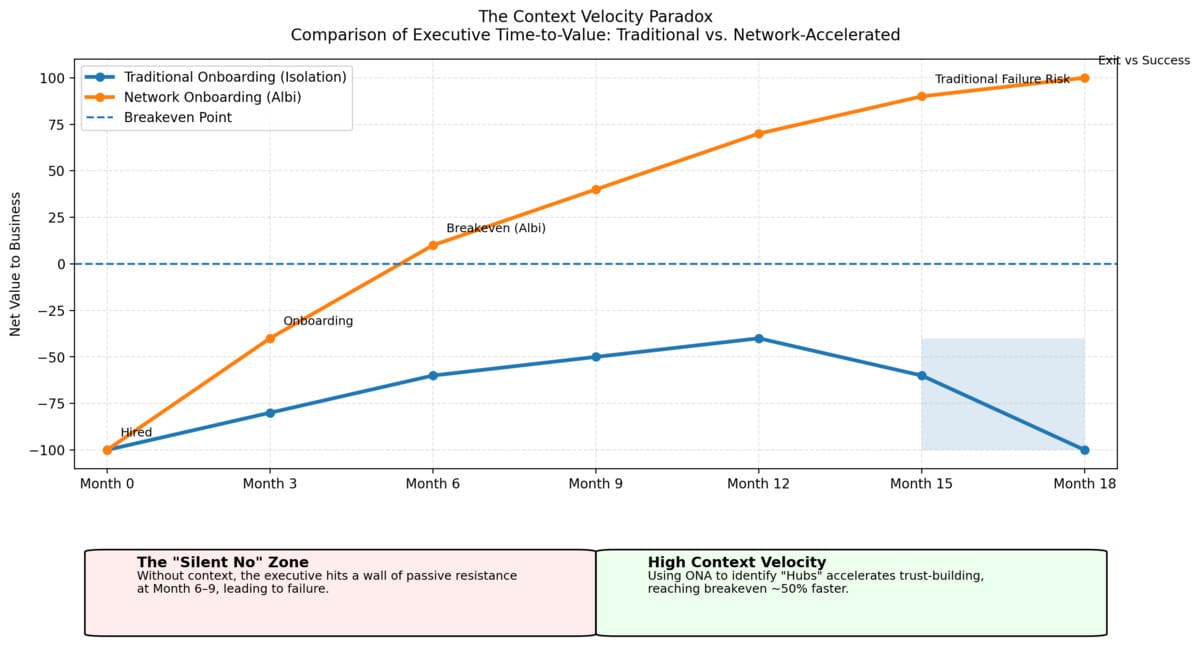
- The Financial Physics of Executive Failure
- Concept Deepening: The Context Velocity Framework
- The Nordic Leadership Paradox
- The Strategic Risk Model: Junior vs. Senior Integration
- Organizational Network Analysis (ONA): The Discovery System
- The 90-Day Executive Integration Blueprint
- Practical Implementation: Influence Discovery System
- Thought Leadership: Counterintuitive Findings
- Conclusion: The Future of Leadership Integration (2026-2028)
1. Executive Summary: The Invisible Deficit in Senior Integration
In the high-stakes arena of global corporate leadership, a silent but devastation crisis is eroding shareholder value across European and Nordic markets. While organizations have mastered the logistical mechanics of recruitment—frequently expending upwards of €150,000 in retained search fees for a single C-suite appointment—their mechanism for integrating this high-value talent remains dangerously archaic. The prevailing assumption, termed within this analysis as the “Plug-and-Play Fallacy,” posits that senior executives, by virtue of their extensive tenure and proven track records, act as modular components that can be inserted into any organizational machine and immediately generate output.
However, empirical data tracking executive performance from 2024 through projections for 2026 suggests a starkly different reality. Credible longitudinal research indicates that nearly 40% of new executive hires fail within the first 18 months, a statistic that has remained stubbornly high despite the proliferation of digital HR technologies.1 In the Nordic region, this failure rate is exacerbated by unique, often invisible cultural dynamics—specifically the consensus-driven leadership model and the sociological phenomenon of Janteloven—which create “invisible networks” of influence that are opaque to outsiders and resistant to traditional hierarchical command.
This report argues that the primary driver of this failure is not a lack of professional competence, but a critical deficit in Context Velocity—the speed at which a new leader can accurately map, navigate, and leverage the informal social capital of their new environment. We present a proprietary analytical framework for measuring and accelerating this velocity, moving executive onboarding from a qualitative “soft skill” to a quantifiable operational science. By leveraging Organizational Network Analysis (ONA) and sophisticated tools that visualize trust capital, such as the AlbiCoins infrastructure, organizations can mathematically reduce the “Time-to-Trust” curve and secure the long-term ROI of their leadership assets.
2. The Financial Physics of Executive Failure
2.1 The Mathematics of Misalignment
The cost of a failed executive hire is frequently underestimated by boards and Finance Directors who calculate risk based solely on the direct costs of recruitment and severance. This accounting method fails to capture the systemic damage inflicted by leadership churn.
The true economic impact is a compound function of direct outlay, opportunity cost, and the elusive but deadly “organizational drag.”
Recent analyses suggest that the total cost of a bad executive hire typically ranges from 213% to over 10 times the executive’s annual salary, depending on the strategic centrality of the role.3 For a Senior Vice President in a European tech firm with a total compensation package of €250,000, the financial exposure is not merely the salary lost; it represents a multimillion-euro liability.
Table 1: The Total Cost of Executive Failure (Strategic Risk Model)
| Cost Category | Components | Estimated Value (Senior VP) | Strategic Impact |
|---|---|---|---|
| Direct Cash Costs | Retained search fees (30-33%), Sign-on bonuses, Relocation packages, Legal fees, Severance (6-12 months). | €250,000 – €400,000 | Immediate liquidity drain; sunk cost with zero ROI. |
| Productivity Drag | Salary paid during “Time-to-Value” ramp-up (6-9 months) where output is sub-optimal or negative. | €150,000+ | “Zombie Leadership”: The executive is present but not effective, consuming resources without decision velocity.1 |
| Opportunity Cost | Stalled strategic initiatives, delayed product launches, missed market windows during the 18-month failure cycle. | €1,000,000 – €5,000,000+ | Market share loss to competitors; innovation stagnation; loss of first-mover advantage. |
| Cultural Erosion | Disengagement of direct reports; increased turnover in high-performing teams; loss of “Trust Capital” in the boardroom. | Intangible but High | “Organ Rejection”: The team isolates the leader, damaging morale and creating a cynicism regarding future hires.1 |
| Reputational Damage | Investor skepticism; brand damage in the talent market; internal cynicism regarding board decisions. | Variable | Long-term increase in Cost of Talent Acquisition (CAC for Talent). |
Total Estimated Risk Exposure: €1.4M – €5.4M per failed executive.
This financial model demonstrates that the risk profile of a senior hire is fundamentally inverted compared to a junior hire. Companies often spend 80% of their onboarding resources on junior staff (who need functional skills training) and only 20% on seniors (who are assumed to know what to do).1 This resource allocation is a strategic error. A junior failure costs €30,000 and is localized; a senior failure can destabilize the enterprise and derail multi-year strategies.
2.2 The Context Gap vs. The Skills Gap
The root cause of this financial hemorrhage is rarely technical incompetence. Executive search firms, particularly at the retained level, are adept at vetting for hard skills, past performance, and intellectual capability. The failure mechanism is almost exclusively environmental. It is a Context Gap.
When a leader enters a new organization, they possess high Human Capital (skills, experience, intellect) but zero Social Capital (trust, relationships, influence).5 In hierarchical cultures (e.g., Anglo-Saxon or American models), authority is conferred by title. A VP can issue directives on Day 1 that will be followed based on the legitimacy of the role. In the Nordic model, and increasingly in modern flat organizations globally, authority is not conferred; it is earned through consensus and relational proof.
A leader attempting to execute strategy without first accumulating sufficient Social Capital encounters Organizational Drag—the friction caused by misalignment, resistance, and lack of information flow.7 Without a mechanism to bridge the Context Gap, the new leader’s Context Velocity remains near zero, while their burn rate (salary + opportunity cost) remains high.
2.3 Strategic Forecast: The Risk Multiplier (2026-2028)
Looking ahead to the 2026-2028 strategic horizon, the risk of executive failure is projected to increase due to several converging trends identified in recent workforce analysis:
- AI-Driven Disruption: As AI reshapes workforce structures, leaders are required to manage not just human teams but human-machine hybrid workflows. This requires higher levels of trust and nuance, making cultural integration even more critical.8
- Remote/Hybrid Complexity: The “Time-to-Trust” in virtual or hybrid environments is significantly longer than in co-located teams. The invisible networks that drive decision-making are harder to see on Zoom or Teams, making the Context Gap wider.9
- The “Agentic” Shift: The move toward “Agentic AI” and autonomous business units means decision-making is becoming more decentralized. A leader who relies on command-and-control will be bypassed by the organization’s own velocity.8
- Rising CEO Turnover: Data indicates that CEO turnover is rising even among strong-performing companies, suggesting that boards are becoming more proactive and less tolerant of “slow starts”.10
Therefore, solving the executive onboarding problem is not an HR task; it is a governance imperative for Boards and CEOs.
3. Concept Deepening: The Context Velocity Framework
To manage the risk of executive failure, we must move beyond vague notions of “cultural fit” and establish rigorous analytical frameworks. We introduce Context Velocity (Vc) as a primary metric for HR Analytics.
3.1 Defining Context Velocity
Context Velocity is defined as the speed at which a new entity (executive) establishes reciprocal, value-generating connections with critical nodes (influencers) within the organizational network. It serves as a proxy for the rate of integration and the reduction of the “Time-to-Value” curve.
Unlike standard “Time-to-Productivity” metrics, which often measure task completion (e.g., “completed compliance training” or “first deal closed”), Context Velocity measures network integration. It asks not “what has the executive done?” but “how connected is the executive to the people who get things done?”
3.2 The Analytical Formula
We propose a conceptual formula for Context Velocity (Vc) to be used in Organizational Network Analysis (ONA):
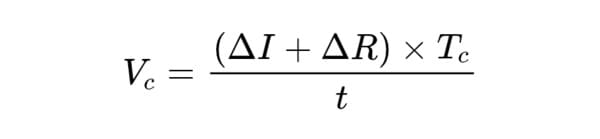
Where:
- ΔI (Information Access): The rate at which the executive gains access to non-public, tacit organizational knowledge. This can be measured by the breadth of their communication network (Degree Centrality). It represents the flow of “insider” information to the new leader.
- ΔR (Relational Depth): The formation of strong ties, measured by reciprocal interactions (e.g., mutual recognition, two-way Slack/Teams communication). A message sent is an attempt; a message returned is a relation.
- Tc (Trust Capital Coefficient): A multiplier representing the level of psychological safety and credibility the leader has established. If trust is zero, the entire velocity collapses to zero, regardless of activity levels. (See Section 3.3).
- t (Time): The duration since the executive’s start date (typically measured in 30-day epochs).
Interpretation of the Metric:
- High Vc: The executive is rapidly becoming a “hub” or “bridge” in the network. They are acquiring context and building trust faster than time is elapsing.
- Low Vc: The executive is isolated. They may be sending messages (high output) but receiving few responses or recognitions (low reciprocity). This is a leading indicator of “Organ Rejection.”
3.3 Trust Capital: The Hidden Currency
Trust Capital is the accumulated “goodwill” that allows a leader to make withdrawals (i.e., ask for difficult changes or high effort) without depleting their standing. In the Nordic model, you cannot lead with a negative Trust Capital balance.
We adapt Maister’s Trust Equation11 for the specific context of Executive Integration:
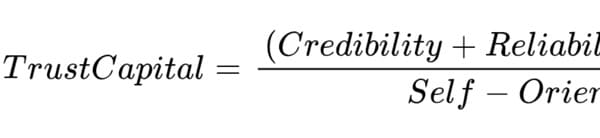
- Credibility: Does the executive know their craft? (Often high for new hires due to resume/reputation).
- Reliability: Do they do what they say? (Takes time to prove; initially neutral).
- Intimacy: Do stakeholders feel safe sharing the “real” truth with them? (Often low for outsiders).
- Self-Orientation: Does the executive appear focused on their own career/agenda or the team’s success? (High self-orientation destroys trust).
The Trap: New executives often try to prove Credibility immediately (launching new strategies), which can inadvertently signal high Self-Orientation. This collapses the equation, resulting in zero Trust Capital. A low Trust Capital score halts Context Velocity because the network blocks information flow to the untrusted node.
3.4 Invisible Networks
The formal organization chart (Org Chart) depicts how authority should flow. The Invisible Network depicts how work actually gets done.12
- Formal Nodes: Managers, Directors, VPs.
- Informal Nodes (The “Mitchells”): As noted by Rob Cross 13, individuals like “Mitchell” may be mid-level managers who connect disparate parts of the organization. They are critical to information flow but invisible on the org chart. They are the “super-connectors” who bridge silos.
- Implication: If a new executive focuses only on “Formal Nodes” (their peers and boss) and ignores the “Informal Nodes” (the key engineers, the veteran sales admin), they will fail to acquire context. They will pull levers that are not connected to any gears.
4. The Nordic Leadership Paradox
The Nordic business environment presents a specific, often counterintuitive challenge for executive integration. The region outperforms globally in innovation, stability, and employee well-being, yet it can be incredibly hostile to incoming leaders who misread its cultural code.
4.1 The Mechanics of Consensus
In the Nordic model (and increasingly in the Netherlands and German “Social Partnership” models), decision-making is not an event but a process.14 It is horizontal, not vertical.
- The Process: Decisions are socialized in coffee rooms, informal chats, and pre-meetings before they ever reach the boardroom. By the time a formal meeting occurs, the decision has effectively already been made through consensus (or forankring – anchoring).
- The Trap for Outsiders: An executive from a UK or US background often treats the meeting as the place where the decision is made. They present a “bold vision” and ask for a vote. The room nods politely. The executive leaves thinking they have agreement. In reality, they have triggered The Silent No.15
4.2 “The Silent No” and Passive Resistance
“The Silent No” is a form of cultural resistance specific to high-trust, egalitarian societies. Because direct confrontation is viewed as disrupting social harmony, disagreement is rarely voiced as a direct “No.” Instead, it manifests as:
- Polite Silence: Team members do not argue, but they do not act.
- Delay: Requests are acknowledged but prioritized below existing consensus-driven tasks.
- The “Pocket Veto”: Key influencers (informal nodes) quietly signal to the group that the new initiative is “not how we do things,” effectively killing it without a single open argument.
This phenomenon is often deadly for new executives. They interpret silence as consent. Three months later, when execution has stalled, they react with increased directive pressure (“Why isn’t this done?”). This pressure confirms the group’s suspicion that the leader is authoritarian and “un-Nordic,” solidifying the rejection.
4.3 Janteloven: The Law of Jante
Underpinning this dynamic is Janteloven, a sociological concept describing the Nordic aversion to individual boasting or exceptionalism.16
- Rule: “You are not to think you are anyone special.”
- Business Impact: A new executive who arrives with a “Savior Complex”—talking about their past wins, their MBA, or how they fixed things at their last company—violates the Law of Jante. They are immediately categorized as arrogant.
- Consequence: The immune system of the organization activates. Information is withheld. Support is withdrawn. The leader is isolated.
4.4 Case Study Analysis: The Helsinki Failure
Scenario: A Series C software company in Helsinki hired a Sales Director from a high-aggression London firm.
Goal: Scale revenue 3x in 18 months.
The Failure Arc:
- Month 1 (The Credibility Trap): The Director launched a “Shock and Awe” strategy presentation. He focused entirely on his vision (High Self-Orientation). He spoke more than he listened.
- Month 2 (The Invisible Block): He bypassed the “Informal Nodes” (the lead developers and long-time support staff) to give direct orders to sales reps. The developers, who held the product knowledge, stopped prioritizing sales requests (The Silent No).
- Month 3 (The Isolation): The Director felt the drag. He tried to force compliance through KPIs. The team complained to the founders about “toxic culture” (Janteloven violation).
- Month 5: The Director was terminated. Cost: €250,000+ direct, plus two quarters of missed targets.
Root Cause Analysis:
- Missed Signal: He mistook the team’s quiet demeanor for lack of drive, rather than a different mode of drive.
- Decision Error: He attempted to withdraw Trust Capital before depositing it.
- Structural Blindness: He failed to map the invisible network where the developers held the power to block sales success.
Alternative Path:
Had he spent the first 30 days mapping the network and asking “How do we succeed together?” (low self-orientation), he might have identified the developers as key allies. A simple acknowledgment of their expertise (giving AlbiCoins or public praise) would have built the Trust Capital needed to later ask for the aggressive sales push.
5. The Strategic Risk Model: Junior vs. Senior Integration
To fix this, organizations must flip their risk model. Currently, onboarding focuses on “Task Proficiency” for all levels. However, the risk profile changes dramatically with seniority.
Table 2: The Comparative Strategic Risk Model
| Dimension | Junior Hire (Individual Contributor) | Senior Hire (Executive/VP) |
|---|---|---|
| Primary Capital Need | Human Capital (Skills, Process knowledge). | Social Capital (Trust, Politics, Influence). |
| Time-to-Value Horizon | 3-5 Months | 6-9 Months (Breakeven Point).18 |
| Primary Failure Mode | Incompetence (Cannot do the job). | Isolation (Cannot get the organization to do the job). |
| Cultural Risk | Low (Expected to adapt). | Extreme (Expected to lead, but often clashes). |
| Network Requirement | Local (Needs to know their manager and team). | Systemic (Needs to navigate cross-functional silos). |
| Hidden Cost | Training hours. | Organizational Drag & Strategic Paralysis. |
| Onboarding Strategy | Instructional: “Here is how you do X.” | Integrational: “Here is who influences Y.” |
Insight: Most companies apply a “Junior” onboarding model (forms, videos, process training) to Senior hires. This is a category error. Senior integration must be Political, Cultural, and Network-based, not functional.
6. Organizational Network Analysis (ONA): The Discovery System
To manage “Context Velocity,” we need to measure it. Organizational Network Analysis (ONA) provides the X-ray vision required to see the invisible organization.12
6.1 Mapping the Invisible
ONA utilizes data (either passive from email/Slack logs or active from surveys/recognition tools) to visualize the connections between employees. For a new executive, ONA answers three critical questions:
- Who are the Influencers? (Centrality). Who do people go to for advice? These are the people the executive must win over in the first 30 days. They are often not the people with the biggest titles.
- Where are the Silos? (Modularity). Are Engineering and Sales talking? If not, the executive knows where to focus their bridge-building efforts.
- Are they Integrating? (Connectivity). By Month 3, is the executive connected to the key nodes, or are they floating on the periphery?
6.2 Passive vs. Active ONA
- Passive ONA: Analyzes metadata (who emails whom, who attends meetings). Good for broad patterns but raises privacy concerns and misses the “quality” of the interaction.12 It shows frequency, not sentiment.
- Active ONA: Uses surveys or recognition data (e.g., AlbiCoins). This is superior for trust mapping because it measures positive sentiment. Sending a generic email is not a signal of trust; sending a “Thank You” coin is.19
6.3 The AlbiCoins Analytical Layer
AlbiCoins (a peer-to-peer recognition currency) serves as a potent “Active ONA” sensor.
- Mechanism: When Employee A sends AlbiCoins to Employee B for “helping with the project,” a digital link is created.
- Data Insight: Over time, these links form a Trust Map. A new executive can look at this map and immediately see who holds the informal power (the people accumulating the most coins from diverse teams).
- Integration Accelerator: If the new executive starts giving coins (recognizing others) early, they signal humility and observation (countering Janteloven). If they receive coins, it is a validated signal that the “immune system” has accepted them.
6.4 Key ONA Metrics for Onboarding
- Leadership Distance: The percentage of the organization within two steps of the executive. Healthy is 85-90%.20
- Silo Index: The percentage of teams detached from the rest of the org.
- Brokerage Score: The executive’s ability to connect unconnected groups.
7. The 90-Day Executive Integration Blueprint
Based on the research from Michael Watkins (“The First 90 Days”) 21 and adapted for the Nordic/European context, we propose a structured “Trust Acceleration Protocol.”
Phase 1: The “Sponge” Phase (Days 1-30)
Goal: Accumulate Trust Capital and Map the Network. Velocity Target: High Intake, Low Output.
- Action 1: The Listening Tour (Structured Interviews).
- Conduct 1-on-1s with 360-degree stakeholders (subordinates, peers, informal influencers identified via ONA).
- The Nordic Twist: Ask “How are decisions actually made here?” and “Who do you go to when you are stuck?” Do not pitch your vision yet. Focus on “Sources of Knowledge” mapping.22
- Action 2: Stakeholder & Influence Mapping.
- Create a physical map. Plot “Formal Power” vs. “Informal Trust” (using Albi/ONA data).
- Identify the “Silent No” blockers—those with high influence but low enthusiasm.
- Action 3: The Humility Signal.
- Publicly recognize the team’s past wins. Use the “Janteloven” dynamic to your advantage by praising the collective rather than individuals or yourself.
Phase 2: The “Pilot” Phase (Days 31-60)
Goal: Secure Early Wins and Test Context. Velocity Target: Moderate Output, High Reciprocity.
- Action 1: The “Small Win” Project.
- Launch a low-risk, high-visibility initiative that solves a team pain point (not a strategic overhaul).
- Purpose: Demonstrate Reliability (Trust Equation). Show you can deliver without breaking the culture.
- Action 2: The Trust Acceleration Protocol.
- Engage in vulnerability-based trust exercises.23 Admit what you don’t know. Ask for help from the “Informal Nodes.”
- Metric: Monitor the executive’s integration into the AlbiCoin flow. Are they receiving recognition from outside their direct reports?
- Action 3: Consensus Building.
- Float your strategic hypotheses in 1-on-1s (The “Pre-meeting”). Adjust based on feedback. By the time you present formally, you should already have alignment.
Phase 3: The “Calibration” Phase (Days 61-90)
Goal: Strategic Alignment and Full Velocity. Velocity Target: High Output, High Alignment.
- Action 1: The Strategic Reveal.
- Present the long-term strategy. Because of Phase 1 & 2, this is now seen as a “Collective Vision” rather than an “Imposed Directive.”
- Action 2: The “Silent No” Check.
- Look for the absence of noise. If everyone is agreeing too quickly, probe deeper. “What are we missing?” “Why might this fail?”
- Action 3: Context Velocity Review.
- Measure the Vc metric. Is the executive’s network density approaching the benchmark of a tenured leader? If not, intervene immediately.
8. Practical Implementation: Influence Discovery System
To execute the blueprint, organizations need a systematic way to discover influence. We recommend the “Influence Discovery System” (IDS) methodology.
8.1 The IDS Methodology
- Identify the Hubs: Use ONA (or simple observation/Albi data) to find the top 3% of super-connectors.13 These 3% often influence 85% of the organization.
- Identify the Bridges: Find the people who connect disparate silos (e.g., the Product Manager who plays football with the Sales VP).
- Map the Flow: Determine how information moves. Is it top-down (unlikely in Nordics) or mesh-based?
- Targeted Integration: Assign the new executive a “Culture Buddy” who is a highly central “Hub” node. This buddy acts as a guide to the invisible network, explaining the unwritten rules.
9. Thought Leadership: Counterintuitive Findings
9.1 The “Experience Trap”
Conventional wisdom says hire for experience. Our analysis suggests that excessive prior experience can be a liability in high-context cultures like the Nordics. Executives with deep experience often have “calcified” habits and rigid mental models of how authority works. They are less adaptable to the “Consensus Trap” than less experienced, more agile leaders.
- Implication: Hire for Adaptability Quotient (AQ) and Network Intelligence over pure Industry Tenure.
9.2 The “Honeymoon” is a Myth
The first 30 days are often called the “Honeymoon Period.” In reality, this is the “Rejection Window.” The organization’s immune system is most active in the first month. If an executive makes a cultural error (e.g., claiming credit) in Week 2, the “Silent No” is triggered immediately, though the symptoms won’t appear until Month 6.
- Implication: Front-load cultural coaching to the pre-boarding phase.
9.3 Conflict is a Sign of Health
In consensus cultures, silence is dangerous. If a new executive reports “zero conflict” in their first 90 days, they are failing. They are likely being handled or ignored. Constructive Friction—open debate and pushback—is a sign that the organism has accepted the new cell and is engaging with it.
- Implication: Train executives to solicit and reward public challenge to their ideas.
10. Conclusion: The Future of Leadership Integration (2026-2028)
As we look toward 2028, the definition of leadership is undergoing a metamorphosis. The era of the “Hero CEO”—the solitary figure commanding from the top—is ending, dismantled by the complexity of networked organizations and the democratization of information via AI.
In the future, leadership will be defined by Network Orchestration. The successful executive of 2028 will not be the one with the best answers, but the one with the highest Context Velocity—the ability to rapidly connect the right nodes to solve novel problems.
Board-Level Implications:
- Governance: Boards must demand “Integration Risk Assessments” for new CEO/C-suite hires, not just search updates.
- ROI Measurement: HR must move from reporting “Time to Fill” (a recruitment metric) to “Time to Trust” (an integration metric).
- Cultural Asset Management: Culture is no longer “fluffy.” It is a defensive moat. Tools like AlbiCoins that visualize and preserve Trust Capital will become as essential as ERP systems for managing financial capital.
Final Recommendation:
Do not leave your €250,000 asset in a vacuum. The “Plug-and-Play” model is broken. By adopting the Context Velocity Framework, leveraging Organizational Network Analysis, and respecting the profound depth of Nordic Consensus Culture, organizations can invert the failure rate. They can turn the “Senior Hire Paradox” into a competitive advantage, building a leadership bench that is not just hired, but truly integrated.
Does your onboarding visualize the network? If not, you are flying blind.
Strategic Checkpoint: Is your new VP at risk?
You cannot improve what you do not measure. Most Nordic companies are flying blind on executive integration until the 6-month mark.
Don’t wait for the “Silent No.” Let’s visualize your new leader’s network integration today.
👉 Schedule a complimentary “Context Velocity” Audit
References
- Egon Zehnder: Executive Onboarding, Accelerated: Insights
- Pinnacle Search: The Hidden Cost of a Bad Executive Hire
- Avenue Leadership: Executive transition failure: causes and solutions
- MyHRFuture: The Role of Organisational Network Analysis in People Analytics
- MyHRFuture: What Is Social Capital and How Do You Measure It?
- Medium (Dario De Santis): Executives, Your Calendar Is the Bottleneck You Don’t See
- Radancy: HR Trends 2026: What’s Next in People Strategy
- Fisher OSU: How to Lead a Successful Remote Team: Building Trust
- Conference Board: CEO Departures Are Rising, Even at Strong-Performing Companies
- Model Thinkers: The Trust Equation
- Umbrex: Organizational Network Analysis (ONA) Frameworks
- Rob Cross: What is Organizational Network Analysis (ONA)?
- ResearchGate: European cultures and management styles
- University of California: The Silent No (Dissertation)
- NLS Norway: The “Janteloven” Phenomenon in the Workplace
- Nordics.info: Jantelov Cultural Concept
- Egon Zehnder: Integrating Executives into Culture: Why Onboarding Isn’t Enough
- AlbiMarketing: The Data You’re Not Tracking: How ‘Invisible Wins’ Predict Team Health
- Teamspective: Organizational Network Analysis: Complete Guide
- Michael Watkins: The First 90 Days: Critical Success Strategies (PDF)
- Michael Watkins: Influence Mapping Strategy
- Restaff: Strategies and Best Practices for Cross-Cultural Teams
- Simon Sinek: Mastering Trust in Remote Teams (Video)