

Everyone knew. It took a customer to say it out loud.
- The symptom: a problem everyone knew about
- The usual explanation, and why it does not hold
- Four triggers, and what happens when they fire late
- How to check this in your own organisation
- The structural response
- Conclusion
- References
Most problems are known inside an organisation long before anyone acts on them, and what usually ends the wait is a moment that makes speaking unavoidable, often supplied by someone outside the company.
The symptom: a problem everyone knew about
A large customer writes to say that the handover between your sales and delivery teams is costing them weeks on every order. The email goes to a director, then to a meeting, and within a fortnight there is a working group, a budget line and a named owner. In the first session someone from operations says, quietly, that this has been a known issue for at least three years. Nobody disagrees. Several people can describe the workaround they built to cope with it.
Nobody was hiding the problem. It came up in retrospectives, in corridor conversations and in the occasional slide titled “lessons learned”. It simply never reached the point where anyone had to do something about it. Then a customer named it in writing, and within days it became a priority.
An earlier article in this series looked at organisations where people stop raising problems at all, because the signals that would make speaking worthwhile are missing. This one is about a different pattern. Here people do talk, often and openly. What is missing is the moment that turns an observation everyone shares into a problem someone has to act on.
Our first study, How Innovation Happens, is based on 28 in-depth interviews with innovation leaders in large Nordic and European organisations. It gives that moment a name. It calls it a trigger, and its account of how triggers work explains why so many organisations end up waiting for a customer to provide one.
The usual explanation, and why it does not hold
The usual explanation is cultural. People did not feel able to speak, the culture discourages bad news, or there is a gap between what staff see and what leadership hears. The remedy that follows is about openness: more listening sessions, an anonymous channel, a message from the top that problems are welcome.
In the case above, none of that applies. The problem was not hidden from anyone. It had been mentioned many times, to the right people, in meetings where speaking was perfectly safe. It still sat untouched until the customer wrote.
The report describes the first stage of the Innovation Flow as the point at which ideas move from silent awareness into speech, and it is precise about what moves them. Triggers interrupt routine and force articulation. In the report’s words, they “are not sources of ideas but moments or conditions that make speaking unavoidable.” The idea, or the problem, usually exists long before the trigger. The trigger is what ends the waiting.
“Ideas can stay there for a long time if there is no management prioritization.”
Innovation & R&D Leader · Imaging & Hardware Technology · Finland
The report draws a conclusion from this that is easy to read past: the more routine dominates daily work, the fewer triggers occur, which makes managing them a leadership priority. A busy, well-run organisation with stable processes is exactly the kind of place where triggers become rare. Problems are absorbed into the routine rather than interrupting it.
Connie Gersick and Richard Hackman’s study of habitual routines in groups (1990) describes the same dynamic at team level. Groups settle into ways of working that they stop examining, and those habits tend to change only at particular moments: when something new is encountered, when the group fails, when a milestone is reached or when someone from outside intervenes. Between those moments the routine runs, including all the workarounds built into it.
A customer complaint is one of those moments. It works, and that is the problem with it. It arrives late, after the cost has already been paid for years, and it arrives in a form the organisation did not choose: as a complaint, in front of a client, with the reputational damage already done. Waiting for customers to supply triggers means the organisation outsources the timing of its own priorities.
Four triggers, and what happens when they fire late
The report identifies four recurring triggers across the interviews, with internal friction the most common. Appendix 2 describes how each one works in practice.
| Trigger | How it works | Who can manage it | What it costs when it fires late |
|---|---|---|---|
| Internal friction | Inefficiencies become visible pain points that demand attention | Line managers and process owners | Years of workarounds that become part of the job |
| External exposure | Customer or market realities expose gaps in current solutions | Sales, service and product leaders | The problem is named by a customer, in writing |
| Informal sensemaking | Conversations and communities generate emotional energy around ideas | Anyone who convenes people across teams | Observations stay in separate heads and are never combined |
| Leadership signals | Explicit cues define when speaking up about problems is expected and safe | Senior leaders | Ideas wait indefinitely for a priority that never comes |
Table 1. The four triggers of articulation, who can manage each one and the cost of leaving it to chance. Source: Bridgium, How Innovation Happens (2026), section 5.1 and appendix 2; the last two columns are our reading.
Internal friction: when the workaround becomes the job
The report describes internal friction as the moment when inefficiencies accumulate to the point where continuing routine work is no longer acceptable. Articulation happens when problems can no longer be absorbed informally. Its summary of the mechanism is short: “Inefficiencies → repeated workarounds → visible pain → articulation becomes necessary.”
“Innovation can simply be doing a job more easily than before.”
Technology Development Manager · Logistics & Infrastructure · Finland
The weak point in that chain is the second step. A workaround solves today’s problem and removes the pain that would have forced someone to speak. Nelson Repenning and John Sterman’s research on process improvement (2001) shows how this traps organisations: people under pressure work harder and patch problems as they appear, which keeps output up and leaves no time for the improvement that would have removed the problem. As their title puts it, nobody ever gets credit for fixing problems that never happened. Diane Vaughan’s study of the Challenger launch decision (1996) shows the extreme form of the same pattern. Repeated anomalies were reinterpreted, one launch at a time, as acceptable, until a deviation that should have stopped work had become part of normal operations. William Samuelson and Richard Zeckhauser’s experiments on status quo bias (1988) add a simpler reason: people disproportionately stick with the current arrangement, even when an alternative would serve them better.
“Innovation only happens when solving a real issue.”
Senior Innovation Leader · Logistics & Ecommerce · Finland
Friction is the most common trigger in the report, and it is also the one most easily neutralised. The better a team is at coping, the longer the friction stays below the threshold where anyone has to speak.
External exposure: the customer as a late alarm
Appendix 2 describes ideas emerging when internal solutions no longer align with customer behaviour, regulatory requirements or external benchmarks. The mechanism, in the report’s words: “External interaction → mismatch becomes visible → internal assumptions questioned → articulation follows.”
“Innovation starts from customer or business need.”
Innovation Lead · Logistics & Postal Services · Finland
“Innovation is driven by challenges that are relevant for our customers.”
Head of Innovation & Venture Building · Engineering & Consulting · Denmark
The question is when that exposure happens. A complaint is exposure at its latest and most expensive point. Eric von Hippel’s work on lead users (1986) showed that some customers face needs months or years before the rest of the market, and that working with them can act as an early warning for what is coming. Dorothy Leonard and Jeffrey Rayport (1997) made a related point: customers often cannot ask for what they do not believe can be provided, so many needs are only visible to people who watch customers work. Both describe exposure that the organisation seeks out deliberately, before the mismatch turns into a complaint.
Informal sensemaking: the conversations that combine what people know
Many ideas surface through informal interaction rather than formal processes. The report describes conversations and communities combining observations and generating emotional energy around ideas, and summarises the mechanism as “Conversation and exchange → shared interpretation → emotional energy → articulation.”
“People are going around here, hearing things, combining them in their heads. And then somebody comes with an idea.”
Innovation & R&D Leader · Chemicals & Materials · Finland
“They gave us new perspectives, new ideas, new energy.”
Innovation & Strategy Lead · Consumer Goods & Branding · Sweden
In the opening example, operations knew about the delays, sales knew which customers were most affected and finance could have put a number on it. Nobody combined the three. Alex Pentland’s research with wearable sensors at MIT (2012) found that patterns of communication, including the energy and engagement of exchanges between people, predicted team performance as strongly as all other factors combined. Informal sensemaking is the trigger that depends most on people meeting outside their own team, and it is the first thing to disappear when calendars fill up. Francesca Gino and Bradley Staats (2015) name the underlying bias as a bias toward action: organisations that stay in constant motion leave little room for the reflection that would connect what different people have noticed.
Leadership signals: when “now this matters”
Leadership does not create ideas, the report says, but it defines when articulation is expected and safe. Strategic priorities, innovation calls or pilot initiatives act as temporal signals, the moment at which an organisation says, in the report’s phrase, “now this matters.”
“If people don’t have support from top management, they would not spend time on it.”
Head of Innovation & Venture Building · Engineering & Consulting · Denmark
This is the trigger the opening quote refers to. Without a signal of priority, ideas and problems can stay where they are for a long time. John Kotter’s analysis of failed transformations (1995) put not establishing a great enough sense of urgency first among the errors that sink change efforts. The customer email in the opening example did exactly what a leadership signal should have done earlier: it told the organisation that this problem now mattered, and when.
The report’s summary insight brings the four together: triggers operate by interrupting routine and lowering the cost of articulation. Each of them can be left to chance or managed. Left to chance, internal friction is absorbed by workarounds, external exposure arrives as a complaint, informal conversations do not happen across teams and leadership signals arrive after the fact. The customer becomes the trigger of last resort.
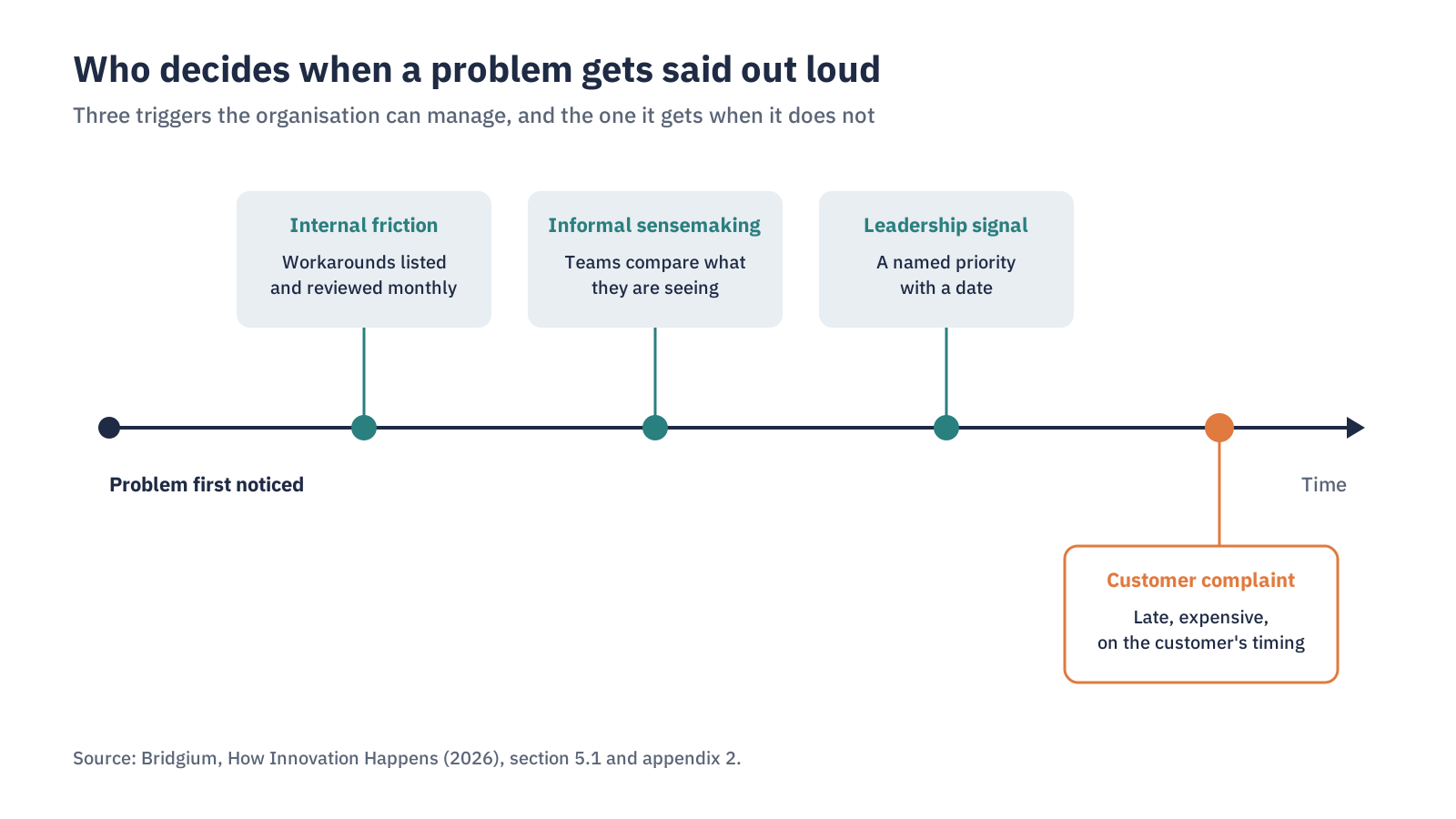
Figure 1. Who decides when a problem gets said out loud: triggers the organisation can manage, and the customer complaint it gets when it does not. Source: Bridgium, How Innovation Happens (2026), section 5.1 and appendix 2.
| Trigger | Managed deliberately | Left to chance |
|---|---|---|
| Internal friction | Workarounds are listed and reviewed regularly | Workarounds become the way the job is done |
| External exposure | Teams observe customers and bring findings inside | The customer raises the problem as a complaint |
| Informal sensemaking | People from different teams meet regularly to compare notes | Each team holds one piece of the picture |
| Leadership signals | Priorities are named with dates and owners | Priority is set by whichever problem becomes most visible |
Table 2. Managed and unmanaged triggers. Source: derived from Bridgium, How Innovation Happens (2026), section 5.1 and appendix 2.
How to check this in your own organisation
Five questions show whether your triggers are managed or left to customers:
- Of the last five problems that became priorities, how many were first raised inside the company, and how many came from a customer, an auditor or a regulator?
- For the most recent one, how long had people inside known about it before it was acted on?
- Could a team lead list the three workarounds their team relies on most, and has anyone above them ever seen that list?
- When did people from operations, sales and finance last sit together with no agenda except comparing what they are seeing?
- Can people name the two or three problems leadership has said matter this quarter, and when they will be looked at?
| What you observe | What it usually indicates |
|---|---|
| Priorities change after customer escalations | External exposure is the main working trigger |
| “We’ve known about this for years” is said in kickoff meetings | Friction was absorbed by workarounds rather than raised |
| Different teams describe different parts of the same problem | Informal sensemaking across teams is missing |
| Ideas are welcomed and then wait without a decision | Leadership signals lack a date or an owner |
Table 3. Signals that triggers are left to chance. Source: derived from Bridgium, How Innovation Happens (2026), section 5.1 and appendix 2.
The Nordic dimension
Nordic organisations start with an advantage on external exposure. Many respondents in our study describe innovation as something that begins close to the customer rather than at the centre of the company. The same Finnish leader whose quote opens this article put it simply:
“Innovation is closer to the customers, not in headquarters.”
Innovation & R&D Leader · Imaging & Hardware Technology · Finland
The risk is the other side of the same strength. Our reading, which goes beyond what the report states directly, is that when customer contact is spread across many teams and handled with a lot of autonomy, what people learn from customers can stay where it was learned. A field engineer or account manager absorbs the mismatch and adapts locally, which is exactly what a competent, trusted employee is expected to do. The organisation as a whole then hears about the problem only when a customer escalates it beyond that person. A culture that values getting on with the job also tends to tolerate friction for longer, because complaining about it can look like not coping.
William Ocasio’s attention-based view of the firm (1997) offers a way to see this. What an organisation does depends on what its decision-makers attend to, and what they attend to depends on the situations they find themselves in and on the structures that channel issues towards them. A problem known to many people at the edges of the organisation does not reach the agenda unless something channels it there. Marcie Tyre and Wanda Orlikowski’s study of technology adaptation (1994) adds a point about timing. They found that adaptation clustered in short windows of opportunity soon after a change, after which routines set in, and that later adaptation was usually prompted by unexpected events. Triggers, in this reading, are what reopen those windows. The question is whether the organisation opens them itself or waits for a customer to do it.
The structural response
- Review friction on a schedule. Once a month, each team lists the workarounds it relies on and picks one to raise. This turns internal friction from something absorbed into something reported, before it becomes painful enough to force articulation on its own.
- Bring the customer’s voice inside before the complaint. People who see customers at work bring one observation each to a fixed meeting, including the small mismatches nobody has complained about yet. This creates external exposure on the organisation’s timing rather than the customer’s.
- Hold regular sensemaking sessions across teams. A short, recurring session where people from different functions compare what they are seeing, with no solution expected. The report places informal sensemaking among the four triggers, and it is the one most likely to vanish from a busy calendar unless it is protected.
- Give leadership signals a date. When leaders name a priority, they name when it will be looked at and who owns it. The report describes leadership signals as temporal: they say when something matters. A priority without a date leaves ideas in the same place as before.
Conclusion
Most of the problems that surprise leadership are not surprises to the people closest to them. They have been noticed, discussed and worked around, sometimes for years. What was missing was not openness or courage. It was a moment that made speaking unavoidable, and in a busy organisation with strong routines such moments are rare unless someone creates them.
Customers will always provide that moment eventually. The cost is that they choose the timing, they set the terms and they have already paid for the problem by the time it reaches the agenda. The four triggers in our research give the organisation a way to choose its own timing: friction reviewed before it becomes pain, customers observed before they complain, teams talking before the pieces drift apart, and leadership naming what matters, with a date.
So it is worth looking at the last problem that became a priority in your organisation and asking how it got there. If the honest answer is that a customer forced it, the next question is harder: what is your team working around right now that a customer will eventually name for you?
If you want to see where ideas and problems stall before they are spoken in your own organisation, Find the Gap maps the four conditions of the Innovation Flow through interviews across departments and shows where new ideas and practices lose momentum.
References
- Bridgium (2026). How Innovation Happens: Insights from Leading Enterprises in Times of Change.
- Gersick, C. J. G. and Hackman, J. R. (1990). Habitual routines in task-performing groups. Organizational Behavior and Human Decision Processes, 47(1), 65–97.
- Repenning, N. P. and Sterman, J. D. (2001). Nobody ever gets credit for fixing problems that never happened: Creating and sustaining process improvement. California Management Review, 43(4), 64–88.
- Vaughan, D. (1996). The Challenger Launch Decision: Risky Technology, Culture, and Deviance at NASA. University of Chicago Press.
- Samuelson, W. and Zeckhauser, R. (1988). Status quo bias in decision making. Journal of Risk and Uncertainty, 1(1), 7–59.
- von Hippel, E. (1986). Lead users: A source of novel product concepts. Management Science, 32(7), 791–805.
- Leonard, D. and Rayport, J. F. (1997). Spark innovation through empathic design. Harvard Business Review, November–December 1997.
- Pentland, A. (2012). The new science of building great teams. Harvard Business Review, April 2012.
- Gino, F. and Staats, B. R. (2015). Why organizations don’t learn. Harvard Business Review, November 2015.
- Kotter, J. P. (1995). Leading change: Why transformation efforts fail. Harvard Business Review, March–April 1995.
- Ocasio, W. (1997). Towards an attention-based view of the firm. Strategic Management Journal, 18(S1), 187–206.
- Tyre, M. J. and Orlikowski, W. J. (1994). Windows of opportunity: Temporal patterns of technological adaptation in organizations. Organization Science, 5(1), 98–118.