

Everyone supports innovation. Nobody’s KPIs do
- The symptom: a successful pilot that is still a pilot
- The usual explanation, and why it does not hold
- Four mechanisms that keep a pilot in trial mode
- How to check this in your own organisation
- The structural response
- Conclusion
- References
Leaders can give an innovation moral support, yet only the measurement system gives people operational permission to make it part of their work, and that permission is decided at the moment of handover.
The symptom: a successful pilot that is still a pilot
A new planning tool for field maintenance has finished its pilot in one region. The results were good enough for the steering group to call it a success, and a senior executive mentioned it by name at the spring town hall. Eight months later, the planners in that region still keep the old spreadsheet open next to the new tool and copy the week’s jobs from one to the other every Monday morning. When someone asks why, the answers are polite and consistent. The monthly review still looks at the figures from the old system. Nobody knows who fixes the tool when it breaks. The tool still has its pilot name.
Nobody in this story is against the tool. What has not happened is everything that would tell a planner the tool is now part of the job: a decision to scale it, a place in the monthly review, someone responsible for keeping it running. Until those things happen, using the tool properly is a personal choice, made on top of a full working week.
This article is about the last stage of what our research calls the Innovation Flow, where a validated innovation either becomes normal work or fades. Our first study, How Innovation Happens, is based on 28 in-depth interviews with innovation leaders and senior practitioners in Nordic and European companies of roughly 5,000 to 150,000 employees, conducted between September and December 2025. It names the dominant risk at this stage as drop-off after pilots, and one sentence in its findings describes the scene above almost exactly: “Without KPI translation, innovation remains morally supported but operationally optional.”
The usual explanation, and why it does not hold
When a good pilot fails to spread, the usual explanation is commitment. Leadership did not push hard enough, middle managers resisted, or the culture is too cautious to let go of the old way. Two remedies tend to follow. One is louder sponsorship: more communication from the top, a programme name, a launch event. The other is to measure innovation directly, with targets for the number of ideas submitted, pilots launched or revenue from new offerings.
Neither fits the case well. The sponsorship was already there, and it was sincere. The planners did what their measurement system asked of them, competently. An innovation target on their scorecard would add one more number competing for the same hours, and would most likely reward the pilot team for starting the next pilot.
The report describes the problem in structural terms. In its account, embedding is enabled when organisations build structures that make adoption legitimate, owned and decidable. A Danish respondent described the moment when the status of a new solution changes:
“As long as something is not integrated into existing processes, it’s seen as a trial. The moment it is prepared for support and maintenance, people understand it’s serious.”
International Business Leader · Imaging & Printing · Denmark
The important word is “seen”. When a solution is prepared for support and maintenance, the solution stays the same while the organisation’s commitment changes, and people read commitments more carefully than speeches. A Finnish respondent made the same point from the side of daily work:
“When people see that new approaches are actually used in real projects, not just discussed, it changes how seriously they take innovation.”
Urban Development Director · Construction & Infrastructure · Finland
The report frames this as legitimation through pipelines and common rules. Clear pipelines define common rules, make the future of an idea predictable and reduce personal risk, and integration into operational systems is the signal that marks the transition from experimentation to routine work. Across all stages of the flow, the report adds, people engage only when expectations are clear, rules are known and outcomes are predictable. When what happens next is uncertain, participation declines, regardless of role or motivation.
Clayton Christensen and Michael Overdorf’s analysis of why established companies struggle with disruptive change (2000) helps explain why sponsorship alone achieves so little. They argue that capable people fail with new initiatives because they work inside processes and business models built for something else. A senior leader’s support changes the mood around a pilot, while the processes that decide what a planner does on Monday morning stay as they were.
This is also why the second remedy, measuring innovation more, tends to disappoint. Donald Campbell’s essay on assessing planned social change (1979) set out what is now known as Campbell’s law: the more a quantitative indicator is used for decision-making, the more it is exposed to corruption pressures and the more it tends to distort the very processes it was meant to monitor. Count pilots, and you get pilots. The report’s list of what makes ideas stick, reproduced later in this article, does not mention the volume of ideas or experiments at all.
| Moral support | Operational permission | |
|---|---|---|
| Who gives it | Senior leaders, sponsors, steering groups | The measurement and governance system: targets, reviews, decision points, support arrangements |
| What it looks like | Praise at a town hall, a programme name, encouragement to experiment | A decision to invest or scale, a KPI that includes the new practice, a named owner for support and maintenance |
| What people conclude | This is valued here | This is now part of my job |
| What happens to the pilot | It is admired and stays a trial | It becomes part of operations, or it is stopped |
Table 1. Moral support and operational permission. Source: derived from Bridgium and Albimarketing, How Innovation Happens (2026), sections 7.2 and 7.4.3.
Four mechanisms that keep a pilot in trial mode
Respondents rarely describe embedding as a formal process. They describe practical governance problems that appear once a pilot is validated and has to live inside the organisation. Four mechanisms explain why goodwill does not carry an innovation across that line.
1. The trial label: people wait for proof of commitment
Moving to a new way of working costs effort: learning, running old and new in parallel, explaining the errors that come with any change. If the solution might be withdrawn after the next budget round, that effort is wasted. So people wait for a sign that the change is permanent, and the clearest sign is investment in the unglamorous parts, such as support, maintenance and training for new joiners. The report’s observation that participation declines when the next step is uncertain applies to adopting a solution as much as to proposing one.
“At some point it should just be part of operations, otherwise people stop going there.”
Former Innovation Director · Engineering & Consultancy · Denmark
The trial label reinforces itself. Low use makes the case for investment harder to argue, which keeps the label in place and use low.
2. Effort follows the measure
“People already have their KPIs. Innovation is always something extra.”
Enterprise Innovation Advisor · Technology & Enterprise Software · Finland
Bengt Holmström and Paul Milgrom’s multitask principal-agent analysis (1991) gives this remark a precise form. Their model looks at an employee who divides time and attention between several tasks, some easy to measure and some hard. In that setting, incentives do two jobs at once: they motivate effort, and they direct it between tasks. When one task is rewarded on a clear measure and another is hard to measure, stronger incentives on the first draw attention away from the second. One of their central results is that the case for strong incentives on any one task weakens as it becomes harder to measure performance on the other tasks competing for the same person’s time. Sometimes weak incentives are the better design, and how tasks are grouped into jobs matters as much as how each is rewarded.
Applied to a pilot at handover, the logic is uncomfortable. The receiving team’s existing KPIs are clear and tied to reviews. Adopting the new practice is hard to measure, slow to pay off and often worsens the existing figures for a while. A competent employee will protect the existing figures. What looks like resistance is the system working as it was designed.
George Baker’s study of incentive contracts (1992) adds a further point. When rewards depend on a performance measure rather than on what the organisation actually wants, incentives fall short of the ideal, and how far short depends on how closely the measure tracks the real objective. A KPI written before the innovation existed cannot track it. Robert Kaplan and David Norton’s balanced scorecard article (1992) started from a similar premise, that what you measure is what you get, and argued that financial measures on their own send misleading signals for the continuous improvement and innovation companies need. The report reaches the same conclusion from interview evidence. Many respondents, it notes, point indirectly to one mechanism: “what gets measured gets embedded.”
3. Failure is tolerated in the wrong place
Gustavo Manso’s model of motivating innovation (2011) asks what kind of incentive scheme encourages people to try untested approaches instead of refining known ones. His answer is that such a scheme has to tolerate early failure and reward long-term success, since a scheme that punishes early failure pushes people back towards what they already know works. Florian Ederer and Manso later tested this in a laboratory experiment (2013). Participants paid under a scheme that combined tolerance for early failure with reward for long-term success explored more and were more likely to discover a better strategy than those on a fixed wage or standard pay for performance. The threat of termination undermined the incentive to innovate.
Many organisations tolerate failure inside the innovation unit. At handover, the innovation moves into a unit whose KPIs carry no such tolerance. The early dip that comes with any new way of working, while people learn, double-run and fix teething problems, lands on a team measured month by month on the old figures. Our reading, extending Manso’s argument from invention to adoption, is that failure is protected where the stakes are smallest and exposed at the point where adoption is decided.
Vijay Govindarajan and Chris Trimble’s article on innovation execution (2010) describes the receiving side as the “performance engine”, the part of the company that runs ongoing operations. They recommend a partnership between the two in which conflicts are actively managed, with a senior executive settling disputes over resources. A KPI that charges the receiving unit for a learning dip is exactly such a conflict, and in most organisations nobody is asked to settle it.
4. No decision point, no landing zone
The report links missing KPI translation to missing pipelines: unclear stages after piloting, no visible decision points and no operational landing zone. It sees this as the reason many successful pilots never become routine practice. Respondents describe formal decision points where the organisation determines whether to invest or stop, how an innovation ties to business objectives and who carries it forward operationally. A Finnish respondent described how the logic changes as an idea moves forward:
“Innovation starts very openly, but it cannot stay open all the way. As ideas move forward, expectations change. Fewer ideas continue, and those that do require clearer ownership and stronger business justification.”
Innovation & Development Lead · Industrial Manufacturing · Finland
Robert Cooper’s Stage-Gate system (1990) built this into the process for new products. Development is divided into stages separated by gates, and at each gate a defined group decides, against known criteria, whether a project goes ahead, is killed, is put on hold or is recycled. The principle carries over to internal innovation. In the opening scene the pilot report was praised, nobody was asked to invest, stop or scale, and so the default of continued trial won.
The report adds a point that is easy to miss. Pipeline management is also described as a protective governance mechanism, balancing innovation with operational stability.
“Not everything should move forward. Part of managing innovation is deciding what should never reach core systems. Otherwise, you overload the organization”
Banking Innovation Lead · Financial Software & Banking · Nordic
This matters for the remedy. If every pilot that ends well is pushed into operations, the report’s innovation overload follows: competition for attention and ownership. Robert Simons’s article on control (1995) addresses this tension directly, asking how managers can promote innovation while avoiding unwelcome surprises. Among the levers of control he describes are boundary systems, which state explicitly what is off limits and leave people free to experiment inside those limits. A clear decision to stop belongs to the same system as a clear decision to scale. Both give people something they can plan around.
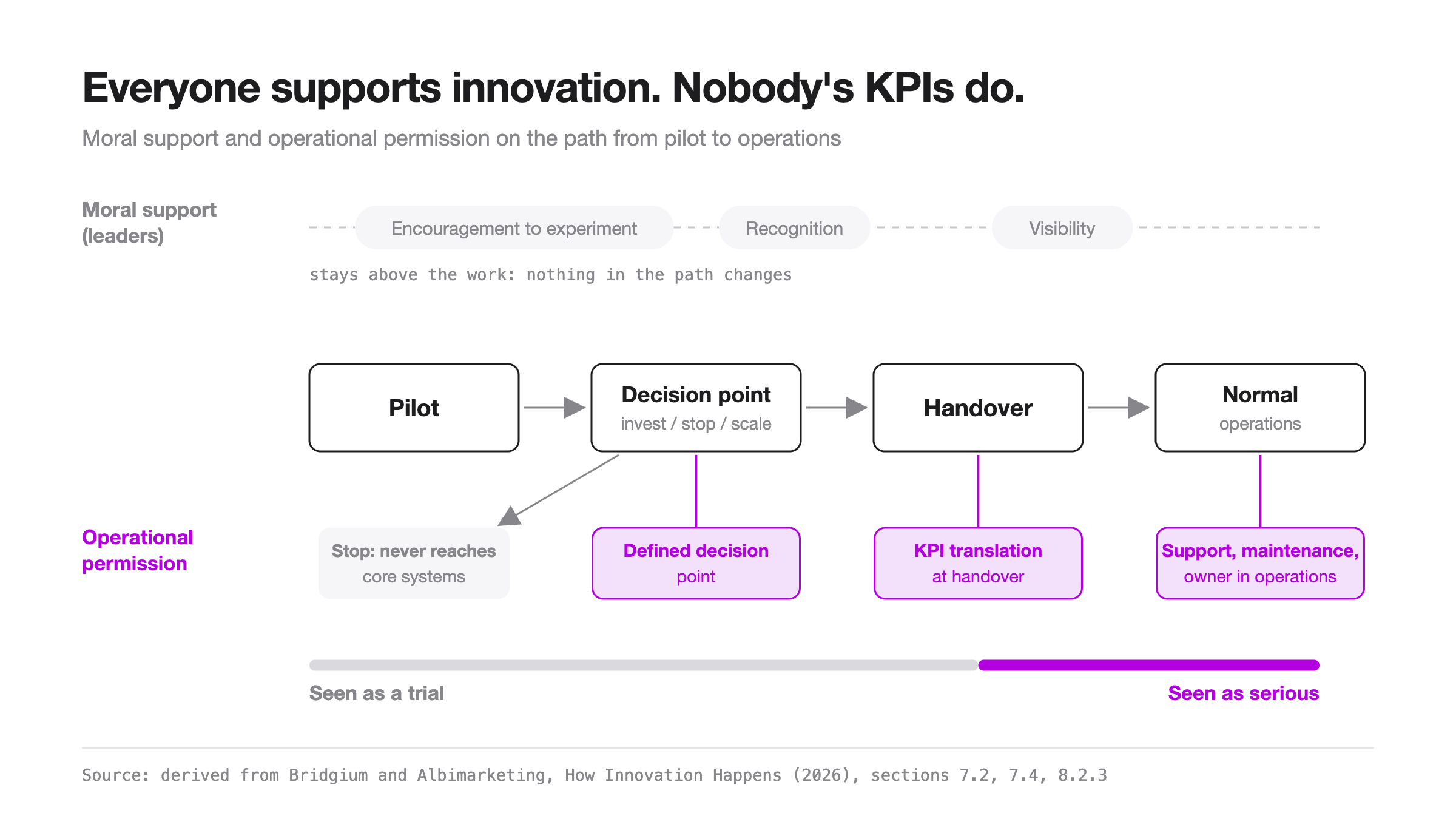
Figure 1. Two lanes on the path from pilot to operations: the moral support leaders give, and the operational permission created by a defined decision point, KPI translation and integration into support and maintenance. Source: derived from Bridgium and Albimarketing, How Innovation Happens (2026), sections 7.2, 7.4 and 8.2.3.
The report’s summary of this stage lists the organisational enablers that turn a validated pilot into normal work, each a commitment the receiving side can see.
| Organisational enabler (report) | What it tells the receiving team | Typical sign that it is missing |
|---|---|---|
| Clear innovation pipeline beyond pilots | There is a next step after the pilot | The pilot report is the last document anyone writes |
| Explicit transfer of ownership to operations or business units | Someone in our own line is responsible | Questions still go to the pilot team months later |
| Defined decision points: invest / stop / scale | A decision will be made, on a known date | Pilots are extended instead of decided |
| Alignment with business KPIs and objectives | Using it counts in my review | The old figures are the only ones anyone reviews |
| Integration into operational systems and processes | This is how we work now | Double entry between old and new systems |
Table 2. The organisational enablers of embedding and what each one signals to the team receiving an innovation. Source: derived from Bridgium and Albimarketing, How Innovation Happens (2026), section 8.2.3; the first column is the report’s Table 3, the other two columns are our reading.
The report pairs these with communicative enablers that sustain use, such as sharing real use cases, feedback loops and recognition during adoption. When both sides are in place, it concludes, innovation becomes habitual and is no longer labelled as innovation.
How to check this in your own organisation
Five questions show whether your innovations have moral support only, or operational permission as well:
- Take the last three pilots your organisation called successful. For each one, who decided to invest, stop or scale, and on what date?
- For an innovation now in handover, which of the receiving team’s KPIs will show its effect, and has anyone adjusted their targets for the learning period?
- If the new solution broke tomorrow, who would fix it, and is that responsibility in their role and their budget?
- How many solutions in your organisation still carry a pilot name more than six months after the pilot ended?
- When did your organisation last decide, explicitly, that a promising pilot should not reach core systems, and was the reasoning recorded where others can find it?
| What you observe | What it usually indicates |
|---|---|
| Pilots are extended instead of decided | No defined decision point to invest, stop or scale |
| Teams run old and new systems in parallel | Integration into processes has not happened |
| Leaders praise the innovation, monthly reviews ignore it | Moral support without KPI translation |
| The pilot team still answers support questions | Ownership and support have not been transferred |
| Operational teams complain about too many initiatives | Protective governance is missing, so nothing is ever stopped |
Table 3. Signals that an innovation is morally supported but operationally optional. Source: derived from Bridgium and Albimarketing, How Innovation Happens (2026), sections 7.2, 7.4 and 8.2.3.
The Nordic dimension
Several of the clearest statements of this problem in our study came from Nordic respondents, and they share a practical register. Seriousness is read from support and maintenance arrangements in Denmark, from use in real projects in Finland and from decisions about what reaches core systems in Nordic banking. That is an advantage. Organisations where people judge an innovation by its operational consequences have an honest test built in, and once the structural steps are taken, adoption tends to follow without a campaign.
The risk is the other side of the same habit. Our reading, which goes beyond what the report states directly, is that moral support is a particularly weak lever in many Nordic organisations. Where teams have a high degree of autonomy and managers rarely override local priorities, people decide for themselves how to spend their week, and they decide according to the commitments that are written down. A leader’s enthusiasm, expressed in a low-hierarchy, consensus-oriented style, can easily be heard as an invitation rather than an instruction. The Finnish advisor’s remark that innovation is always something extra describes the result: nobody refuses the innovation, and nobody makes room for it.
Robert Gibbons’s review of incentives in organisations (1998) helps show the limits of relying on trust here. Formal measures are incomplete, and organisations fill the gap with subjective evaluation sustained by ongoing working relationships. High-trust organisations are well placed to work this way, but it only helps an innovation if managers actually credit the time spent adopting it. Where they fall back on the formal numbers, Holmström and Milgrom’s multitask logic runs its course.
The structural response
- Put a decision point at the end of every pilot. Before a pilot starts, name the date on which someone will decide to invest, stop or scale, and name who that someone is. An extension is allowed only as an explicit decision with its own date. This is Cooper’s gate applied to internal change, and it removes the default of an endless trial.
- Translate the innovation into KPIs at the moment of handover. As part of the decision to scale, agree which of the receiving unit’s KPIs will reflect the new practice, and adjust targets for the learning period so that the early dip is not charged to the team adopting the change. This is the KPI translation the report describes, and it moves adoption from extra work into expected work.
- Fund support and maintenance as part of the decision to scale. Name the operational owner, the support route and the budget line before the pilot team steps back, and share the first real use cases from operations as soon as they exist. In the words of the Danish business leader quoted earlier, this is the moment people understand the change is serious.
- Make stopping an explicit, recorded outcome. Agree in advance what kinds of change should never reach core systems, and treat a well-argued stop as good governance. Record what each stopped pilot taught, so it stays in the organisation’s innovation memory. A visible stop decision makes the scale decisions more credible and protects operational teams from overload.
Conclusion
Most innovations that fade after a good pilot have plenty of support. What they are missing is the handful of operational commitments that tell people the innovation is now part of their job: a decision, a place in the KPIs, an owner, a support route. Until those exist, the people expected to adopt it are making a reasonable choice when they treat it as a trial.
Measuring innovation more will not close this gap, and pushing every successful pilot into operations would create a different problem. The task our respondents describe is narrower. At the end of each pilot, someone decides what moves forward and what stops, and whatever moves forward is translated into the measures the receiving unit already lives by. Where that kind of structure is present, the report observes, “organizations are able to respond to knowledge rather than merely acknowledge it.”
So list the solutions in your organisation that still carry a pilot name, and note for each which leader has praised it and which KPI it has changed. If the first list is longer, the question for your next steering meeting is this: which of these pilots will you take to an invest, stop or scale decision by a named date, with the receiving team’s targets already rewritten for the case that you scale it?
If you want to see where innovations in your organisation lose momentum between pilot and normal work, Find the Gap maps the four conditions of the Innovation Flow through interviews across departments and shows where new ideas and practices stall.
References
- Bridgium and Albimarketing (2026). How Innovation Happens: Insights from Leading Enterprises in Times of Change.
- Christensen, C. M. and Overdorf, M. (2000). Meeting the challenge of disruptive change. Harvard Business Review, March–April 2000.
- Campbell, D. T. (1979). Assessing the impact of planned social change. Evaluation and Program Planning, 2(1), 67–90.
- Holmström, B. and Milgrom, P. (1991). Multitask principal-agent analyses: Incentive contracts, asset ownership, and job design. Journal of Law, Economics, and Organization, 7(special issue), 24–52.
- Baker, G. P. (1992). Incentive contracts and performance measurement. Journal of Political Economy, 100(3), 598–614.
- Kaplan, R. S. and Norton, D. P. (1992). The balanced scorecard: Measures that drive performance. Harvard Business Review, January–February 1992.
- Manso, G. (2011). Motivating innovation. Journal of Finance, 66(5), 1823–1860.
- Ederer, F. and Manso, G. (2013). Is pay for performance detrimental to innovation? Management Science, 59(7), 1496–1513.
- Govindarajan, V. and Trimble, C. (2010). Stop the innovation wars. Harvard Business Review, July–August 2010.
- Cooper, R. G. (1990). Stage-gate systems: A new tool for managing new products. Business Horizons, 33(3), 44–54.
- Simons, R. (1995). Control in an age of empowerment. Harvard Business Review, March–April 1995.
- Gibbons, R. (1998). Incentives in organizations. Journal of Economic Perspectives, 12(4), 115–132.