

Why do you innovate? Your answer decides which ideas get said.
- The symptom: a full pipeline with nothing uncertain in it
- The usual explanation, and why it does not hold
- Four meanings of innovation, four filters
- Matching the purpose to the stage
- How to check this in your own organisation
- The structural response
- Conclusion
- References
Every organisation explains why it innovates, and people read that explanation as a signal of which efforts count, which ideas are worth raising and which are safer kept to themselves.
The symptom: a full pipeline with nothing uncertain in it
At the start of the year a leadership team launches its innovation programme. The message is clear and sensible: every proposal needs a business case, and the company will fund what improves margins or brings new revenue within the year. Within weeks the idea portal is busy: a faster approval step for supplier invoices, a cheaper packaging material, an automated monthly report. Each proposal is reasonable and comes with a number. At the coffee machine, a product engineer tells a colleague that two large customers have started asking about a service the company does not offer. She has no idea what it would earn. She does not submit it.
Six months later the leadership team asks why the portfolio contains nothing bold. The organisation asked a precise question, and people answered it precisely. The engineer’s observation did not fail an evaluation. It never entered one, because the call for ideas had already told her what kind of idea was wanted.
Our first study, How Innovation Happens, is based on 28 in-depth interviews with innovation leaders and senior practitioners in Nordic and European companies of roughly 5,000 to 150,000 employees, conducted between September and December 2025. Before it examines how ideas move, it asks why organisations say they innovate at all. The answers matter more than they appear to, because they decide what people notice and say at the start of the flow.
The usual explanation, and why it does not hold
When a pipeline fills with safe, incremental proposals, the usual diagnosis is about people: staff lack appetite for risk and the culture is too cautious. The remedies follow from that, usually a hackathon or a senior leader asking everyone to be bolder.
The scene above does not fit that diagnosis. The engineer had an uncertain idea and was willing to talk about it. What stopped her was a reasonable reading of what the organisation had asked for. The report says the meanings attached to innovation matter because they communicate why innovation is needed, “setting expectations about which initiatives count and where effort should be invested.” Appendix 1 goes further and treats the stated purpose of innovation as an internal signal that enables the flow to begin. Early calls for innovation implicitly tell people which kinds of effort count. In the report’s words: “These meanings do not remain abstract: they shape what people believe is worth noticing, articulating, and investing effort in at the very start of the innovation flow.”
Research on issue selling describes the same behaviour from the employee’s side. Jane Dutton, Susan Ashford and colleagues studied how middle managers decide whether to bring strategic issues to top management (1997). Before speaking, the managers read the context: whether top management was willing to listen, whether the culture was supportive, and whether raising the issue carried a risk to their image. That risk rose when selling the issue would break the norms for how issues are normally raised, when it left them politically exposed, or when they had a distant relationship with top management. The decision to speak was made before anyone heard the idea.
Susan Ashford and James Detert’s later article (2015), based on a study of issue selling across many organisations, lists the tactics that distinguished successful issue sellers. One of them is to frame the issue around a strategic priority. That is good advice for the individual, with a consequence for the organisation: if the only priorities on offer are margin and payback, ideas that cannot be framed in those terms are hard to sell, and people who read the context well stop trying. Very often the organisation has told people, in its own words, which ideas it can hear.
Four meanings of innovation, four filters
Section 4 of the report finds that respondents explain why innovation is needed in several overlapping ways. Innovation is expected to support growth and economic value, to contribute to efficiency and cost protection, and to keep the organisation relevant to customers, partners and employees. Underneath these sits a fourth meaning: innovation as a continuous flow. According to Appendix 1, these meanings shape how innovation is supported, prioritised and evaluated.
| Meaning | How respondents describe it | What it legitimises | What it tends to filter out |
|---|---|---|---|
| Flow | A continuous process embedded in daily operations | Small, everyday improvement by many people | Ideas that require a break from current routines |
| Growth and economic value | Revenue, new business, strategic positioning | Investment, scaling and adoption | Ideas that cannot yet show financial or tangible impact |
| Efficiency and cost protection | Improving existing systems, a better way of doing the same thing | Incremental change that protects stability | Ideas that would disrupt existing systems |
| Competitive relevance and signal | Showing customers, partners and specialists that development is ongoing | Early articulation and experimentation while outcomes are uncertain | The pressure to move from discussion to adoption |
Table 1. Four meanings of innovation and what each one legitimises. Source: Bridgium and Albimarketing, How Innovation Happens (2026), section 4 and appendix 1; the last column is our reading.
Flow: innovation as everyday work
The first meaning describes innovation as a process that has to be sustained and built into daily operations. The report summarises it in one line: “Innovation is experienced as infrastructure rather than inspiration.”
“Innovation is not a one-time thing. It’s something continuous. It needs to be embedded.”
Director of Innovation · Industrial Manufacturing · Finland
“Innovations are needed every day. I’m a big fan of continuous improvement: small steps today, small steps tomorrow.”
Senior R&D Manager · Materials & Process Industry · Finland
This frame invites broad participation: anyone who improves their own work is doing innovation. John Bessant and Sarah Caffyn’s research on high-involvement continuous improvement (1997) shows both the value and the difficulty of this. Involving employees widely in ongoing, small-scale problem solving can bring substantial benefits, yet putting it into practice is hard, and their framework describes distinct levels of capability, each with its own barriers and enablers. Its blind spot is the idea that cannot be reached by small steps, because it asks the organisation to stop doing something it currently does well.
Growth and economic value: innovation as impact
For many respondents innovation is tightly linked to growth and tangible outcomes. The report states the condition plainly: “Without visible economic impact, innovation quickly loses legitimacy.”
“Innovation without financial or tangible impact is just ideas.”
Commercial Director · Technology & B2B Services · Finland
“We innovate to create impact. Innovation itself does not create impact, but implementation does.”
CEO · IT & Digital Services · Finland
These leaders are right, and the second quote is precise about why: ideas earn nothing until they are implemented. The growth frame is what allows an organisation to invest and scale. The difficulty is timing. A frame that asks for financial impact is a fair test at the point of investment and an unfair one at the point of first articulation, when nobody can yet know what an idea might earn.
Robert Burgelman’s process study of corporate entrepreneurship (1983) found that organisations need both diversity, which comes mainly from autonomous initiatives by people at operational level, and order, which comes from a strategic concept imposed on the organisation. Initiatives outside the current strategy survive only if top management recognises them, and Burgelman concluded that strategic recognition is top management’s most important contribution, more so than detailed planning. A purpose expressed only as revenue leaves little room for that recognition.
Efficiency and cost protection: innovation as a better way of doing the same thing
In industrial and operations-heavy contexts, respondents often describe innovation as improving existing systems. The report notes: “Incremental change is described as both realistic and socially acceptable.”
“It can be resource efficiency, energy efficiency, cost efficiency: a better way of doing the same thing.”
Senior Strategy Manager · Energy & Utilities · Finland
“Most innovation is incremental. You improve one corner today, another tomorrow.”
R&D Lead · Industrial Manufacturing · Finland
For organisations that run plants and networks, this is often the most responsible meaning available: it protects stability while improving performance. Mary Benner and Michael Tushman’s longitudinal study of the photography and paint industries (2002) shows what it does to the rest of the portfolio. Over two decades, firms that expanded process management activities, measured through ISO 9000 quality certification, produced more exploitative innovation that built on existing knowledge, and exploitation took a larger share of their total innovation. The authors concluded that exploitation crowds out exploration. The efficiency frame works the same way at the level of language: it selects the idea that can show its savings over the one that would change the system being saved.
Competitive relevance and signal: innovation as a message
The fourth meaning goes beyond outcomes. Innovation also tells partners, employees and the market that the company is serious about its future. The report describes it as a form of symbolic capital that reinforces trust and long-term relevance.
“Innovation is about staying relevant.”
Head of Innovation · Energy & Infrastructure · Finland
“It’s very important for attracting and retaining specialists that they see the company is developing.”
Innovation Director · Engineering & Consulting · Denmark
“Customers and partners need to see that development is ongoing.”
Senior Leader · Global Engineering Firm · Denmark
According to Appendix 1, this is the meaning that can legitimise early articulation and experimentation while outcomes are still uncertain. When leaders emphasise relevance and future positioning, people are more likely to speak up, explore problems and put in effort before results are clear. The engineer in the opening scene would have submitted her observation into a programme framed around what customers will need next.
The relevance frame has its own failure mode. John Meyer and Brian Rowan’s classic analysis of formal structure as myth and ceremony (1977) argued that organisations adopt structures matching widely accepted expectations because this brings legitimacy, and that such structures tend to become decoupled from daily activity. An innovation message aimed at customers and recruits can follow the same path, visible on the website and disconnected from any decision inside. Blake Ashforth and Barrie Gibbs (1990) add that organisations pursuing legitimacy through symbolic means risk looking manipulative, one of their types being the overacting actor that overstates its claims, and that such efforts can set off vicious circles that reduce legitimacy. Employees are the first audience to notice when a company talks about relevance and funds only payback.
Matching the purpose to the stage
Read together, the four meanings do different work, and a company does not have to choose one of them. Appendix 1 makes the point directly: growth and efficiency frames can help legitimise investment, scaling and adoption, while competitive relevance may legitimise early articulation and experimentation. Each meaning fits a different point in the flow.
That gives a simple picture of what goes wrong. A company that talks only about impact and return gets incremental, provable ideas and silence about the uncertain ones, which is the dominant risk of the first stage. A company that talks only about relevance gets plenty of conversation and very little adoption, because nothing in its stated purpose tells people when an idea has to start earning its place. A company that talks only about flow gets steady improvement and few changes of direction.
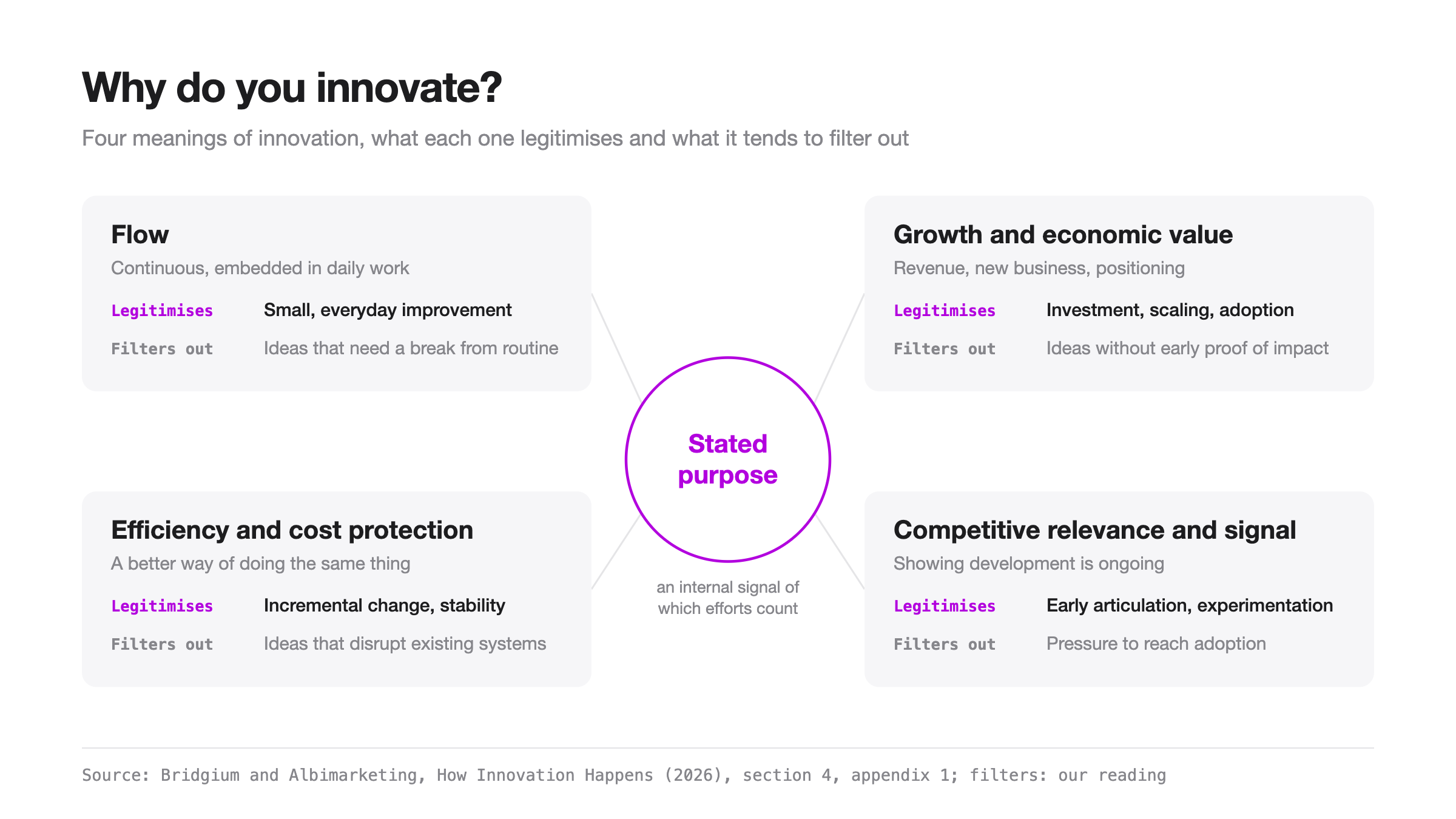
Figure 1. Four meanings of innovation, what each one legitimises and what it tends to filter out. The stated purpose acts as an internal signal of which efforts count. Source: Bridgium and Albimarketing, How Innovation Happens (2026), section 4 and appendix 1; the “filters out” labels are our reading.
Section 8.1 of the report explains why this signal carries so much weight. It describes legitimacy as the condition that enables engagement: people take part in innovation only when innovation-related actions are recognised as real work, as opposed to extra work or informal personal initiative. Legitimacy, the report says, answers a practical employee question: “Am I expected to do this, and will it be taken seriously?” The stated purpose of innovation is the first and most widely heard answer to it, and it reaches people long before any pipeline or decision rule does.
The mapping below goes one step beyond Appendix 1. Placing flow between the stages, and the wording in the last two columns, is our reading of how the report’s findings apply stage by stage.
| Stage of the Innovation Flow | Dominant risk | Meaning that legitimises the work | What leaders can say | What to avoid saying at this stage |
|---|---|---|---|---|
| 1. Ideas become speakable | Silence | Competitive relevance | “What are you seeing that we should be paying attention to?” | “What is the payback?” |
| 2. Ideas take shared, concrete form | Fragmentation | Relevance, with flow keeping ideas alive between discussions | “What would we need to learn to know whether this matters?” | “Show us the full business case first” |
| 3. Embedded in routine practice | Drop-off after pilots | Growth and efficiency | “What will this earn or save, and who will run it?” | “It is enough that we tried” |
Table 2. Which meaning of innovation fits which stage. Source: derived from Bridgium and Albimarketing, How Innovation Happens (2026), section 4 and appendix 1; the stage mapping beyond appendix 1 is our reading.
Applied everywhere, efficiency logic reaches into the earliest stage and crowds out exploration before it starts. Charles O’Reilly and Michael Tushman’s study of ambidextrous organisations (2004) describes one structural answer: companies that both improve current businesses and develop breakthroughs tend to separate exploratory units from exploitative ones, give each its own processes, structures and culture, and keep them tightly linked at senior level. The principle applies to language too: different kinds of work need different criteria, and people need to know which ones apply to the work in front of them.
One respondent put the condition for all of this in a single sentence:
“A clear pipeline and criteria are needed so people know where ideas go.”
Founder · Industrial Technology · Finland
How to check this in your own organisation
Five questions show whether your stated purpose is opening the flow or narrowing it:
- Take the last call for ideas your organisation issued. Which of the four meanings does it use, and which are missing?
- What evidence is required at the first point of entry? Could someone with an observation about a customer shift, and no numbers, get past it?
- How many ideas in your current pipeline could not yet be expressed in revenue or cost terms? If none, ask whether such ideas are missing or simply not being raised.
- When leaders talk about relevance and the future, can employees say where an idea goes next and who decides on it?
- Does the question asked of an idea change as it moves from first discussion to scaling, or is the same return question asked from start to finish?
| What you observe | What it usually indicates |
|---|---|
| A full pipeline of small, provable proposals and nothing exploratory | Growth or efficiency criteria are applied at the point of entry |
| Uncertain ideas come up in informal conversation but are never submitted | People have read the context as unfavourable to ideas without numbers |
| People pitch ideas in finance language even when it does not fit them | The official vocabulary is the only one that feels legitimate |
| Many conversations about the future, few pilots reach operations | Relevance is stated without a pipeline or adoption criteria |
| Innovation appears mostly in external messaging and recruitment material | The signal has become decoupled from internal decisions |
Table 3. Signals that the stated purpose of innovation is filtering ideas. Source: derived from Bridgium and Albimarketing, How Innovation Happens (2026), section 4 and appendix 1.
The Nordic dimension
Nordic organisations start with an advantage in how they talk about innovation. The respondents quoted in Appendix 1, all from Finland and Denmark, describe it in practical terms, as continuous improvement and small steps, which makes innovation ordinary work. That makes participation easy and keeps innovation close to the daily operations where, in the respondents’ own metaphor, an innovation has to live if it is to survive. The two Danish quotes on relevance also name specialists and partners as the audience of the signal, which ties the relevance frame to people inside and around the company.
The risk sits in the same place. Our reading, which goes beyond what the report states directly, is that when incremental change is the socially acceptable form of innovation, the uncertain idea carries a social cost. Proposing something large and unproven can look immodest where people value not overstating their case, so ideas get framed in the safest terms or kept for the coffee machine. Dutton, Ashford and colleagues’ later study of how managers decide whether to raise gender-equity issues (2002) found that people read cues from top management and the wider culture before speaking, and that how exclusive the culture felt had the strongest effect on their willingness to raise an issue. The topic was different, but the logic carries over: norms decide what feels sayable.
Gary Hamel and C. K. Prahalad’s article on strategic intent (1989) offers a counterweight. They described leading global companies that began with ambitions far beyond their resources and capabilities and sustained a company-wide drive to win over long periods. An explicit long-term intent makes the uncertain idea legitimate, because it serves something the organisation has already said it wants. For a Nordic organisation, placing such an ambition next to its practical vocabulary gives people permission to raise ideas the small-steps frame cannot reach.
The structural response
- State the purpose of innovation per stage. Tell people which meaning applies at which point. Early on, the question is what is changing for customers, partners and specialists that the company should notice. Later, it is what an idea will earn or save, and who will run it. Saying when each applies removes the guesswork that leads people to self-censor.
- Separate entry criteria from scaling criteria. Ask for no business case at the point of first articulation, and ask for a rigorous one at the decision to invest or scale. Publish both, in line with O’Reilly and Tushman’s principle that exploratory and exploitative work need their own rules.
- Give relevance a landing. Every message about relevance and the future should come with a visible route: where ideas go, who looks at them and when they will hear back. Without it, the relevance frame produces talk without adoption and, over time, the loss of credibility Ashforth and Gibbs describe.
- Write the purpose down in operational terms and revisit it. Jim Collins and Jerry Porras (1996) criticised vision statements for being vague, and argued that enduring companies keep a stable core purpose while their strategies and practices change. Treat the purpose of innovation the same way: keep the core stable, review once a year whether calls for ideas, evaluation criteria and leadership language still match it, and correct the stage where they drift.
Conclusion
Organisations explain innovation in several overlapping ways: as flow, as growth, as efficiency and as relevance. Our research suggests that these explanations work as an internal signal, and people use it to decide what is worth noticing, saying and investing effort in. A purpose stated only in terms of return produces exactly the ideas it asks for and silence about the rest.
None of the four meanings is wrong. Growth and efficiency legitimise the investment and adoption that turn ideas into practice. Relevance legitimises the early, uncertain articulation that gives the organisation something new to invest in. Flow keeps improvement going between the two. The difficulty arises when one meaning is applied everywhere, and the leadership task is to say deliberately which one applies at which stage.
So it is worth rereading the last message your organisation sent about why it innovates, and asking who could have answered it. If the honest answer is only the people whose ideas already come with a number, the question that follows is harder: which observation is sitting with someone in your organisation right now because your stated purpose gave it nowhere to go?
If you want to see where your stated purpose and your actual pipeline part ways, Find the Gap maps the four conditions of the Innovation Flow through interviews across departments and shows where new ideas and practices lose momentum.
References
- Bridgium and Albimarketing (2026). How Innovation Happens: Insights from Leading Enterprises in Times of Change.
- Dutton, J. E., Ashford, S. J., O’Neill, R. M., Hayes, E. and Wierba, E. E. (1997). Reading the wind: How middle managers assess the context for selling issues to top managers. Strategic Management Journal, 18(5), 407–423.
- Dutton, J. E., Ashford, S. J., Lawrence, K. A. and Miner-Rubino, K. (2002). Red light, green light: Making sense of the organizational context for issue selling. Organization Science, 13(4), 355–369.
- Ashford, S. J. and Detert, J. R. (2015). Get the boss to buy in. Harvard Business Review, January–February 2015.
- Bessant, J. and Caffyn, S. (1997). High-involvement innovation through continuous improvement. International Journal of Technology Management, 14(1), 7–28.
- Burgelman, R. A. (1983). Corporate entrepreneurship and strategic management: Insights from a process study. Management Science, 29(12), 1349–1364.
- Benner, M. J. and Tushman, M. (2002). Process management and technological innovation: A longitudinal study of the photography and paint industries. Administrative Science Quarterly, 47(4), 676–706.
- Meyer, J. W. and Rowan, B. (1977). Institutionalized organizations: Formal structure as myth and ceremony. American Journal of Sociology, 83(2), 340–363.
- Ashforth, B. E. and Gibbs, B. W. (1990). The double-edge of organizational legitimation. Organization Science, 1(2), 177–194.
- O’Reilly, C. A. and Tushman, M. L. (2004). The ambidextrous organization. Harvard Business Review, April 2004.
- Hamel, G. and Prahalad, C. K. (1989). Strategic intent. Harvard Business Review, May–June 1989 (reprinted July–August 2005).
- Collins, J. C. and Porras, J. I. (1996). Building your company’s vision. Harvard Business Review, September–October 1996.