

The pilot worked. Nobody owns what comes next.
- The symptom: a good result with nowhere to go
- The usual explanation, and why it does not hold
- Where the handover breaks
- How to check this in your own organisation
- The structural response
- Conclusion
- References
A successful pilot produces evidence, and evidence on its own does not give a solution a budget, a decision-maker or a place in daily operations. Our study shows that the handover from pilot to practice has to be designed before the pilot ends.
The symptom: a good result with nowhere to go
The review is booked for forty-five minutes in a meeting room above the production floor. Through the window you can see the line where the pilot ran for three months. The startup founder has brought six slides. The results are good: fewer unplanned stops on the two machines in the test, faster fault diagnosis, and a maintenance team that kept using the tool after the formal test period had ended. The innovation manager who set up the pilot nods through the presentation. The operations manager, who arrives ten minutes late, asks two sensible questions: who would support the system on a night shift, and how long the free licence runs. Then he says the results look promising and asks to be kept posted.
Everyone thanks everyone. The founder walks to the car park with no date for a next meeting and no name in the business unit who will decide. Nothing for the solution appears in next year’s budget. Three months later the maintenance team is still using the tool on a free licence that runs out in the spring. The innovation manager has started two new pilots. The operations manager simply has no mandate and no budget for absorbing something he did not ask for.
No one in the room made a mistake. The pilot proved what it was asked to prove. The difficulty is that nobody had asked, at the start, who would own the answer.
This article is the third in our series on our study From Discovery to Practice, based on 48 qualitative interviews: 28 with innovation leaders and senior practitioners in large Nordic and European corporations, conducted between September and December 2025 for our previous study, and 20 with founders and senior representatives of startups and SMEs engaged in corporate collaboration. The study focuses on Finland, Sweden, Denmark, Norway and the Netherlands, with selected input from Central Europe. Earlier pieces in this series looked at how corporates and startups find each other and how early collaboration is judged. This one looks at the last stage of the Innovation Flow, Integration / Embedding, which the report describes as the hardest point.
The usual explanation, and why it does not hold
When a pilot does not scale, the usual explanation is that the evidence was not strong enough. The startup was too young, or the test too small. The usual remedy follows from it: extend the pilot, run a second one at another site, ask for more data.
Our study points somewhere else. In section 7.1 the report describes a structural mismatch at this stage. Startups and innovation teams often treat a successful pilot as evidence for scaling and continuation. Operational units evaluate the same solution through the logic of continuity, process fit, resource allocation and long-term maintainability. Both sides are reasonable, and they are answering different questions.
“Even successful pilots don’t automatically have a place in the organization.”
Strategy Director · Telecommunications · Denmark
The report then names the risk that more evidence cannot fix. In section 7.3 it states: “A pilot may be technically validated and still fail to move forward if no business unit, P&L owner or operational sponsor is prepared to fund scaling, allocate people or absorb implementation risk.” A second pilot produces a second set of good numbers for the same empty chair.
Research on implementation has made this distinction for decades. Katherine Klein and Joann Sorra (1996) separate the decision to adopt an innovation from its implementation, the period in which the people expected to use it become skilled, consistent and committed users. In their model, implementation effectiveness depends on the climate for implementation in the organisation and on how well the innovation fits the values of the people who must use it. A strong pilot result says little about either. Klein later returned to the theme with Andrew Knight (2005), arguing that many organisations fail to gain the expected benefits from innovations they adopt because of implementation failure, while the innovation itself would have worked.
Robert Fichman and Chris Kemerer (1999) offer a useful picture from a different field. Studying software tools in companies, they found that technologies could be widely acquired but much less widely deployed, and they called the difference an assimilation gap. Counting completed pilots creates the same illusion inside a corporation: a portfolio of successful pilots can look like progress while very little has entered daily operations.
| Area | What a successful pilot answers | What integration still needs |
|---|---|---|
| Whether it works | Yes, under test conditions and with close attention | Proof that it works inside existing processes, at scale and over time |
| Ownership | Usually the innovation or transformation team that started it | A business unit, P&L owner or operational sponsor willing to carry it |
| Funding | A pilot budget, or a free proof of concept | Funding for scaling, people and implementation risk |
| Permission | Often handled through exceptions during the test | Clearance through procurement, legal, IP, cyber and data-security vetting |
| Next step | “Keep us posted” | A decision with a date, and someone with the right to make it |
Table 1. What a successful pilot answers, and what integration still needs. Source: Bridgium and Albimarketing, From Discovery to Practice (2026), sections 7.1 and 7.3.
Where the handover breaks
The report describes the Integration / Embedding stage as the point where validated solutions must function inside existing systems, routines, governance structures and business priorities. Reading sections 7.1 to 7.4 together, we see four places where a successful pilot loses its way. They often occur together, and each needs a different response.
1. Two logics meet at the handover
Pilots are usually started by innovation or transformation teams. Operational implementation depends on business units responsible for infrastructure, execution, budgets and long-term support. The handover between them is where momentum is most often lost.
“Projects lose momentum when they move from innovation teams to business units.”
Head of R&D · Energy · Norway
The report connects this directly to our previous study, How Innovation Happens (2026), which identified the same transition as one of the most fragile moments in the Innovation Flow. Innovation slows there because organisations lack stable ownership transfer, integration routines and coordinated movement between innovation and operational structures. The ideas themselves have usually not failed technically.
Dorothy Leonard-Barton’s study of new product development projects (1992) explains why the receiving side can resist something that clearly works. She showed that the core capabilities which make a company good at what it does, including its skills, technical systems, managerial systems and values, can turn into core rigidities when a project does not fit them. An operations unit that has spent years building reliability is right to protect it.
Rebecca Henderson and Kim Clark (1990) add a second layer. They described architectural innovation: changes that reuse familiar components but alter how they are linked together. Established firms often struggle to recognise such changes, because their knowledge of how the parts connect is built into communication channels, information filters and problem-solving routines. Many pilot results are of this kind: a tool that sends maintenance data straight into production planning changes who talks to whom, and a unit whose channels were built for the old linkage may not see the value.
2. The gates appear after the evidence
Section 7.1 of the report describes what changes once the test is over: “At this stage, organizations prioritize operational stability. Procurement, legal, IP, cyber and data-security vetting often become structural gates between pilot validation and operational adoption.” Startups, in the report’s words, face “a transition from proving relevance to proving reliability”.
During a pilot many of these questions are handled through exceptions, such as a test licence or a temporary agreement. When the pilot ends, the exceptions end with it, and the solution meets the full set of requirements for the first time. For a young company this can mean months of security questionnaires and supplier onboarding with no guarantee of a contract.
The gates themselves are legitimate. Section 6 of the report notes that in regulated and asset-heavy sectors long cycles may reflect real constraints, such as certification, safety cases and OT and IT security. The difficulty is timing. When the gates are first met after the evidence is in, they look like obstacles. When they are known at the start, they become part of the pilot design: what data the pilot may touch, what the solution must show to pass security review, what contract would follow if it succeeds.
Klein and Knight (2005) list adequate financial resources and management support among the conditions that make implementation succeed. A pilot that has not met the functions behind the gates before its final review has not yet met the people who decide whether it can continue.
3. Many teams, no shared view
Embedding a solution, the report observes in section 7.2, requires coordination across innovation teams, operational units, procurement, legal, compliance and management structures. Each of them looks at the startup through its own lens.
“Different teams evaluate the same startup differently, and there is no shared view.”
Innovation Program Manager · Automotive · Germany
The consequence, in the report’s words, is that “pilots remain isolated local successes rather than scalable organizational practices.” Startups struggle to understand who owns the transition process, what criteria decide continuation and how priorities shift between units.
Fariborz Damanpour’s meta-analysis of organisational innovation (1991) found internal communication among the factors positively associated with innovation across many earlier studies. At the integration stage, when the evaluations of IT, procurement and operations are never placed side by side, each function can delay without anyone seeing the whole picture.
Section 7.4 extends the problem to learning. At this stage learning is spread across teams, countries, operational contexts and user groups. Some units adapt quickly while others meet resistance. The report argues that integration depends on repeatable feedback mechanisms, so that upgrades, failures and successful practices are shared and retained. Gabriel Szulanski’s study of best-practice transfer inside firms (1996) showed how hard this is. Even when a practice had proven its value in one unit, transferring it to another was slowed mainly by knowledge-related barriers: the receiving unit’s limited ability to absorb it, ambiguity about why it worked, and a difficult relationship between the source and the recipient. He called this internal stickiness. A successful pilot at one plant is a best practice waiting to be transferred, and it meets the same barriers.
4. Encouragement without commitment
The fourth break is the least visible in reports and the most visible in the opening scene. Section 7.3 of the report describes the absence of clear embedding mechanisms: even successful pilots often lack explicit ownership, operational resources and structured pathways toward implementation. One respondent described the question that has to be asked before an initiative can move on:
“Do you understand how this future could look? And are you willing to commit to it?”
Director of Growth & Development · Energy Technology · Netherlands
Without this step, the report notes, an initiative may receive encouragement, “this is nice, please carry on”, while nobody actually intends to put resources behind it. Encouragement keeps the relationship warm and leaves the decision for later, and for a startup on a short runway, later is expensive.
Research on innovation champions shows that people make the difference at this point. Jane Howell and Christopher Higgins (1990) compared champions of technological innovation with non-champions in the same organisations and found that champions showed more risk taking and innovativeness, made more influence attempts with a wider variety of tactics, and displayed more transformational leadership behaviour. An innovation needs someone who will argue for it in rooms where the innovation team is absent. Hans Georg Gemünden, Søren Salomo and Katharina Hölzle (2007) studied 146 new product development projects and found that the roles people played around a project strongly affected its success. One of their results is a useful warning: at high levels of technological innovativeness, support from senior members of the organisation had a significant negative effect on success. Our reading is that general support from above does not replace an owner in the line who will commit people and budget.
Nelson Repenning’s simulation study (2002) helps explain why encouragement fades. He examined why management innovations so often succeed at first and then fail to deliver lasting benefit, even when the innovation itself is effective. In his model, commitment to an innovation is built over time after adoption, and seemingly rational decisions by individuals can together produce the pattern of early success followed by decline. A pilot that ends with “please carry on” leaves commitment to build itself.
| Innovation Flow condition | What weakens at integration | What corporates need to provide | What startups need to provide |
|---|---|---|---|
| Legitimacy | The solution is still seen as an experiment, outside normal operations | Operational ownership, connected to business priorities | Evidence of operational relevance beyond the pilot |
| Predictability | Ownership, budget, resources and decision steps remain unclear | Clear implementation pathways, decision rules and resource allocation | Reliability, continuity, compliance awareness and long-term support capability |
| Connectivity | Innovation, operations, procurement, IT, compliance and users work apart | Coordination across operational, IT, procurement, compliance and business units | Engagement with many stakeholders and adaptation to existing systems and workflows |
| Innovation memory | Implementation learning stays local and is restarted in each project | Feedback loops, documented implementation learning, shared knowledge across teams | Operational feedback captured, iteration on adoption realities, support for knowledge transfer |
Table 2. The four Innovation Flow conditions at the Integration / Embedding stage. Source: Bridgium and Albimarketing, From Discovery to Practice (2026), section 7.5 and Table 5.
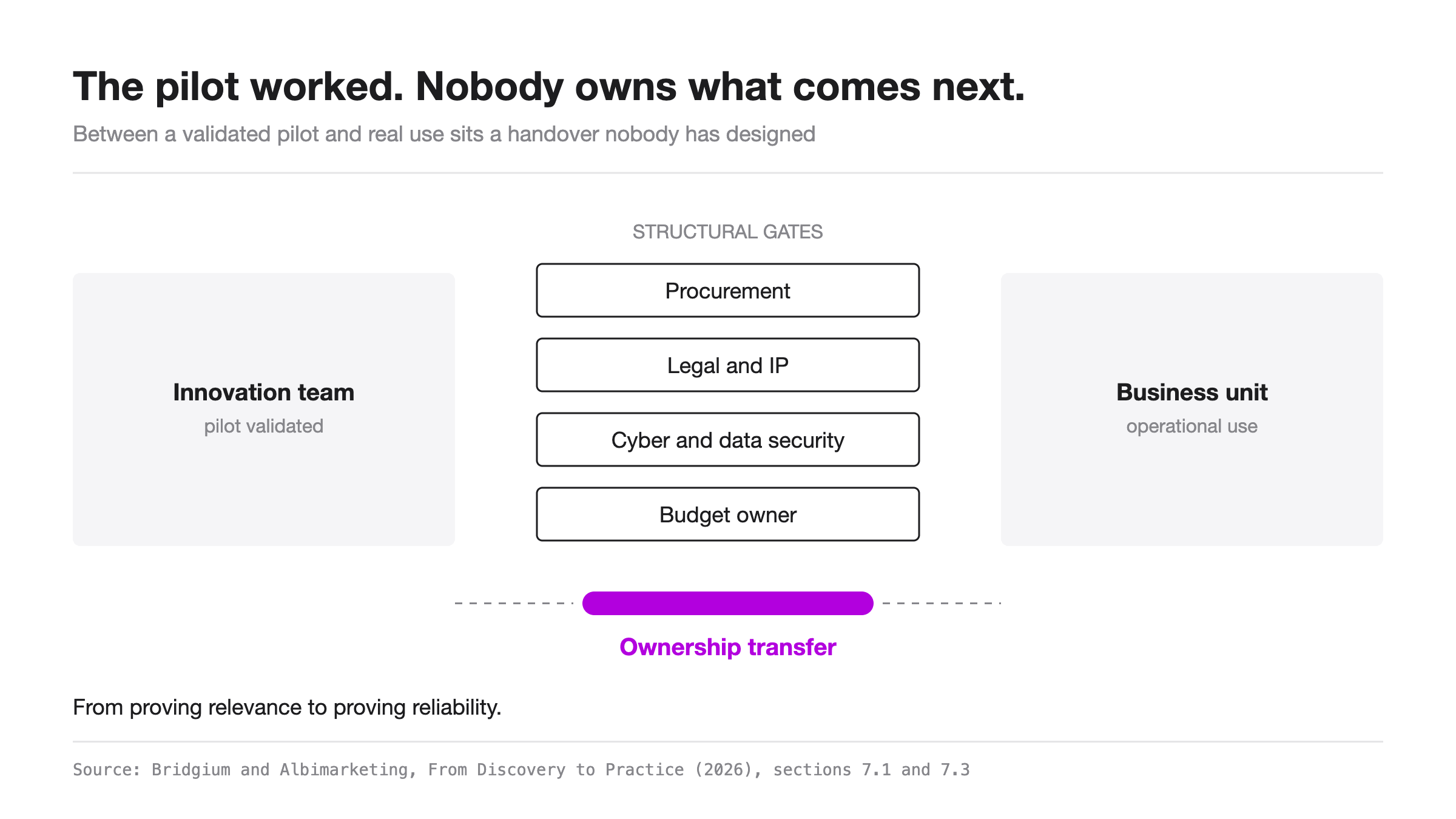
Figure 1. The handover zone: a validated pilot passes from the innovation team to the business unit through four structural gates, procurement, legal and IP, security, and a budget owner. Source: Bridgium and Albimarketing, From Discovery to Practice (2026), sections 7.1 and 7.3.
How to check this in your own organisation
The report’s value at this stage is diagnostic. It helps leaders see whether a stalled pilot is a problem of evidence or a problem of ownership, gates, alignment or commitment. Five questions help place your own pilots:
- For your last three completed pilots, who in the business unit was named as owner before the pilot started, and did that person attend the final review?
- Before each pilot began, did procurement, legal, IP and security know it existed, and did anyone ask what they would need to see at the end?
- Which budget line, in which unit, would pay for scaling if the pilot succeeds, and does the person who controls it know that?
- When the pilot ended, was there a decision with a date to scale, adapt or stop?
- If a team in another country wanted to repeat a pilot you completed last year, where would they find what you learned?
| Signal | What it suggests | First step |
|---|---|---|
| Pilot reviews end with “keep us posted” | Encouragement without commitment; no owner with a mandate to decide | Make the final review a decision meeting with a named decision-maker and three options: scale, adapt or stop |
| Successful pilots wait months for security or supplier approval | The structural gates were first met after the evidence was in | Invite procurement, legal and security to the pilot kick-off and record their conditions |
| The innovation team keeps running solutions after the pilot | Ownership was never transferred to the business unit | Name the receiving owner before the next pilot starts |
| IT, procurement and operations give the same startup different verdicts | No shared view across functions | Hold one joint evaluation with all functions in the room, using the same criteria |
| The same kind of pilot is run again at another site | Implementation learning stayed local | Keep a short shared record of each pilot: what was tested, decided and learned |
Table 3. Signals that a pilot has an evidence problem or an ownership problem, and where to start. Source: Bridgium and Albimarketing, From Discovery to Practice (2026), sections 7.2 to 7.4 and 7.7.
The Nordic dimension
Most organisations in our study are based in the Nordic countries or the Netherlands, and the low hierarchy of these workplaces is a real strength at the integration stage. An innovation manager can usually reach the operations manager, the head of IT security or a procurement lead directly, without a formal request through several layers. The cross-functional alignment teams that the report recommends in section 7.7 are easier to form where people already work across functions by habit.
The risk sits in how commitment is expressed. In consensus-oriented cultures, a direct refusal in a meeting can feel impolite, and a friendly “please carry on” is the easier thing to say. The respondent who described the commitment question works in the Netherlands, where business communication is often described as direct, and still saw encouragement without intent as a recurring pattern. Our reading, which goes beyond what the report states directly, is that the same politeness that makes Nordic collaboration pleasant can make ownership hard to see, because a clear “no” is rare and a clear “yes, with my budget” is rarer still. The remedy is a fixed moment where the commitment question is answered out loud.
The structural response
- Name the receiving owner before the pilot starts. No pilot should begin without a person in the business unit who will own the result if it succeeds. That person helps define what the pilot must prove, takes part in it and leads the final review. Section 7.7 of the report puts clear ownership transfer first among the conditions for effective integration.
- Bring the structural gates into the pilot design. Procurement, legal, IP and security should know about the pilot from the first week and state what they will need at the end. The pilot can then collect that evidence along the way. Startups move from proving relevance to proving reliability earlier, and with less wasted time.
- Agree the decision, the decision-maker and the budget logic at the start. Before the pilot begins, write down which decision follows it, who makes it, by when, and which budget line would fund scaling. Ask the commitment question at that point, while the answer still shapes the pilot. Donna Kelley (2011) notes that mature firms are built for efficiency and steady, routine progress, and that conscious effort is needed to build lasting capacity for corporate entrepreneurship. A written decision path is a small, concrete form of that effort.
- Make integration learning travel. Keep a short shared record of each pilot: what was tested, what changed, what was decided and why. The report’s section 7.4 calls for repeatable feedback and learning mechanisms so that implementation learning does not remain local. A record that every unit can read is the simplest version, and it turns innovation memory from a personal asset into an organisational one.
Conclusion
A successful pilot answers the question it was given. In many organisations that question is whether the solution works, and the answer is yes. Our study shows that integration asks other questions: who owns this now, who pays for it, is it allowed, and who decides. When nobody has prepared those answers, the evidence waits, and a good result slowly turns into what the report calls an isolated local success.
The four breaks described here, the change of logic at the handover, the late structural gates, the missing shared view and encouragement without commitment, have the same root. Each is a decision that was postponed from the start of the pilot to its end. None of them needs a new programme. Each needs one question asked earlier, and a person in the business unit willing to answer it.
It is worth looking at the last pilot your organisation called a success and tracing what happened in the month after the final review. If the founder of that startup were asked today who in your organisation owns their solution, what name would they give?
If you want to see where validated ideas lose momentum in your organisation, Find the Gap maps the four Innovation Flow conditions through interviews across departments and shows where new ideas and practices stall.
Natalia Illarionova looks at the same question in her LinkedIn article “A successful pilot. And then what?“
References
- Bridgium and Albimarketing (2026). From Discovery to Practice: How Corporate–Startup Collaboration Becomes Usable.
- Klein, K. J. and Sorra, J. S. (1996). The challenge of innovation implementation. Academy of Management Review, 21(4), 1055-1080.
- Klein, K. J. and Knight, A. P. (2005). Innovation implementation: Overcoming the challenge. Current Directions in Psychological Science, 14(5), 243-246.
- Fichman, R. G. and Kemerer, C. F. (1999). The illusory diffusion of innovation: An examination of assimilation gaps. Information Systems Research, 10(3), 255-275.
- Leonard-Barton, D. (1992). Core capabilities and core rigidities: A paradox in managing new product development. Strategic Management Journal, 13(S1), 111-125.
- Henderson, R. M. and Clark, K. B. (1990). Architectural innovation: The reconfiguration of existing product technologies and the failure of established firms. Administrative Science Quarterly, 35(1), 9-30.
- Damanpour, F. (1991). Organizational innovation: A meta-analysis of effects of determinants and moderators. Academy of Management Journal, 34(3), 555-590.
- Szulanski, G. (1996). Exploring internal stickiness: Impediments to the transfer of best practice within the firm. Strategic Management Journal, 17(S2), 27-43.
- Howell, J. M. and Higgins, C. A. (1990). Champions of technological innovation. Administrative Science Quarterly, 35(2), 317-341.
- Gemünden, H. G., Salomo, S. and Hölzle, K. (2007). Role models for radical innovations in times of open innovation. Creativity and Innovation Management, 16(4), 408-421.
- Repenning, N. P. (2002). A simulation-based approach to understanding the dynamics of innovation implementation. Organization Science, 13(2), 109-127.
- Kelley, D. (2011). Sustainable corporate entrepreneurship: Evolving and connecting with the organization. Business Horizons, 54(1), 73-83.