Culture Eats Strategy for Breakfast. But What Eats Culture?
- The Anatomy of Character: The 11 Dimensions That Define Everything
- Making Character Visible: From Theory to Practice
- The Economics of Character: A Measurable Return on Investment
- Conclusion: From Values on the Wall to Character in Action
Introduction: The Culture Cul-de-Sac
For decades, leaders worldwide have repeated Peter Drucker’s mantra: “Culture eats strategy for breakfast.” Companies spend millions formulating values and publishing colorful “culture codes.” But the reality is often disappointing. The stories of Enron, Theranos, and Wells Fargo are vivid examples of how declared values and real actions can exist in parallel universes. Why does this happen?
The answer may lie in the next question: if culture eats strategy, then what eats culture? Research and practice show that the answer is character. Its absence was a root cause of the 2008 Global Financial Crisis. The problem is more relevant than ever: recent McKinsey data shows that only 25% of leaders truly inspire their teams, and nearly 72% of organizational transformations fail due to management issues and employee resistance. It’s time to stop talking about culture and look deeper.
The Anatomy of Character: The 11 Dimensions That Define Everything
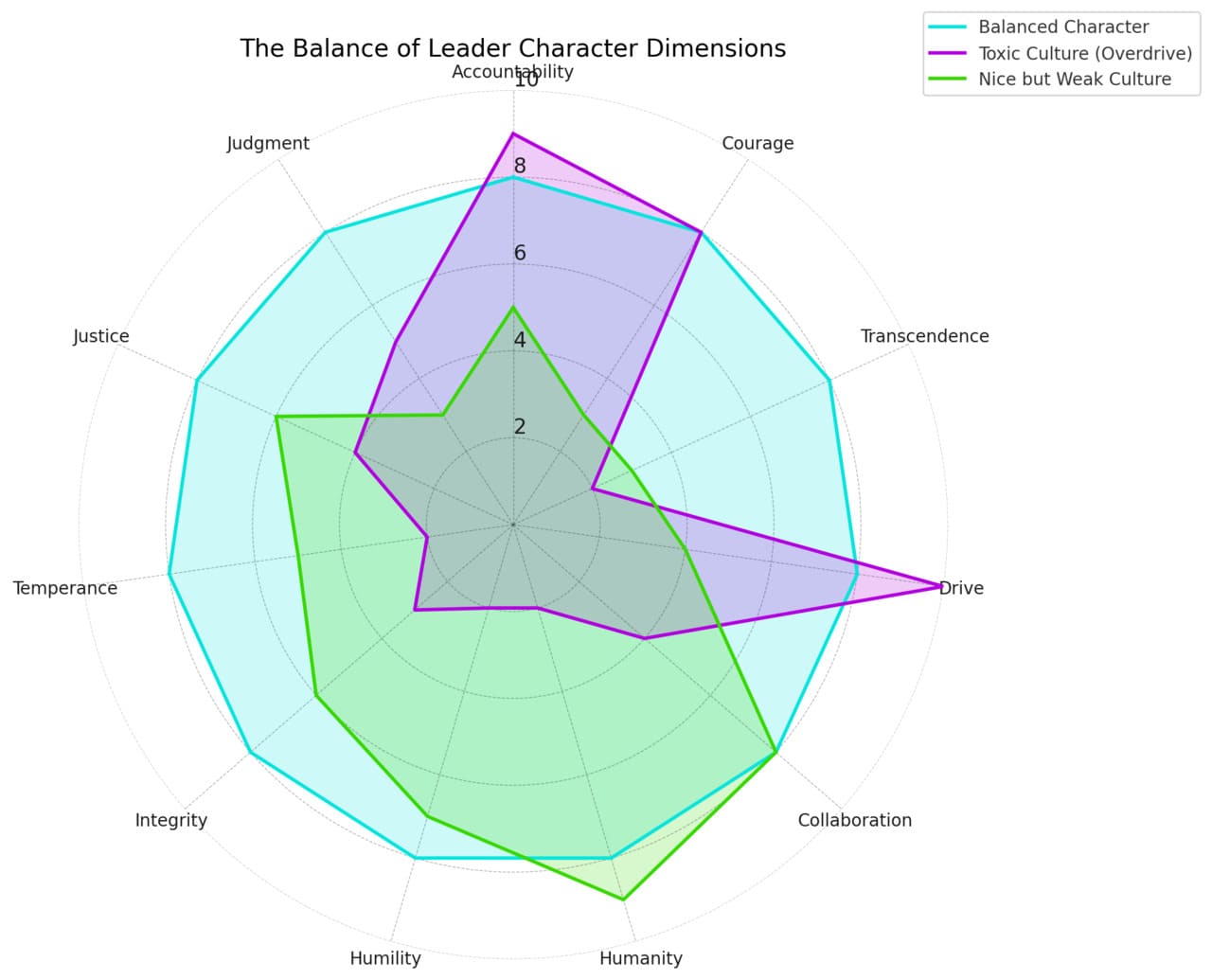
Character is not just about ethics or morals. According to extensive research from the Ivey Business School, it is an interconnected system of 11 virtuous habits that define a person’s judgment and influence their effectiveness: Accountability, Courage, Transcendence, Drive, Collaboration, Humanity, Humility, Integrity, Temperance, Justice, and Judgment.
Problems in organizations arise not when one of these qualities is absent, but when their balance is disturbed. A company that excessively rewards Drive while ignoring Humanity and Temperance will inevitably face burnout and a toxic atmosphere. An organization where Collaboration dominates without Courage becomes a “club of nice people” incapable of making tough decisions. Most companies don’t know how to diagnose and purposefully correct these imbalances.
Making Character Visible: From Theory to Practice
For a long time, character was considered abstract and immeasurable. Today, however, technology exists to make its development a part of daily work. Our platform, AlbiCoins, was designed specifically as a tool to implement a culture based on character.
We don’t just offer gamification; we provide the ability to notice and reward specific behavioral manifestations of character:
- Peer-to-peer Recognition: When employees thank each other for help, they are developing Humanity and Collaboration. A bonus system for teamwork encourages Justice.
- Internal Startup Boost: This module directly stimulates Courage (the willingness to risk and propose new ideas) and Transcendence (the striving for excellence and innovation).
- Upskill & Reskill Reward: Encouraging learning and development is a practical way to cultivate Humility (the readiness to admit knowledge gaps and continuously learn) and Drive.
Thus, AlbiCoins allows a shift from abstract values on a wall to a daily “character gym,” where the right actions become visible and rewarded.
The Economics of Character: A Measurable Return on Investment
Developing character is not altruism; it’s a direct investment in financial performance. Research from the Ivey Business School shows that moving from weak to strong leader character yields:
- +14% in leader effectiveness.
- +18% in employee voice (the willingness to speak up).
- +16% in psychological safety within the team.
This data correlates directly with other key business metrics. Strengthening character dimensions like Humanity and Collaboration leads to the formation of workplace friendships, which, according to SHRM, increases employee retention by 25%. And McKinsey’s “The Social Economy” report confirms that implementing social technologies to improve collaboration can boost the productivity of knowledge workers by 20-25%.
Conclusion: From Values on the Wall to Character in Action
It’s time to admit that a culture not founded on character is just a collection of nice slogans. To build a resilient and successful organization, you need to purposefully develop and reward virtuous habits in leaders and employees.
The task seems daunting, but today, technological platforms exist to solve it. AlbiCoins is, in essence, an operating system for a character-based culture. It makes the right actions visible, measurable, and rewarding.
Ready to turn your company culture into a measurable and manageable asset? Visit our page for detailed information about the AlbiCoins platform and to request a demo:
albimarketing.com/employee-tech/
References:
- Nielsen, R. K., & Nørreklit, H. (2009). “A discourse analysis of the disciplined and punishing practices of performance measurement” Critical Perspectives on Accounting, 20(7), 847-865.
- Edmondson, A. C., & Lei, Z. (2014). “Psychological safety: The history, renaissance, and future of an interpersonal construct” Annual Review of Organizational Psychology and Organizational Behavior, 1, 23-43.
- Liden, R. C., Wayne, S. J., Zhao, H., & Henderson, D. (2008). “Servant leadership: Development of a multidimensional measure and multi-level assessment” The Leadership Quarterly, 19(2), 161-177.
- Crossan, M., Byrne, A., & Seijts, G. (2017). “Toward a framework of leader character in organizations” Academy of Management Journal, 60(5), 1775-1798.