
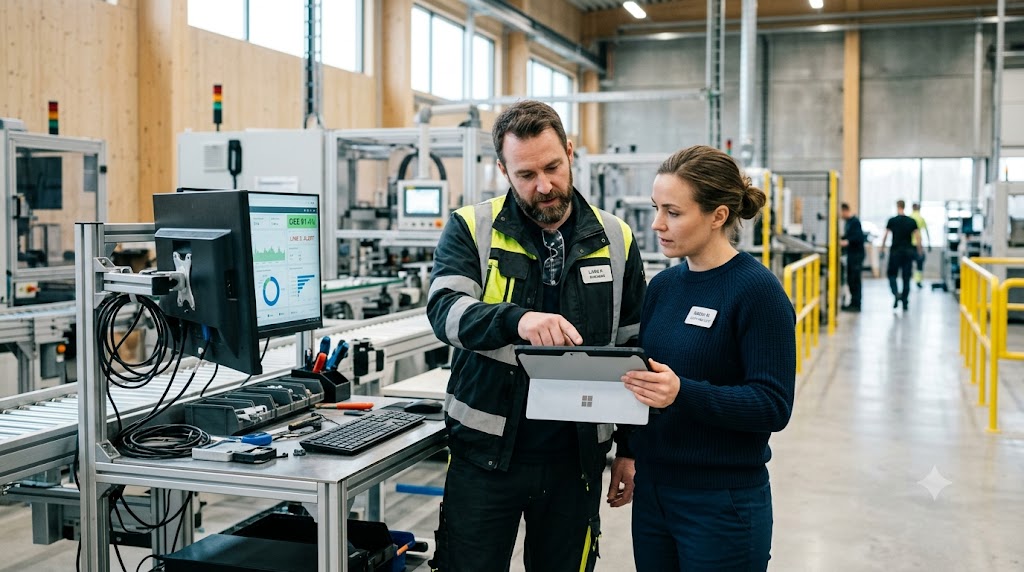
Innovation Flow in Manufacturing and Industrial Tech: Escaping Pilot Purgatory
- Many Pilots, Little Scale
- The IT/OT Divide as a Structural Hole
- The Three Stages on the Factory Floor
- The Shop Floor’s Innovation Capital — and the Kaizen Advantage
- The Lighthouse Model: Innovation Memory Done Right
- The Nordic Manufacturing Dimension
- The Structural Response
- Conclusion
- References
The technology works and the value is proven. What keeps most manufacturers stuck is a structural gap between two worlds that were never designed to talk to each other
Many Pilots, Little Scale
Few sectors have invested more hope in a transformation than manufacturing has in Industry 4.0. McKinsey has estimated its value-creation potential at around USD 3.7 trillion. The technologies — industrial IoT, machine learning, digital twins, predictive maintenance, connected shop floors — are mature and repeatedly proven in practice. And yet the results, in aggregate, tell a striking story.
Only about 30% of manufacturers are capturing value from Industry 4.0 solutions at scale. The majority are stuck in what McKinsey named pilot purgatory: at one point some 74% of surveyed companies reported being trapped there. Manufacturers run, on average, around eight digital pilots — and implement fewer than a third of them at scale. The pattern is not a shortage of ideas, technology, or investment. It is a failure to move validated pilots into standard operational practice across the factory network.
The Bridgium research with 28 innovation leaders, several from industrial manufacturing, offers a precise diagnosis. Pilot purgatory is not a mysterious affliction. It is the Adoption Gap — the characteristic Stage 3 failure of the Innovation Flow — made literal and visible at industrial scale. And its root cause in manufacturing has a specific structural shape: a gap between two worlds that were built separately and were never designed to hand work to each other.
“Most ideas don’t die. They just disappear.”
— Director, Growth & Development · Energy & Industrial Systems · Netherlands
The IT/OT Divide as a Structural Hole
Manufacturing runs on two distinct technological worlds. Information Technology (IT) is the world of data, software, analytics, and the digital systems where most Industry 4.0 innovation originates. Operational Technology (OT) is the world of the physical shop floor: the machines, the control systems, the production lines, and the people who run them. These two worlds have different languages, different priorities, different cultures, and — crucially — different people.
Ronald Burt’s network theory (1992) gives this its structural name: the gap between IT and OT is a classic structural hole, a disconnect between two groups that do not naturally communicate. Industry 4.0 innovation typically originates in the IT world and must cross into the OT world to become real. The pilot proves the concept in a controlled, IT-led setting. Scaling requires it to survive in the OT world of uptime targets, safety constraints, and shop-floor reality. The crossing is where pilots die — and it is precisely a structural-hole crossing, which is why McKinsey research repeatedly identifies the IT/OT ‘last mile’ as the decisive barrier to escaping pilot purgatory.
| Dimension | IT World (where pilots start) | OT World (where scale must happen) |
|---|---|---|
| Primary metric | Data value, model accuracy, digital capability delivered | Uptime, output, safety, overall equipment effectiveness (OEE) |
| Attitude to change | Iterative, fail-fast, comfortable with experimentation | Reliability-first; a stopped line is a direct, measurable loss |
| Knowledge type | Explicit, codified, transferable across sites | Deeply tacit; how this machine, this line, this plant actually behaves |
| Who owns it | Digital, data, and innovation teams | Plant managers, engineers, operators, maintenance |
Neither world is wrong; each is optimised for its job. But an innovation that lives comfortably in the IT world can be effectively unadoptable in the OT world unless the gap between them is deliberately bridged. The pilot succeeds in IT terms and stalls in OT terms — and because no one structurally owns the space between the two, the innovation simply disappears into the hole. This is the manufacturing-specific form of the Ownership Void the Bridgium research identifies at the Stage 2-to-3 handover.
The Three Stages on the Factory Floor
Reading manufacturing through the three stages of the Innovation Flow locates exactly where the sector’s innovation stalls — and where its distinctive strengths lie.
| Stage | The Manufacturing Pattern | Implication |
|---|---|---|
| Stage 1 Externalization | Often a genuine strength: continuous-improvement traditions (kaizen, lean) give operators legitimate channels to raise observations | Manufacturing frequently has healthier Stage 1 articulation than other sectors — an asset to build on, not fix |
| Stage 2 Objectivation | Shop-floor insight and IT-led concepts struggle to combine into shared, workable form across the IT/OT language gap | Ideas ‘said out loud’ in one world are not yet workable in the other; fragmentation across the divide |
| Stage 3 Internalization | The binding constraint: pilots proven in IT terms cannot cross into OT operations at scale — pilot purgatory | This is the Adoption Gap made literal; the sector’s central innovation challenge sits here |
“You can say the idea out loud, but until others can work with it, it’s not really there.”
— Innovation Lead · Industrial Manufacturing · Germany
This captures the Stage 2 challenge in manufacturing precisely. An idea articulated in the IT world — a model, a dashboard, an algorithm — is not yet real until the OT world can work with it. The translation across the divide is exactly the objectivation the framework describes: turning something said into something shared and workable. Where that translation does not happen, the idea stays trapped on one side of the structural hole.
The Shop Floor’s Innovation Capital — and the Kaizen Advantage
Manufacturing holds one of the richest reserves of Innovation Capital of any sector, and it sits on the shop floor. Operators, engineers, and maintenance staff possess profound tacit knowledge of how the physical system actually behaves — the sounds a machine makes before it fails, the informal adjustments that keep a line running, the reasons a theoretically optimal solution will not survive contact with reality.
It is no accident that Nonaka and Takeuchi built their foundational theory of organisational knowledge creation (1995) substantially from studying manufacturing. The tacit-to-explicit knowledge conversion they described — turning what operators know into what the organisation can use — is exactly the movement Industry 4.0 requires and pilot purgatory prevents. The shop-floor knowledge that would make a digital pilot actually work often never reaches the IT team designing it.
Manufacturing also holds a structural advantage that most sectors lack: a genuine culture of continuous improvement. The kaizen and lean traditions have, for decades, given frontline workers legitimate channels to raise observations and suggest improvements. In Bridgium terms, many manufacturers already have unusually healthy Stage 1 articulation — the exact condition other sectors struggle to build. The opportunity is to extend that same discipline across the IT/OT divide: to treat digital innovation adoption with the same structured, frontline-involved, continuously-improving approach that manufacturing already applies to physical process improvement.
“If you go too fast to decision-making, you kill half of the ideas before they even make sense.”
— Innovation Lead · Industrial Manufacturing · Finland
The Lighthouse Model: Innovation Memory Done Right
Manufacturing has also produced one of the clearest working examples of Innovation Memory functioning at scale: the lighthouse-factory model, in which leading sites that have successfully scaled Industry 4.0 are studied and their best practices captured into a shared library for the wider manufacturing community. This is Innovation Memory as structural practice — what worked, why, and how, retained and made reusable rather than relearned at each site.
The principle scales down inside a single company. A manufacturer running eight pilots across a factory network is running eight opportunities to build Innovation Memory — or eight opportunities to lose it. When the learning from each pilot (what bridged the IT/OT gap, what failed, which operator insight proved decisive) is captured and shared, each subsequent pilot starts from a higher baseline. When it is not, every site rediscovers the same lessons, and the network scales nothing. Across a manufacturer with many plants, this difference compounds into the gap between a company that escapes pilot purgatory and one that stays.
The Nordic Manufacturing Dimension
Nordic industrial manufacturers — in machinery, automation, marine, forestry equipment, and industrial systems — bring specific strengths to this challenge. The region has a world-class engineering tradition and a strong culture of operator respect and worker participation, rooted in low power distance and consensus (samförstånd). On the shop floor, this means operators are more readily treated as a source of insight than as hands to be directed — a genuine Stage 1 advantage.
This collaborative culture is well suited to bridging the IT/OT divide, because bridging a structural hole requires exactly the cross-boundary respect and joint problem-solving that Nordic industrial cultures tend to value. Where a more hierarchical manufacturing culture might impose an IT-designed solution on the OT world, the Nordic default is more likely to bring operators and engineers into the design together. The risk is the familiar one: consensus can slow decisive adoption, and the IT/OT translation still has to be actively managed rather than assumed. But the cultural foundation for the partner-based, frontline-involved approach that escapes pilot purgatory is unusually strong in Nordic industry.
The Structural Response
- Bridge the IT/OT hole deliberately. Escaping pilot purgatory begins with treating the IT/OT gap as a structural hole that needs a bridge — not assuming an IT-designed pilot will cross into OT on its own. This means involving OT people (operators, plant engineers, maintenance) in pilots from the start, so the innovation is designed for the shop floor rather than delivered to it.
- Convert shop-floor tacit knowledge into the design. The operator who knows how the line really behaves holds the knowledge that determines whether a pilot scales. Building channels to surface that tacit knowledge — and feed it into the IT design — is the highest-leverage move for making pilots adoptable. It is also exactly what mature kaizen practice already knows how to do.
- Build Innovation Memory across the network. Treat every pilot as a deposit into a shared library of what works — the lighthouse principle applied internally. Capturing and circulating pilot learning across sites turns a network of factories from a place where lessons are lost into one where they compound, which is the difference between scaling and stalling.
- Sequence adoption against operational capacity. Eight simultaneous pilots competing for the attention of the same plant teams is a recipe for change fatigue on the shop floor. Sequencing adoption — fully embedding one before pushing the next — respects the OT world’s reliability-first reality and produces more scaled innovation than running everything at once.
Conclusion
Manufacturing’s pilot purgatory is one of the most visible and expensive examples of the Adoption Gap anywhere in business — trillions in potential value, proven technology, and yet only a minority of companies scaling it. The reflexive explanations point to technology maturity or investment. The structural explanation is sharper: the innovation must cross a gap between the IT world where it starts and the OT world where it must live, and that gap — a classic structural hole — is where pilots die when no one bridges it.
The encouraging news is that manufacturing holds unusual strengths for closing this gap: deep shop-floor Innovation Capital, a genuine continuous-improvement culture that already does Stage 1 well, and in the lighthouse model a proven example of Innovation Memory at scale. Escaping pilot purgatory is not about better technology or more pilots. It is about bridging the IT/OT hole deliberately, converting tacit shop-floor knowledge into the design, and building the memory that lets a factory network scale what one site has proven. For Nordic industrial manufacturers, with their engineering depth and collaborative shop-floor culture, the foundations are already in place.
The question for any manufacturer is direct: your pilots have proven the technology works — is your innovation flow built to carry them across the gap between the digital world and the factory floor, or are they disappearing into it?
The Bridgium Innovation Flow Checklist helps manufacturers locate where pilots are crossing the IT/OT gap and where they are stalling:
bridgium-research.eu/innovation-checklist-2026/
Full research report:
bridgium-research.eu/innovation-report-2026/
References
- Burt, R.S., Structural Holes: The Social Structure of Competition, Harvard University Press (1992). Publisher
- Nonaka, I. & Takeuchi, H., The Knowledge-Creating Company, Oxford University Press (1995). Publisher
- McKinsey & Company, “Capturing Value at Scale in Discrete Manufacturing with Industry 4.0,” McKinsey (2019). Read
- McKinsey & Company, “Capturing the True Value of Industry 4.0,” McKinsey (2022). Read
- McKinsey & Company, “What Are Industry 4.0, the Fourth Industrial Revolution, and 4IR?” McKinsey Explainers. Read
- Cohen, W.M. & Levinthal, D.A., “Absorptive Capacity,” Administrative Science Quarterly (1990). JSTOR
- Imai, M., Kaizen: The Key to Japan’s Competitive Success, McGraw-Hill (1986). Publisher
- Kerr, S., “On the Folly of Rewarding A, While Hoping for B,” Academy of Management Journal (1975). JSTOR
- Berger, P.L. & Luckmann, T., The Social Construction of Reality, Doubleday (1966). Publisher
- Weick, K.E., Sensemaking in Organizations, Sage Publications (1995). Publisher
- World Economic Forum & McKinsey, “Global Lighthouse Network” (advanced manufacturing best practice). Read
- Bridgium, How Innovation Happens: Research Report, Albi Marketing Oy & Digitune Oy (2025). Read