

Unlocking Latent Innovation Capital: Shifting from Generation to Structural Activation
- Redefining Innovation Capital
- The Architecture of Invisibility: Why Capital Remains Hidden
- The Compounding Cost of Unused Capital
- Mapping the Hidden Assets: Where to Look
- Strategic Shift: From Generation to Activation
- Conclusion
The Asset Hiding in Plain Sight
Almost every enterprise innovation conversation begins with a baseline assumption of deficit: the organization needs more. More ideas, more creativity, more capacity, and more programs. The gap between an organization’s current innovation capability and its strategic goals is routinely framed as something missing that must be artificially generated or acquired.
Recent research by Bridgium, based on 28 in-depth interviews with innovation leaders across Nordic and European enterprises, challenges this fundamental assumption. The deficit is rarely found in what the organization possesses. Rather, the deficit lies in what the organization is structurally capable of seeing.
Across diverse industries and organizational scales, a consistent pattern emerges: capable professionals already notice systemic inefficiencies, develop informal solutions, and possess the contextual knowledge required to create new value. However, very little of this operational intelligence reaches the formal systems designed to scale it.
The Bridgium framework defines this latent resource as Innovation Capital — the accumulated insight embedded in everyday work that never enters the formal pipeline. The structural challenge for modern enterprises is not a shortage of innovation capital, but the absence of the architecture required to make it visible, stable, and actionable.
Redefining Innovation Capital
Innovation capital should not be confused with general creativity or registered intellectual property. It is a highly specific, contextual, and often informal asset. It represents the practical knowledge that accumulates organically during operational work, holding the potential to improve, reframe, or scale how the organization functions.
Table 1: Redefining the Innovation Focus
| Attribute | Traditional Innovation View | The Innovation Capital Framework (Bridgium) |
|---|---|---|
| Core Definition | Net-new ideas generated through formal programs (labs, workshops). | Practical, contextual knowledge embedded in everyday operational work. |
| Primary Challenge | Idea generation and stimulating creativity. | Activation, structural visibility, and institutional memory. |
| Format | Pitches, hackathons, patented intellectual property. | Workarounds, frontline observations, informal network exchanges, pilot learnings. |
| Leadership Focus | Requesting “more” from employees; funding new initiatives. | Building architectural conditions for existing knowledge to flow. |
In the majority of organizations examined in the Bridgium research, innovation capital remains trapped in individual heads, private team channels, or discontinued initiatives.
The Architecture of Invisibility: Why Capital Remains Hidden
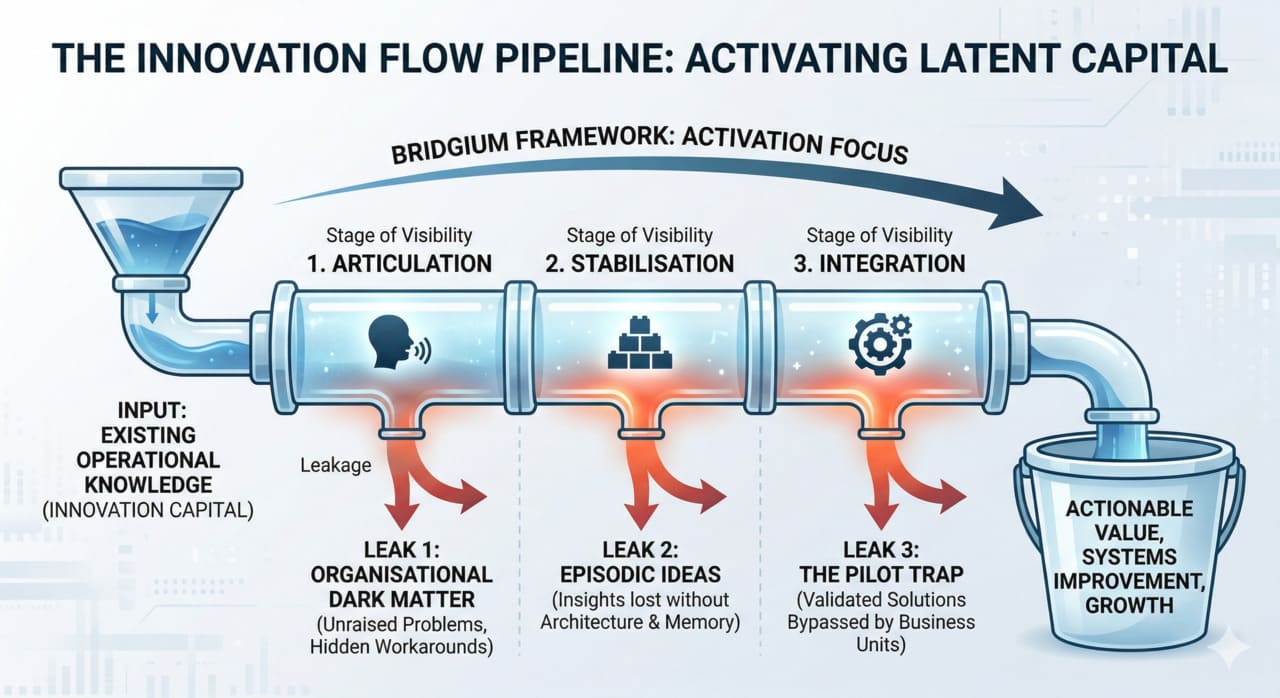
The research identifies three distinct structural mechanisms that keep innovation capital hidden. Each corresponds to a critical failure point in the organizational Innovation Flow, shifting the diagnostic question from “what goes wrong?” to “what value goes unseen?”
Table 2: The Three Mechanisms of Invisible Innovation
| Stage | Mechanism | Structural Root Cause | Organizational Outcome |
|---|---|---|---|
| 1. Articulation | Invisible at Source | No predictable pathway for ideas; performance systems do not reward observation. | “Organisational Dark Matter” – insights are kept private as a rational allocation of effort. |
| 2. Stabilisation | Invisible in Transit | Absence of protected spaces for development and lack of Innovation Memory. | Episodic visibility – ideas are voiced in meetings but dissolve without structural follow-up. |
| 3. Integration | Invisible at Handover | Disconnect between pilot environments and business unit absorption capacity. | The “Pilot Trap” – validated solutions are bypassed; ROI on innovation generation is lost. |
Mechanism 1: Invisible at Articulation
When raising a problem has no predictable next step, or when systemic contributions fall outside the metrics of formal performance reviews, professionals accumulate insight privately. They understand what is broken and how to fix it, but rationally choose not to share this knowledge because the organization has not established the conditions under which sharing makes operational sense.
Mechanism 2: Invisible at Stabilisation
Even when ideas are articulated, they often fail to stabilize. They enter discussions lacking follow-up mechanisms or an Innovation Memory system to preserve context. The insight becomes briefly visible—perhaps in a workshop or a digital workspace—and then vanishes because the organization lacks the architecture to objectify and hold it.
Mechanism 3: Invisible at Integration
The most critical structural failure occurs at the boundary between pilot validation and operational practice. An innovation is developed and proven, yet when “handed back” to a core business unit, it is quietly bypassed due to a lack of structural absorption capacity. The organization pays for the generation of capital, only to lose it at the precise moment of adoption.
The Compounding Cost of Unused Capital
The true cost of invisible innovation capital is not merely the direct financial loss of failed pilots; it is a compounding structural deficit:
- Knowledge Asymmetry: As professionals stop sharing insights, organizational learning becomes distributed and private. The enterprise becomes wealthy in localized knowledge but poor in its institutional capacity to leverage it.
- Talent Attrition: Professionals whose practical intelligence consistently fails to reach decision-making systems eventually migrate to environments where their capital is activated. This is rarely framed as an “innovation” issue in exit interviews, but the structural root cause remains the same.
- Redundant Investment: Launching generic, externally sourced initiatives without first activating internal innovation capital results in shallow foundations. Organizations pay for consulting frameworks while highly specific, contextual intelligence sits unused within their own tenured workforce.
Mapping the Hidden Assets: Where to Look
To activate this capital, leaders must look beyond the innovation lab and into the everyday spaces where operational reality happens:
- Frontline Observations: Upstream functions rarely see the granular patterns visible to those closest to service delivery or production.
- Informal Networks: Peer-to-peer exchanges (unscheduled calls, private channels) are where true collective sensemaking occurs, yet they remain disconnected from formal operational systems.
- Abandoned Pilots: Discontinued experiments hold dense, high-value learnings about organizational friction and viability that are typically discarded along with the project.
- Operational Workarounds: The informal adaptations teams build to bypass broken processes contain enormous practical intelligence about systemic gaps.
- Tenured Pattern Recognition: The ability to anticipate second-order effects is accumulated over years but is rarely captured by standard performance metrics.
Strategic Shift: From Generation to Activation
Addressing invisible innovation capital requires a fundamental shift in enterprise leadership strategy. Adding capacity to generate ideas does not solve the mechanisms that keep existing capital unseen.
The approach must become diagnostic.
Table 3: The Leadership Paradigm Shift
| Dimension | The Generation Paradigm | The Activation Paradigm |
|---|---|---|
| Core Question | “How do we generate more ideas?” | “What is preventing our existing capital from flowing?” |
| Primary Investment | Ideation platforms, workshops, external labs. | Clear pipelines, Innovation Memory systems, absorption capacity. |
| Definition of Success | Volume of ideas generated / Pilots launched. | Movement: The successful transition of insights into formal systems. |
| Leadership Posture | Demanding more creativity from the workforce. | Building structural trust and pathways for existing knowledge. |
Conclusion
The question most enterprise leaders are asked to answer – “How do we become more innovative?” – contains a flawed premise. Enterprises are rarely short of innovation. They are short of the structural conditions under which existing innovation capital becomes visible, shared, and actionable.
Replacing a deficit narrative with an asset narrative is not merely a motivational tactic; it is a pragmatic operational realignment. By focusing on systemic activation rather than constant generation, organizations can finally capitalize on the wealth of insight they already possess.
Resources & Diagnostics
- Berger & Luckmann, The Social Construction of Reality (1966)
- Burt, Structural Holes: The Social Structure of Competition (1992)
- Nonaka & Takeuchi, The Knowledge-Creating Company (1995)
- Burt, Structural Holes (1992)
- Cohen & Levinthal, “Absorptive Capacity,” Administrative Science Quarterly (1990)
- Kerr, “On the Folly of Rewarding A, While Hoping for B,” Academy of Management Journal (1975)
- Amabile, Creativity in Context (1996)
- Weick, Sensemaking in Organizations (1995)
- Blau, Exchange and Power in Social Life (1964)
- Bridgium, How Innovation Happens, Albi Marketing Oy & Digitune Oy (2025)