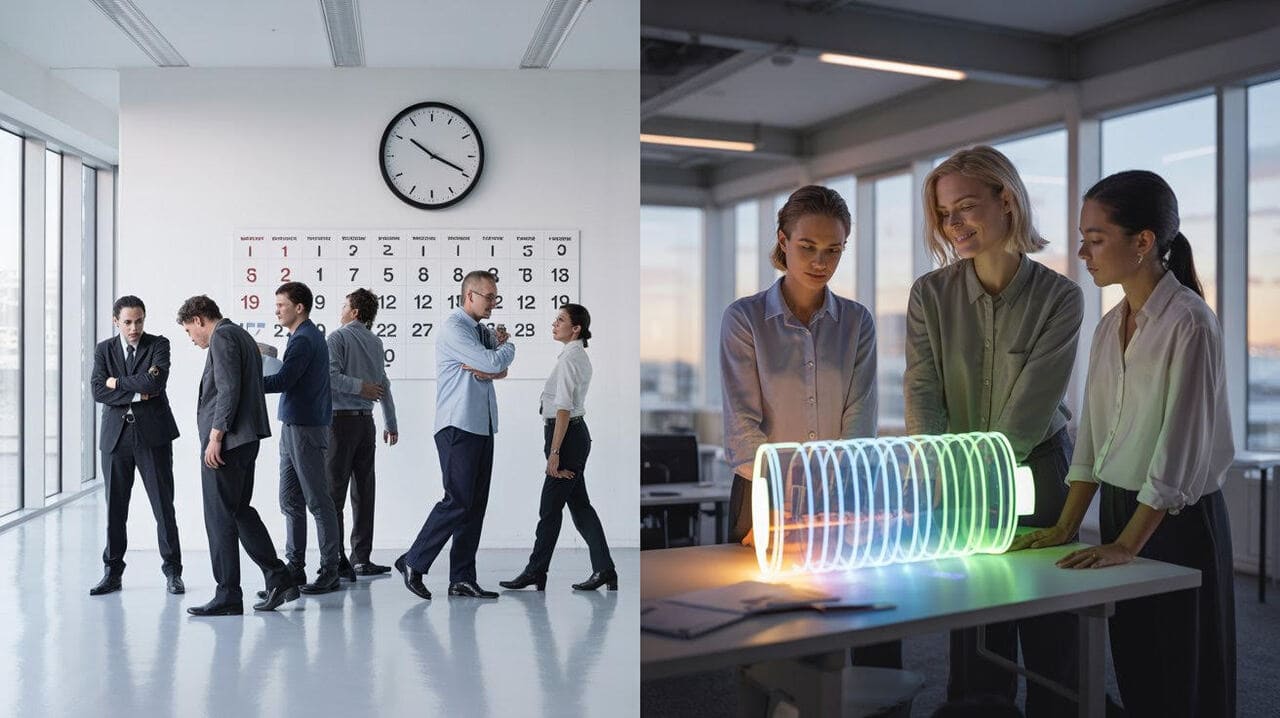
Why Time Management is Dead: How Energy Management Saves Companies from Burnout
- The Problem of “Silent Burnout”
- Digital Signals of Exhaustion
- From Time Management to Energy Management
- How It Works in Practice
- Conclusion
- Self-Check: Is Your Team at Risk?
Between 2020 and 2024, the corporate world was obsessed with efficiency. We implemented time trackers, optimized calendars, and fought for every minute of the workday. Yet, a paradox emerged: the tighter the schedule became, the lower actual productivity fell.
The reason is simple: in the era of knowledge work, the primary resource is not time (which is constant), but energy (which is finite).
In this article, we explore why classic burnout prevention methods—like annual surveys—no longer work, and how behavioral analytics can identify “energy dips” in your team before resignation letters hit your desk.
The Problem of “Silent Burnout”
Traditional HR tools, such as eNPS (Employee Net Promoter Score) or annual engagement surveys, share one critical flaw: they are reactive.
By the time an employee writes in a survey that they are “burned out” or “dissatisfied,” it is often too late. The process of disengagement likely began 3–4 months prior. In behavioral economics, this is known as “perception lag.”
Fact: High Performers often do not complain. They work at maximum capacity until their very last day, and then leave “suddenly” from their manager’s perspective.
Digital Signals of Exhaustion
While surveys remain silent, data screams. Burnout is not just a mood; it is a behavioral pattern that leaves a digital footprint.
Our experience with the Workplace Energy Tracker shows that declining energy levels can be predicted by three objective markers:
- Time Fragmentation.
The employee switches between tabs (contexts) every 2–3 minutes. This is a sign of cognitive overload. They are “doing a lot,” but cannot focus on deep work. - Network Shrinkage (Social Isolation).
In a healthy state, an employee interacts with 10–15 colleagues per week. During burnout, this circle shrinks to 3–4 people (usually just their direct manager and closest peer). The individual instinctively “saves fuel” by cutting off social ties. - Always-On Activity.
Systematic activity in Slack, Jira, or email after 8:00 PM or on weekends. This is not a sign of diligence; it is a sign that the employee can no longer cope with their workload during business hours due to declining cognitive abilities.
From Time Management to Energy Management
Most companies try to treat burnout with a “day off” or time management courses. This is a mistake. Teaching an exhausted person to manage time is like teaching a drowning person to swim the butterfly stroke.
A paradigm shift is needed at the analytics level:
| Old Paradigm (Efficiency) | New Paradigm (Energy) |
|---|---|
| Metric: Hours worked. | Metric: Deep Work hours. |
| Goal: Fill the calendar. | Goal: Create buffers for recovery. |
| Control: “Why aren’t you online?” | Control: “Why are you working on Sunday?” |
| Tool: Time Tracker (Surveillance). | Tool: Energy Tracker (Care). |
How It Works in Practice
Instead of waiting for survey results, an HR Director should monitor the organizational energy dashboard.
Case Study
The system highlights a “red zone” in the Design Department. Analysis reveals that over the last month:
- Meeting volume increased by 40%.
- “Quiet work” time dropped to just 1 hour per day.
- File uploads shifted to late-night hours.
Intervention:
You don’t need to hire a psychologist immediately. You need to change the process: introduce “No-Meeting Days” or revise SLA requirements. You treat the root cause (work design), not the symptom (fatigue).
Conclusion
Burnout is not a personal failure of the employee; it is a failure of work design. If you are not measuring your team’s energy levels as rigorously as you measure revenue or conversion rates, you are neglecting your most valuable asset.
Stop managing time. Start managing energy.
Self-Check: Is Your Team at Risk?
Your company is in the danger zone if:
- You praise employees in public chats for working on weekends.
- You have no designated “quiet hours” when meetings are forbidden.
- You only learn about burnout during exit interviews.
- You use time trackers for control rather than for support.
🔗 See how Workplace Energy Tracker visualizes burnout risks:
albimarketing.com/employee-tech/
References
- Microsoft Work Trend Index: The Rise of the Triple Peak Day
- Gallup: Employee Burnout: Causes and Cures
- Harvard Business Review: Manage Your Energy, Not Your Time
- McKinsey Health Institute: Addressing Employee Burnout
- Deloitte: Workplace Burnout Survey