

You scout a lot and work with almost nobody
- The symptom: a full funnel and an empty project list
- The usual explanation, and why it does not hold
- What failed: connectivity, and the three gaps at entry
- How to check this in your own organisation
- The structural response
- Conclusion
- References
Volume at the entry stage is easy to increase, and it moves independently of whether anything matches.
The symptom: a full funnel and an empty project list
The scouting plan is in place. Three ecosystem events a quarter, a platform subscription, a standing slot for inbound pitches, a shared spreadsheet with several hundred companies in it. Then ask the team a narrow question: the last startup you declined, which corporate problem was it answering? The pause that follows is the subject of this article.
Two counts describe the position. The number of external contacts the organisation makes in a year, which rises whenever anyone decides to try harder. The number of joint projects that reach a working stage, which sits where it sat three years ago. The second number is insensitive to the first, and that is the finding, rather than an accident of a bad year.
Our second study puts the mechanism in a single sentence: interaction increases while alignment does not. More exposure produces more conversations with no corresponding rise in the number of conversations that go anywhere, because exposure and matching are produced by different things.
“Corporates… don’t really tell you about their problems… only when you are already in.”
Sales Leader · IT Services · Finland
The pattern is not confined to one market or one sector. Across the interviews, entry emerged as a process of interpretation under uncertainty on both sides at once: corporates reading pitch decks written for a different audience, founders reading public strategy statements for clues about what any of it means operationally. Neither party is withholding anything deliberately. The information each one needs simply has no channel to travel through.
That sentence is worth sitting with, because it describes a closed loop. The information needed to approach a corporate usefully becomes available after the approach has already succeeded. Everyone outside the loop is guessing, and the guesses arrive on your desk as loosely relevant proposals.
The usual explanation, and why it does not hold
Two standard readings circulate, and both lead somewhere unhelpful.
The first blames reach. On this account the funnel is too narrow at the top, and the answer is another platform, two more events, a scouting partner in a new region. Our interviews suggest that platforms increase exposure while rarely supplying the trust, contextual understanding or translation that alignment requires. They make more companies visible to you. Visibility and connection are separate achievements, and buying the first does not deliver the second.
The second reading blames the conversion rate. If several hundred companies enter and a handful come out, something must be broken. The strongest practice documented in our study looks exactly like that and is working as designed.
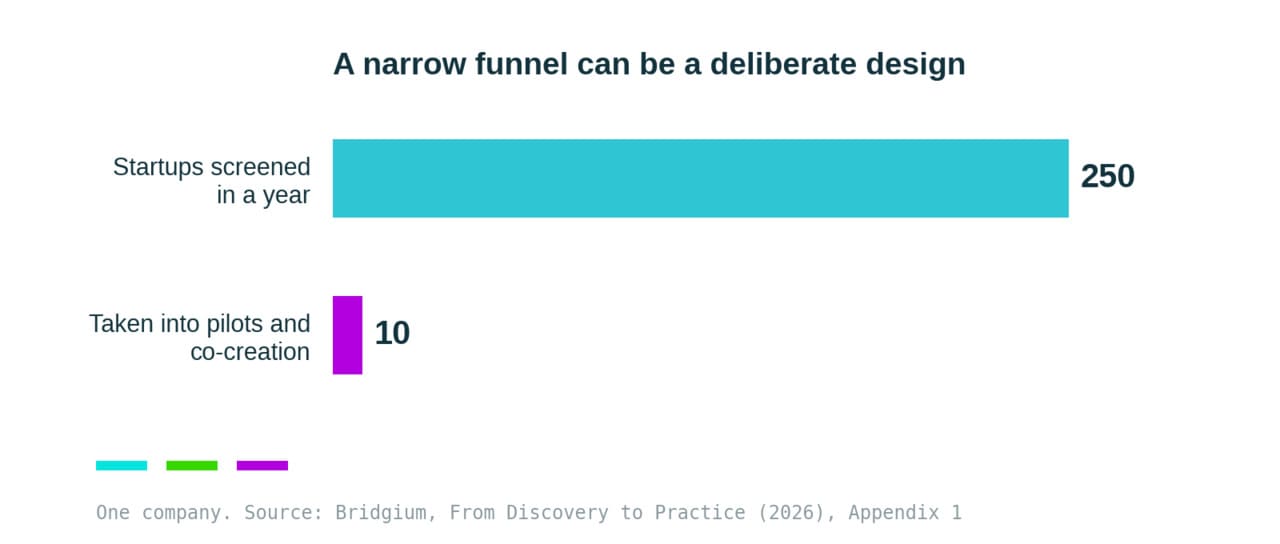
Figure 1. A deliberately selective funnel at one engineering and consulting firm. Source: Bridgium, From Discovery to Practice (2026), Appendix 1.
“We screened around 250 startups every year and selected roughly ten for deeper pilot and co-creation programmes.”
Innovation Community & Startup Collaboration Lead · Engineering & Consulting · Sweden
A ratio of about one in twenty-five is not a symptom of anything on its own. In that company the filtering is doing the work: the funnel stays broad so the organisation remains connected to the wider ecosystem, and internal resources concentrate on the few opportunities that fit. The ratio is the output of a design.
The question that separates the two situations is therefore not how many companies you decline. It is whether you can state, for each decline, which internal problem the company failed to fit. Where that answer exists, you have a filter. Where it does not, you have noise arriving at a constant rate and a team sorting it by instinct.
What failed: connectivity, and the three gaps at entry
The Innovation Flow framework names four conditions that determine whether anything moves: legitimacy, predictability, connectivity and innovation memory. At the entry stage our second study finds connectivity constrained by fragmented ecosystem structures and by limited transparency of innovation needs, with access depending on personal networks, local hubs and informal visibility. Three gaps produce that result, and they compound.
The transparency gap
Corporates operate with defined strategies, priorities and internal problem spaces. Those remain largely implicit and inaccessible to anyone outside, so the external actor has nothing concrete to respond to and responds to signals instead.
“Lack of free, accessible knowledge bases of corporate research questions impedes matching startups with corporate needs.”
Group Vice President · Industrial Technology · Netherlands
The language gap
Corporates frame an opportunity through business value, integration and risk. Startups describe product capability, innovation potential and vision, often in the form built for an investor audience. Our study is explicit that the distance is conceptual as much as linguistic: each side operates inside a different logic of value, so early conversations become translation exercises that neither party has been asked to perform.
“I didn’t even understand what they were talking about… What are you looking for?”
Open Innovation Lead · Industrial Technology · Germany
The ecosystem visibility gap
Entry into collaboration turns out to be socially mediated. Connections form through recurring events, informal exchange and introductions inside networks that already exist, which means access depends on proximity and standing rather than on relevance. Startups without network access stay undiscovered whatever their fit, and corporates keep working through intermediaries they already trust.
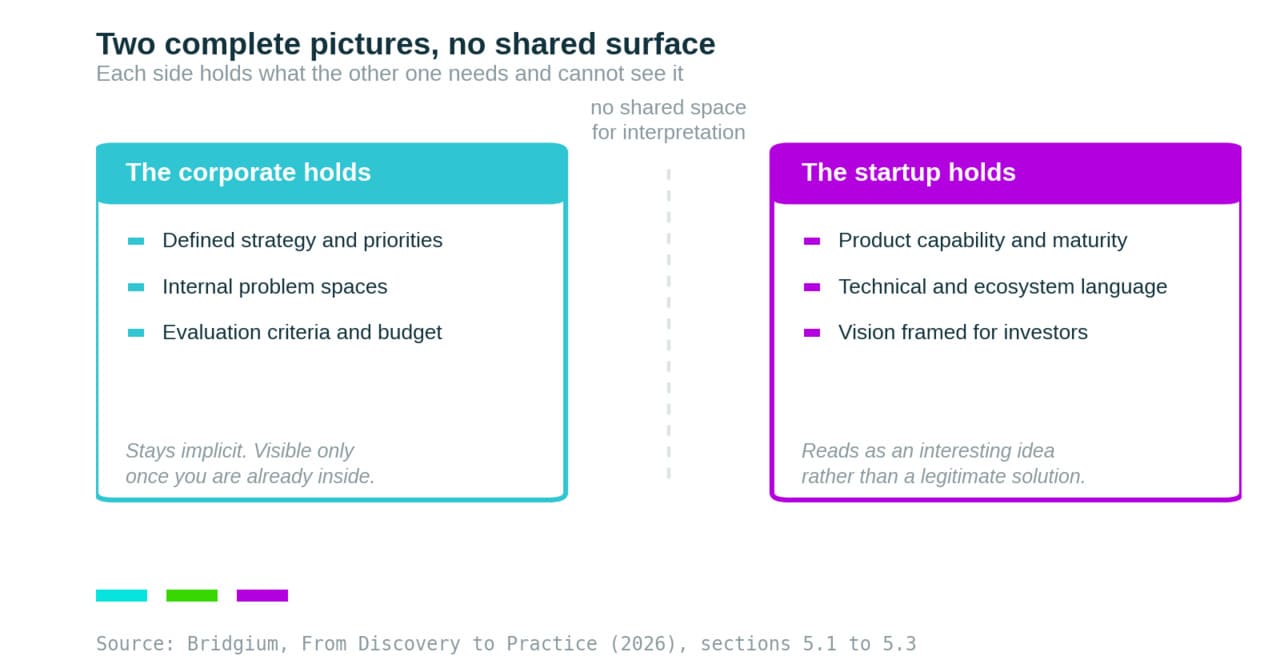
Figure 2. What each side holds at the entry stage, and the surface that is missing between them. Source: Bridgium, From Discovery to Practice (2026), sections 5.1 to 5.3.
The three gaps reinforce one another, which is why fixing one in isolation changes little. Publishing a problem statement helps nobody if it is written in internal language. Translating your language helps nobody if the underlying problem is still unstated. Opening a new channel carries whatever was already unclear into a larger audience, which is how a well-run open call produces several hundred responses and no shortlist.
The academic reading
Mark Granovetter’s 1973 work on weak ties explains why a dense local ecosystem underperforms at exactly this task. Tightly connected groups circulate the same information among people who already share it, and new information travels along the sparse connections between groups. A scouting practice built on recurring attendance at the same regional events is a strong-tie practice, and it will keep returning companies you could already have found.
Ronald Burt’s account of structural holes adds the positional consequence: the value sits with whoever spans the gap between otherwise disconnected clusters, and most corporate scouting functions occupy a well-populated position instead. George Akerlof’s 1970 analysis of markets under information asymmetry covers the rest. When buyers cannot assess quality and sellers cannot identify what buyers want, volume rises and matching quality falls, which is a fair description of a scouting inbox.
How to check this in your own organisation
Five questions, each answerable inside a week.
First, and this is the diagnostic one: is any of your innovation questions written down somewhere an outsider can read, in terms that let them judge whether they are relevant? Not a strategy statement and not a list of technology areas, but a problem with enough shape that a stranger could decide to walk away from it.
Second: for the last ten companies you declined, can you name the internal problem each one failed to fit? If the reasons reduce to too early, not a fit and interesting but not now, the filter is a person’s judgement rather than a criterion, and it cannot be delegated or audited.
Third: what proportion of your current pipeline arrived through someone already known to the team? A high proportion is not a failure in itself, and it does tell you that your reach is the reach of your address book.
Fourth: do you tell external partners which engagement mode you are in, co-exploration or a ready solution to embed? Our study names this distinction as the thing that decides whether an approach reads as a legitimate solution or as an interesting idea.
Fifth: where do the results of last year’s scouting live? If a colleague wanted to know which companies you assessed in a given area eighteen months ago and what you concluded, could they find it without asking you? Where the answer is no, the matching process restarts from zero each cycle, which is innovation memory failing at the entry stage.
| What you observe | What is usually assumed | What to check instead |
|---|---|---|
| Inbound volume rises, projects do not | The funnel needs to be wider still | Whether any internal problem is published in external terms |
| Most pitches feel loosely relevant | The market has little to offer us | What signal the market is actually responding to |
| Conversations stall after the first meeting | The partner was not serious | Whether next steps and criteria were stated at the first contact |
| The same companies keep appearing | The regional ecosystem is small | How much of the pipeline comes through existing contacts |
| Scouting restarts each year | Last year’s work is out of date | Where assessments and challenge definitions are stored |
Table 1. Entry-stage symptoms and the checks that separate a reach problem from a transparency problem. Source: Bridgium analysis based on From Discovery to Practice (2026), section 5.
Two of these are answerable from material you already hold, and the other three take one conversation each. The fifth is the one most often postponed, because the honest answer usually involves a spreadsheet that lives on somebody’s laptop and has not been opened since the last reorganisation.
The Nordic dimension
The advantage in Nordic ecosystems is real and it is described by the respondents themselves: the networks are navigable, people know each other across company lines, and an introduction is genuinely available to anyone who shows up consistently.
“The ecosystem has been pretty local… you start to know the people… in your region who are dealing with it.”
Innovation Manager · Chemicals Industry · Finland
The same locality is the constraint. Information flow stays fragmented across small communities that do not always talk to each other, and our interviews record an additional dynamic that is rarely said out loud.
“…small groups and communities are competing with each other… that stops the flow of information.”
Innovation Manager · Urban Development · Finland
For a Nordic corporate this produces a specific failure mode. Scouting feels productive because every event yields warm conversations with people you recognise, and the pipeline stays inside a circle whose boundary nobody has drawn deliberately. Broader markets and partnerships sit one structural hole away and never appear in the funnel at all.
The structural response
Our second study describes the stronger practice as a combination of openness and structure, in a defined sequence: open broadly, clarify the problem, invite external interpretation, assess fit, filter gradually, and move only relevant cases forward. Four things make that sequence possible.
- Publish the problem area, not the solution. A company does not have to disclose sensitive detail to be approachable. It can state the problem area, the expertise it expects, the collaboration stage and the possible next step, which is enough for an external actor to interpret the challenge and self-select. In the documented cases the problem area was defined while the solution space stayed open, and that combination is what attracted specialised contributors instead of general interest.
- State the engagement mode at first contact. Co-exploration and ready-to-integrate are different propositions with different evidence requirements, different timelines and different internal owners. Naming which one you are in costs a sentence and removes the most common cause of mutual disappointment three meetings later.
- Build a repeatable dialogue space rather than an event. The practice cases in our study converge on this point: the strongest mechanisms are recurring interaction environments where needs and ideas can be interpreted jointly, and one-off events and platform searches are the weaker form. A standing challenge programme with mentors and expert feedback does work that no amount of attendance can replicate.
- Make evaluation steps and outcomes visible. Transparent entry pathways, contact points, evaluation criteria, decision steps and possible outcomes are what allow both sides to anticipate whether an engagement will progress. They also give you the record that makes next year’s scouting cumulative instead of repetitive.
| Condition | Corporate requirement | External partner requirement |
|---|---|---|
| Legitimacy | Formulate clear innovation questions and problem areas that show why external collaboration matters | Explain the solution in corporate terms: the problem addressed, operational relevance and expected value |
| Predictability | Provide transparent entry pathways, contact points, evaluation criteria, decision steps and possible outcomes | Show solution maturity, readiness, required resources, timelines and commitment |
| Connectivity | Enable access through open networks, communities, events, hubs and cross-functional interfaces | Build relationships across the ecosystem and maintain active dialogue with problem owners and sponsors |
| Innovation memory | Maintain visible knowledge bases, challenge repositories, pilot records and feedback loops | Reuse feedback, references and pilot learning to refine the solution and improve fit |
Table 2. Requirements for effective entry-stage collaboration by Innovation Flow condition. Source: Bridgium, From Discovery to Practice (2026), Table 3, section 5.6.
Conclusion
Scouting volume is the easiest number in corporate innovation to move. Another event, another platform, another regional partner, and the count goes up within a quarter. Because it responds so readily to effort, it becomes the number that gets reported, and a function can spend years increasing it while the thing it was supposed to produce stays flat.
The organisations in our study that collaborate well are doing something less visible. They make one problem legible to outsiders, they say which kind of engagement they are offering, they keep a space where interpretation can happen before selection, and they write down what they learned so the next cycle starts further along. None of that raises the number of companies in the spreadsheet, and all of it raises the number that turn into work.
So the question to put to your own scouting function this quarter is a short one. If a relevant company wanted to find you, what could they read?
The findings above come from From Discovery to Practice: How Corporate–Startup Collaboration Becomes Usable (2026), a Bridgium study based on 48 interviews with corporate innovation leaders and startup founders across Northern and Central Europe. Section 5 covers the entry stage in full, and Appendix 1 documents the practice cases referred to here. The report is available at
https://bridgium-research.eu/startup-report-2026/
References
- Bridgium, From Discovery to Practice: How Corporate–Startup Collaboration Becomes Usable (2026), section 5 and Appendix 1
- Bridgium, How Innovation Happens: Insights from Leading Enterprises in Times of Change (2026)
- Granovetter, M. S. (1973). The Strength of Weak Ties. American Journal of Sociology, 78(6)
- Burt, R. S. (1992). Structural Holes: The Social Structure of Competition. Harvard University Press
- Cohen, W. M. & Levinthal, D. A. (1990). Absorptive Capacity: A New Perspective on Learning and Innovation. Administrative Science Quarterly, 35(1)
- March, J. G. (1991). Exploration and Exploitation in Organizational Learning. Organization Science, 2(1)
- Assenova, V. A. & Amit, R. (2024). Poor Places, Rich Ventures. Strategic Management Journal
- Weick, K. E. (1995). Sensemaking in Organizations. Sage
- Berger, P. L. & Luckmann, T. (1966). The Social Construction of Reality. Penguin
- Nonaka, I. & Takeuchi, H. (1995). The Knowledge-Creating Company. Oxford University Press
- Knowledge loss and employee turnover, Part I. The Learning Organization, 30(2)
- Akerlof, G. A. (1970). The Market for Lemons: Quality Uncertainty and the Market Mechanism. Quarterly Journal of Economics, 84(3)