

Everyone likes the innovation team and nobody funds it
- The symptom: a full calendar and an empty budget line
- The usual explanation, and why it does not hold
- What legitimacy is actually made of
- How to check this in your own organisation
- The structural response
- Conclusion
- References
Support that costs nothing is easy to give, and it is the main thing that keeps innovation functions out of the annual budget.
The symptom: a full calendar and an empty budget line
You are invited to the strategy offsite. You present to the board twice a year. Visiting delegations are walked past your part of the floor. Then the annual planning round happens, and the function has no line of its own. Your people are borrowed from other teams, your projects are funded case by case out of budgets you do not control, and you learn how the allocation went after it was made.
Two records make the position visible, and they point in opposite directions. The calendar is full of innovation. The budget contains no line called innovation, and no named person whose own result depends on one existing.
The difficult part is that nobody has said no. A refusal can be answered: you can argue with it, escalate it, or plan around it. Warmth leaves nothing to work with. It arrives as encouragement, it costs the person giving it nothing at all, and it is indistinguishable in the moment from a commitment.
“Ideas can stay there for a long time if there is no management prioritization.”
Innovation & R&D Leader · Imaging & Hardware Technology · Finland
Across the interviews for our first study, this came up as a structural condition with a recognisable shape. Ideas and functions do not get rejected. They sit.
The position usually forms over about two planning cycles, and it forms without a visible event, so nobody inside it can name the moment it happened. In the first cycle the function is new, so being funded out of a central transformation pot is normal and nobody objects. In the second cycle the pot is reallocated, the function is asked to demonstrate value, and it responds with the evidence it has: activity. Pilots run, workshops held, ideas collected, partners met. All of it is true, none of it appears on anybody else’s scorecard, and the allocation goes to the units whose numbers are already in the plan.
The usual explanation, and why it does not hold
The standard account blames internal communication. On this reading, the innovation function is bad at selling itself, and the remedy is better storytelling: more demos, an innovation day, a newsletter, a sharper narrative for the board. It is a comfortable explanation because the fix sits entirely inside the function’s own control.
The premise of the symptom contradicts it. A function that is invited everywhere has already solved visibility. The problem appears after awareness is achieved, which means more awareness cannot be the answer.
External survey data has been pointing at the same distinction for years. In BCG’s 2024 innovation study, 83 per cent of companies placed innovation among their top three priorities, while 3 per cent were assessed as ready to turn that priority into results. Approval is at the ceiling. Readiness, which is a question about resources, ownership and process, is somewhere else entirely.
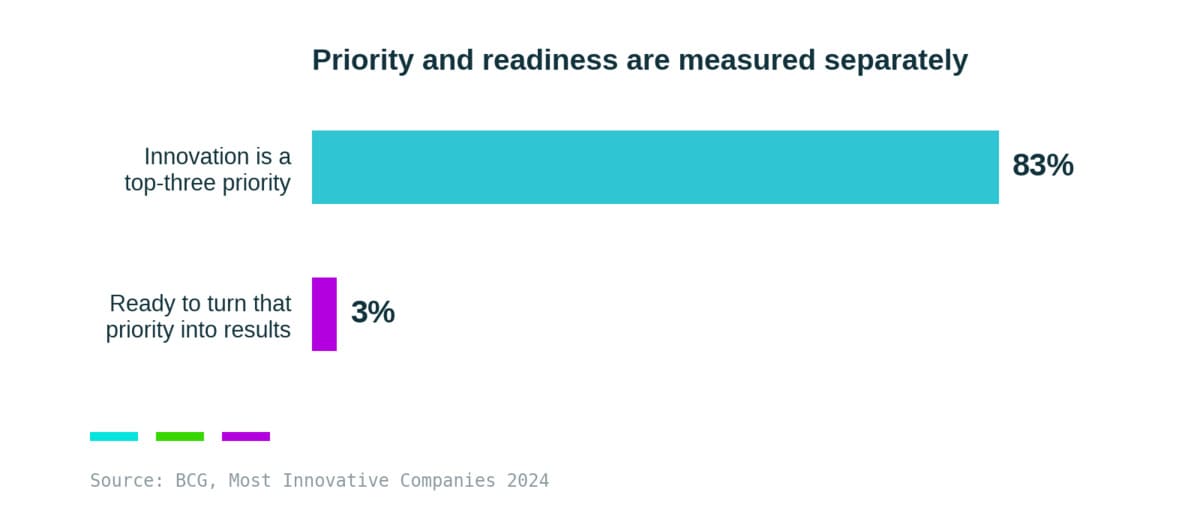
Figure 1. Priority and readiness are measured separately. Source: BCG, Most Innovative Companies 2024.
BCG has been separating these two things since its 2021 study, which distinguished companies that name innovation a priority from those that also put committed investment behind it. The share naming it a priority has moved around between roughly two thirds and four fifths of respondents across two decades of that survey. The share converting the priority into organised delivery has stayed small throughout.
There is a second reason the communication remedy backfires. A function that presents constantly and asks for nothing specific trains the organisation to respond with applause, because applause is what the format invites. Every presentation without a request attached reinforces the pattern the function is trying to escape, and the more polished the presentation, the more comfortable the applause.
Our own data explains why the two numbers come apart. Approval is a weak signal because it costs the person giving it nothing. What people actually read is the set of visible rules attached to the work.
“Innovation without financial or tangible impact is just ideas.”
Commercial Director · Technology & B2B Services · Finland
What legitimacy is actually made of
Legitimacy is one of the four conditions in the Innovation Flow framework, and at this stage it answers a practical question that every employee asks silently before spending an hour on anything: am I expected to do this, and will it be taken seriously? Our first study found that the answer is established through visible rules, and lists three of them.
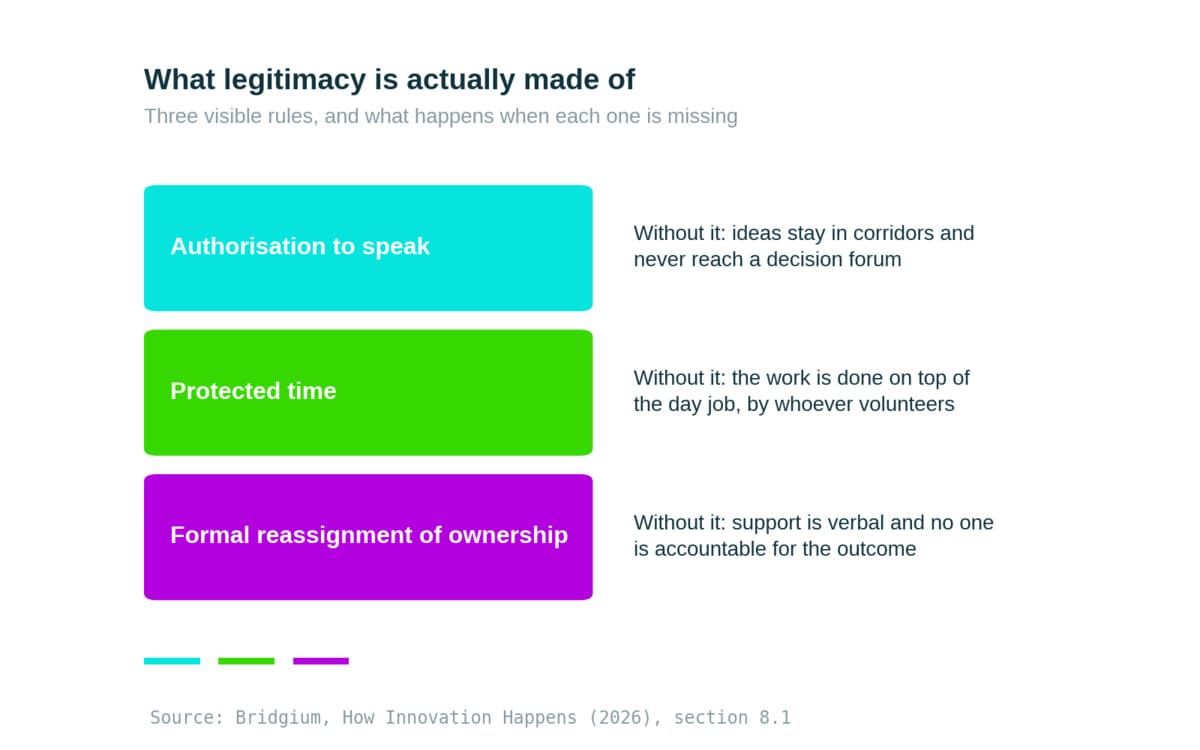
Figure 2. The three visible rules that establish legitimacy, and the effect of each one’s absence. Source: Bridgium, How Innovation Happens (2026), section 8.1.
Approval appears on none of that list. This is the whole of the problem in one line: the thing an innovation function receives in abundance is the one input that does not establish legitimacy.
“If people don’t have support from top management, they would not spend time on it.”
Head of Innovation & Venture Building · Engineering & Consulting · Denmark
Support in that sentence means something specific. Our first study describes leadership signals as temporal markers that tell people when articulation is expected and safe: a strategic priority, an innovation call, a pilot initiative. The sequence runs from strategic signal to legitimacy to engage, and only then to people speaking up. Encouragement given to one person in a corridor produces none of that, because it is not visible to anyone else and it sets no expectation.
The academic reading
Mark Suchman’s 1995 synthesis of the legitimacy literature separates three forms, and the distinction explains the budget question precisely. Moral legitimacy rests on normative approval: innovation is a good thing to be doing. Cognitive legitimacy rests on taken-for-grantedness: of course a company this size has an innovation function. Pragmatic legitimacy rests on the self-interest of the audience, which means somebody’s own outcome improves because the function exists.
Innovation functions typically hold the first two in large quantities and the third hardly at all. Budgets are allocated by people whose own results are measured, and they follow pragmatic legitimacy. A function that everybody approves of and nobody depends on will be praised in every forum and funded in none.
This is also why the usual internal comparison misleads. Legal, IT and procurement are rarely loved, and all three are funded without discussion, because a named executive’s own result deteriorates immediately if they stop working. The innovation function is the inverse case: widely liked, and nobody’s quarter gets worse next month if it pauses. Affection and funding are produced by different mechanisms, and an hour spent increasing the first does nothing to the second.
The same pattern shows up from the outside in our second study. At the integration stage, corporates often continue to treat validated external solutions as experimental initiatives rather than as operational practice, which leaves the partner in the identical position: widely welcomed, structurally unplaced.
How to check this in your own organisation
Five questions, each answerable without a survey.
First: does the function have a line of its own in next year’s budget, and who defends it in the room where the allocation is decided? A function funded only through other people’s budgets is a supplier to those budgets, whatever the org chart says.
Second: how many people are formally reassigned to innovation work, and how many are doing it on top of a full job? The ratio between those two numbers is the most honest measure of legitimacy available to you, and it takes ten minutes to calculate.
Third: when was the last time innovation work was named in a report on financial results, by someone other than you? Being named there converts moral legitimacy into the pragmatic kind, because it attaches the function to a number that an accountable executive already owns.
Fourth: who represents innovation at resource allocation, and is that person in the room while trade-offs are being made or informed once they are settled?
Fifth, and this is the diagnostic one: what refusal have you received in writing in the past twelve months? Zero refusals alongside a full calendar means that no decision about the function has been taken at all. Your position is undecided, and an undecided position consumes budget-planning cycles indefinitely while producing nothing to appeal against.
Two of these five can be answered from documents you already have, and the remaining three require one conversation each. If a question turns out to be awkward to ask, that awkwardness is itself part of the answer, because it usually means the person who would have to answer it has never been asked to take a position.
The Nordic dimension
Flat structures and direct access to leadership give Nordic innovation functions a real advantage on the signal side. When a leadership team does issue a genuine strategic signal, it travels quickly and reaches people without formal escalation, and the sequence our first study describes runs faster here than in more hierarchical settings.
The cost sits on the other side of the same trait. Consensus norms make agreement cheap to obtain and a named budget owner expensive. Refusals are rare because a direct no feels impolite, so the absence of a no carries almost no information. An innovation lead in Stockholm or Helsinki can spend two planning cycles reading warmth as progress, for the straightforward reason that warmth is what a polite institution produces when it has decided nothing.
| What you hear | What it usually means | What to ask next |
|---|---|---|
| This is really important for us | Approval with no resource attached | Which budget line carries it next year |
| Great work, keep going | Continuation without a decision | What was decided, by whom, and on what date |
| We will find the resources | Intention without an owner | Whose profit and loss the resource comes from |
| Everyone here supports this | Broad approval, no accountable party | Who would have to explain it if this failed |
| Come and present to the board again | Visibility without status | What changes in the plan after the presentation |
Table 1. Warm responses, what they usually indicate, and the question that converts each one into a decision. Source: Bridgium analysis based on How Innovation Happens (2026) and From Discovery to Practice (2026).
The structural response
Four responses follow. None of them requires the organisation to like the innovation function more than it already does.
- Attach the function to a number somebody already owns. Pragmatic legitimacy comes from an audience whose own outcome improves. Pick one metric that an accountable executive is already measured on, agree in advance what share of the movement in it the innovation work is responsible for, and report against that rather than against activity. Counting pilots and workshops measures your effort, and it gives no one else a reason to fund you.
- Move people formally instead of borrowing them. Formal reassignment of ownership is one of the three visible rules, and it is the one most often skipped because borrowing is faster. Work done on top of a full job signals to everyone watching that the organisation regards it as optional, whatever is said about it in the offsite.
- Get a seat where trade-offs are made. Presenting to the board is a broadcast. Resource allocation is a negotiation, and being told the outcome afterwards is the structural definition of having no pragmatic legitimacy. Ask for the seat explicitly, and treat a refusal of the seat as information about your actual status.
- Ask for decisions in writing, including refusals. A written no is more valuable than a verbal yes: it has an author, a date and a reason, all three of which can be worked with next cycle. Make written outcomes a standing request for every initiative, and the supply of costless encouragement drops immediately, which is the point.
The sequence matters more than the individual items. The first response creates a reason for somebody to want the function to exist, the third puts you where that reason can be acted on, and the fourth turns the result into something you can carry into the next cycle. Starting with the third, which is what most innovation leads attempt, produces a seat at a table where you still have nothing the other people in the room are measured on.
Conclusion
An innovation function with universal support and no budget line is being treated exactly as its structural position dictates: approved of, invited, and left out of the decisions where resources move. Nothing about that requires anyone to be hostile or even inattentive. The warmth is sincere. It is also, in the strict sense, free.
What changes when the four responses are in place is the quality of the information coming back. Some initiatives will be refused, and several of them should be. A function that collects four written refusals and one committed budget line in a year is in a far stronger position than one that collects a year of enthusiasm, because it knows where it stands and can plan from there.
So the question for your next planning cycle is a narrow one. In the past twelve months, what did your organisation give the innovation function that cost it something?
The findings above come from two Bridgium studies: How Innovation Happens (2026), based on 28 interviews with innovation leaders in Northern Europe, and From Discovery to Practice (2026), based on a further 48 interviews with corporate innovation leaders and startup founders. Both reports are available here:
https://bridgium-research.eu/startup-report-2026/
References
- Bridgium, From Discovery to Practice: How Corporate–Startup Collaboration Becomes Usable (2026), sections 7.3 and 7.5
- Bridgium, How Innovation Happens: Insights from Leading Enterprises in Times of Change (2026), section 8.1 and Appendix 2
- Boston Consulting Group, The Global Innovation Readiness Gap (2024), drawing on Most Innovative Companies 2024
- Boston Consulting Group, Most Innovative Companies 2021: Understand Innovation.
- Boston Consulting Group, Innovation Advantages: 2023 Most Innovative Companies
- Suchman, M. C. (1995). Managing Legitimacy: Strategic and Institutional Approaches. Academy of Management Review, 20(3)
- March, J. G. (1991). Exploration and Exploitation in Organizational Learning. Organization Science, 2(1)
- Cohen, W. M. & Levinthal, D. A. (1990). Absorptive Capacity: A New Perspective on Learning and Innovation. Administrative Science Quarterly, 35(1)
- Kerr, S. (1975). On the Folly of Rewarding A, While Hoping for B. Academy of Management Journal, 18(4)
- Weick, K. E. (1995). Sensemaking in Organizations. Sage
- Berger, P. L. & Luckmann, T. (1966). The Social Construction of Reality. Penguin
- Nonaka, I. & Takeuchi, H. (1995). The Knowledge-Creating Company. Oxford University Press.