

You held the workshop. Nothing came of it.
- The symptom: a good day, then a quiet month
- The usual explanation, and why it does not hold
- What breaks after the room empties: four mechanisms
- How to check this in your own organisation
- The structural response
- Conclusion
- References
A good workshop moves an idea through the first of three transitions, and the other two are supposed to happen after everyone has gone back to their desks.
The symptom: a good day, then a quiet month
Fourteen people from four departments spent a day together. The facilitator was good, the energy was real, and by the afternoon the wall was covered in sticky notes clustered under three ideas that the room had voted to take forward. Someone photographed the wall and posted it in the team channel. Several people said it was the most useful session they had attended all year.
A month later, one person is still sending reminders about the strongest of the three ideas. Nobody else has replied to the last two. There has been no second meeting. When someone asks which formulation of the problem the group agreed on, three people give three slightly different answers, and the photograph of the wall does not settle it.
Nothing was rejected. No manager said no, and no budget was refused. An earlier article in this series looked at what happens when ideas are evaluated too early, before anyone understands them. This one looks at the opposite case: ideas that nobody evaluates at all, because they stop moving before anyone is asked to decide.
Our first study, How Innovation Happens, is based on 28 in-depth interviews with innovation leaders in large Nordic and European organisations. Its account of the second stage of the Innovation Flow explains why the month after a workshop so often looks like this, and why a better facilitator rarely changes it.
The usual explanation, and why it does not hold
The usual explanation is a missing follow-up. The facilitation was weak at the end, nobody sent the summary, or the actions were not written down clearly enough. The remedy that follows is procedural: a better template for workshop outputs, a summary email within 24 hours, an action list with names against each line.
Those things help, and they are not where the problem sits. The report describes the second stage of the flow, which it calls objectivation, as the point at which ideas are discussed, reframed and stabilised as shared ownership, or die. Interviewees describe it as the moment where innovation “either starts to exist or disappears.” And the report breaks that stage into three separate transitions, each of which changes the status of an idea in a different way.
| Transition | What changes | Sign that it happened | Sign that it is stuck |
|---|---|---|---|
| From idea to shared problem | A personal observation becomes a problem others recognise as relevant | People outside the original group describe the problem in the same terms | Each participant remembers a different version of what was agreed |
| From individual to shared ownership | The idea detaches from its originator and others start carrying it | Others refer to the idea, adapt it or build it into their own work | One person sends every update and sets up every meeting |
| From talk to a first concrete step | Discussion produces something tangible others can interact with | A small test, prototype or defined piece of work exists | The idea is waiting for approval before anything is tried |
Table 1. The three transitions of the second stage, and how to tell whether each has happened. Source: Bridgium, How Innovation Happens (2026), section 6.2.
None of this means workshops are a waste of time. Robert Sutton and Andrew Hargadon’s study of brainstorming at a product design firm (1996) found that sessions did much more than generate ideas: they spread knowledge across projects, gave designers variety in their work and helped build the firm’s reputation with clients. A workshop can produce all of that and still leave its own ideas exactly where they were. A well-run workshop is very good at the first transition. It puts people from different functions in one room and lets them work out together what the problem actually is.
“You bring people together, and then together you find out what is actually the relevant problem to solve.”
Innovation Leader · Engineering & Consulting · Denmark
The second and third transitions are different in kind. They depend on what people do after the session: whether others pick the idea up, and whether anything gets tried. A summary email records the first transition. It cannot perform the other two, which is why better follow-up procedures so often produce better summaries of ideas that still go nowhere.
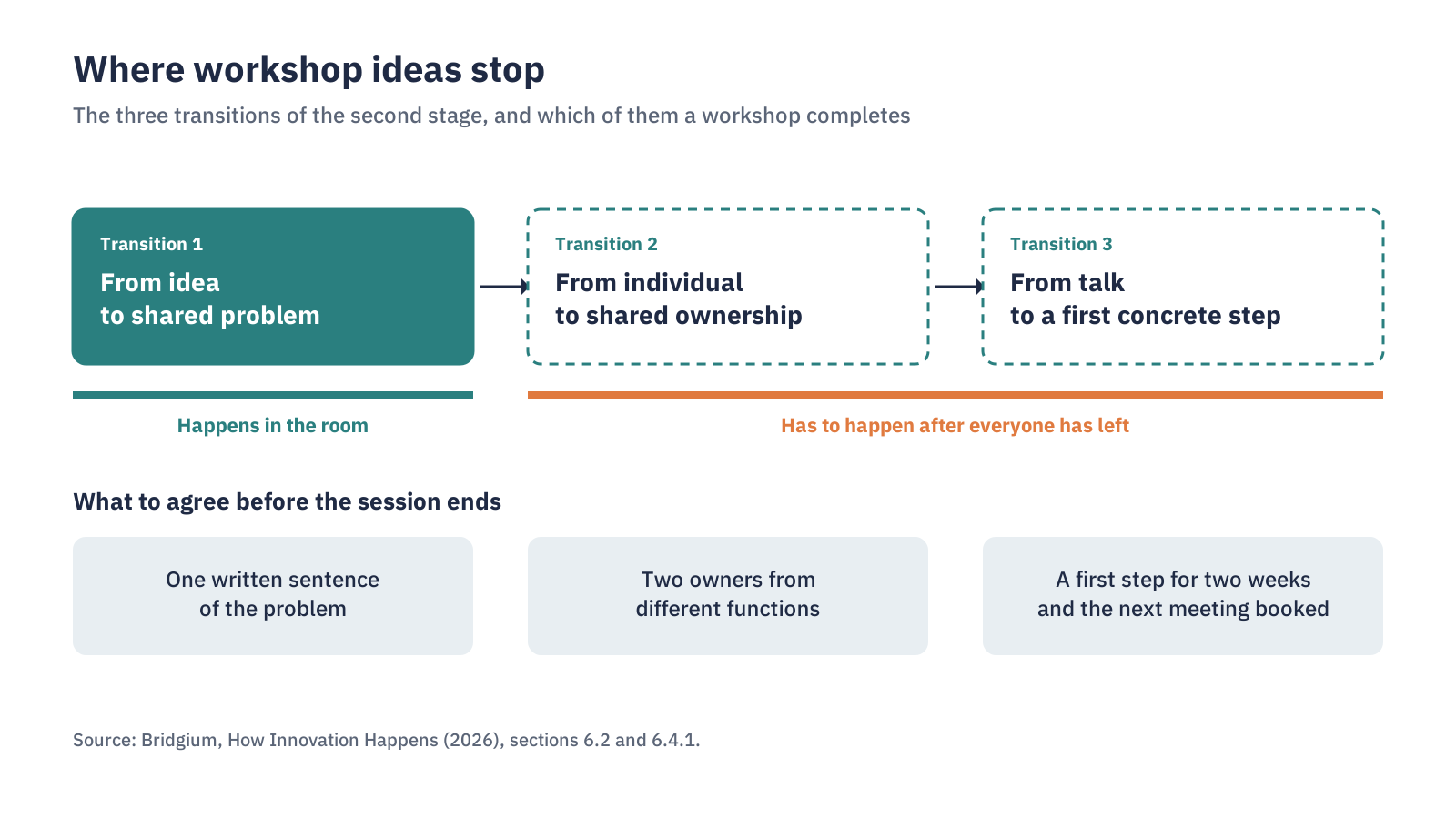
Figure 1. Where workshop ideas stop: the transition a workshop completes and the two that have to happen after it. Source: Bridgium, How Innovation Happens (2026), sections 6.2 and 6.4.1.
What breaks after the room empties: four mechanisms
The idea stays with the organiser. Section 6.2.2 of the report is direct on this point: ideas rarely survive when responsibility remains with a single individual, and shared ownership distributes both meaning and risk.
“The most impactful part is the network — it’s guidance, it’s talking, it’s others taking the idea further.”
Open Innovation Lead · Industrial Automation · Finland
A workshop creates the feeling of shared ownership without the substance. Everyone agreed, so in a sense everyone owns the outcome, and in practice nobody in particular does. John Darley and Bibb Latané’s experiments on diffusion of responsibility (1968) showed the underlying pattern in a very different setting: the more people who could act, the less likely any one of them was to do so. Bibb Latané, Kipling Williams and Stephen Harkins (1979) found a related effect in group work: people put in less effort when their individual contribution cannot be seen. An action list that says “the group will explore this further” describes exactly that situation. The organiser, who was already carrying the idea, ends up carrying it alone.
There is nothing others can work with. The same section describes what shared ownership looks like when it happens: others start referring to the idea, adapting it or integrating it into their own work. For that to happen, the idea needs a form that travels. Susan Leigh Star and James Griesemer (1989) described such forms as boundary objects: things that are flexible enough for each group to use in its own way and stable enough to keep a common identity across groups. A short problem statement, a rough sketch or a one-page outline can do this. A photograph of forty sticky notes rarely can, because it records the conversation without the reasoning that connected the notes. Paul Carlile’s ethnography of new product development (2002) adds why this matters most across functions: each department’s knowledge is local and invested in its own way of working, so an idea that crosses a boundary needs an object both sides can work on, or it stops at the boundary. Etienne Wenger (1998) calls the act of giving shared understanding a form “reification”, and stresses that it needs participation alongside it. A workshop is strong on participation and usually leaves reification for later.
The group waits for approval instead of taking a small step. Section 6.2.3 describes the last transition of the stage as the moment discussion leads to a first tangible step: a pilot, a prototype, an experiment or a defined project. The report adds that this step does not require full approval or scale. Interviewees describe early pilots as social proof, a signal that the idea is legitimate enough to exist in practice.
“At some point, you need to let people try. Otherwise it stays theoretical.”
Innovation & Strategy Lead · Telecommunications · Finland
“Pilots are not about success. They are about making the idea real enough to learn.”
Head of Innovation · Energy & Utilities · Finland
Karl Weick’s essay on small wins (1984) gives the reasoning behind this. A large problem framed as a whole tends to overwhelm the people facing it, while a concrete, completed outcome of modest size is something they can achieve, see and build on. Teresa Amabile and Steven Kramer’s diary studies of knowledge workers (2011) found that progress in meaningful work, including small steps forward, did more than anything else to lift motivation on a given day. A workshop that ends with three ideas and no first step leaves people with nothing to make progress on.
There is no next meeting. Section 6.4.1 summarises what keeps ideas alive at this stage: a repeatable space where people regularly share problems and ideas, and feedback loops that let an idea return for further discussion. Repetition is what allows meaning to stabilise and ownership to move from one person to a group. A workshop is, by design, a single event. Peter Gollwitzer’s research on implementation intentions (1999) points to the practical fix: plans that specify when and where an action will happen are carried out far more often than general intentions to act. “Let’s follow up” is a general intention. A meeting with a date in four people’s calendars is the specific version. The next meeting does not need to be long. Leslie Perlow, Constance Noonan Hadley and Eunice Eun (2017) report that executives already spend nearly 23 hours a week in meetings, so a thirty-minute check with the two owners and a clear question has a far better chance of happening than another half-day session.
| Mechanism | What you see a month later | Transition it blocks |
|---|---|---|
| The idea stays with the organiser | One person sends every reminder | Individual to shared ownership |
| Nothing others can work with | Several versions of what was agreed | Idea to shared problem |
| Waiting for approval | A request sits with a manager; nothing is tried | Talk to first concrete step |
| No next meeting | The group has not met since the workshop | All three, through lack of repetition |
Table 2. Four mechanisms that stop an idea after a workshop. Source: derived from Bridgium, How Innovation Happens (2026), sections 6.2 and 6.4.1.
There is also a simpler reason the month after gets less attention than the day itself. The workshop is visible: it has an agenda, attendees and photographs, and it can be reported. The follow-up work is spread across several people’s ordinary weeks and appears in nobody’s objectives. Jeffrey Pfeffer and Robert Sutton (1999) describe the general pattern as the smart-talk trap: organisations tend to reward people for talking well about a problem rather than for doing something about it, and a good discussion starts to feel like progress in itself. An organisation that counts workshops held and hopes for ideas carried forward tends to get more workshops.
The report’s word for what the second stage needs is objectivation: a meaning that starts in individual heads becomes something that exists independently of them, which others can see, refer to and act on. A workshop is a strong start on that process and a weak finish. The day itself produces agreement. The weeks after it are where the idea either becomes an object other people can work with or remains a memory of a good afternoon.
How to check this in your own organisation
Five questions show whether workshops in your organisation complete the second stage or only begin it:
- Think of the last three workshops you attended. For each one, can you name the person who now owns the idea that came out of it, and is it someone other than the organiser?
- Could two participants from different departments write down the agreed problem in one sentence each and produce recognisably the same sentence?
- Did anything get tried within a month: a small test, a mock-up, a conversation with a customer?
- Was the next meeting scheduled before people left the room?
- When the last workshop idea faded, did anyone decide to stop it, or did it simply stop?
| Signal | What it usually indicates |
|---|---|
| Workshop outputs are photographs of walls | Nothing was produced that others can work with |
| Follow-up emails get fewer replies each time | Ownership has stayed with the sender |
| Ideas resurface in the next workshop under new names | The previous round never reached a first step |
| Participants rate the sessions highly and cannot name an outcome | The first transition is working and the other two are not |
Table 3. Signals that workshops stop at the first transition. Source: derived from Bridgium, How Innovation Happens (2026), section 6.
The Nordic dimension
Nordic organisations bring real strengths to the first transition. Section 6.1 of the report describes the space this stage needs: small, non-hierarchical groups, synchronous dialogue with immediate feedback, and a high degree of autonomy. Respondents from Finland and Denmark describe exactly this kind of conversation, and several prefer meeting in person because meaning settles faster when people can react to each other directly.
The same strengths carry a risk. Our reading of the data, which goes beyond what the report states directly, is that a culture good at conversation in the room can be weak at carrying meaning out of it. When groups are trusted to organise themselves, nobody outside the group is expected to pick up what it produced. When the understanding was built face to face, very little of it was written down. The report notes that digital tools help stabilise an idea after meaning has begun to form, and that used at the right moment they help ideas persist. The hour after a good workshop is precisely that moment, and it is usually the hour everyone spends travelling back to their own work.
The structural response
- Name two owners before the session ends. Two people, from different functions, who will carry the idea for the next month. One owner reproduces the organiser problem. Two from different departments start the shift to shared ownership the report describes in section 6.2.2.
- Leave with one sentence of the problem, written down. Before people leave, the group agrees a single written statement of the problem, short enough to repeat to someone who was not there. This is the simplest form of an object others can work with, and it protects the first transition from fading into several private versions.
- Agree a first step that fits in two weeks and needs no approval. A conversation with three customers, a mock-up, a test on one line or one team. Section 6.2.3 is clear that the first concrete step does not require full approval or scale. Its purpose is to make the idea real enough to learn from.
- Put the next meeting in the calendar before anyone leaves the room. A date, a time and the two owners as hosts. Section 6.4.1 links survival at this stage to repetition and feedback, and a meeting that already exists is far more likely to happen than one that someone intends to arrange.
Conclusion
A workshop that produces energy and nothing else has usually done its own job well. It completed the first transition of the second stage, turning separate observations into a shared problem. The difficulty is that the remaining two transitions were assumed to follow on their own, and they depend on things a workshop does not produce: an owner beyond the organiser, an object others can use, a first step and a next meeting.
The cost is easy to miss because nothing visibly fails. The idea is not rejected. It thins out over a few weeks of unanswered emails, and the next workshop starts from a blank wall with some of the same people in the room.
The fix is mostly a matter of what happens in the last twenty minutes of the session, rather than in the weeks after it. Name the owners, write the sentence, agree the step and book the meeting before the room empties. Then look back at your last workshop and ask one question: who, apart from the person who organised it, is carrying its idea today?
If you want to see which of these transitions stalls in your own organisation, Find the Gap maps the four conditions of the Innovation Flow through interviews across departments and shows where new ideas and practices lose momentum.
References
- Bridgium (2026). How Innovation Happens: Insights from Leading Enterprises in Times of Change.
- Sutton, R. I. and Hargadon, A. (1996). Brainstorming groups in context: Effectiveness in a product design firm. Administrative Science Quarterly, 41(4), 685–718.
- Darley, J. M. and Latané, B. (1968). Bystander intervention in emergencies: Diffusion of responsibility. Journal of Personality and Social Psychology, 8(4), 377–383.
- Latané, B., Williams, K. and Harkins, S. (1979). Many hands make light the work: The causes and consequences of social loafing. Journal of Personality and Social Psychology, 37(6), 822–832.
- Star, S. L. and Griesemer, J. R. (1989). Institutional ecology, ‘translations’ and boundary objects: Amateurs and professionals in Berkeley’s Museum of Vertebrate Zoology, 1907-39. Social Studies of Science, 19(3), 387–420.
- Carlile, P. R. (2002). A pragmatic view of knowledge and boundaries: Boundary objects in new product development. Organization Science, 13(4), 442–455.
- Wenger, E. (1998). Communities of Practice: Learning, Meaning, and Identity. Cambridge University Press.
- Weick, K. E. (1984). Small wins: Redefining the scale of social problems. American Psychologist, 39(1), 40–49.
- Amabile, T. M. and Kramer, S. J. (2011). The power of small wins. Harvard Business Review, May 2011.
- Gollwitzer, P. M. (1999). Implementation intentions: Strong effects of simple plans. American Psychologist, 54(7), 493–503.
- Perlow, L. A., Hadley, C. N. and Eun, E. (2017). Stop the meeting madness. Harvard Business Review, July–August 2017.
- Pfeffer, J. and Sutton, R. I. (1999). The smart-talk trap. Harvard Business Review, May–June 1999.