

Nobody brings you problems any more
- The symptom: it has gone quiet, and quiet looks like fine
- The usual explanation, and why it does not hold
- What is missing: four signals that make speaking reasonable
- How to check this in your own organisation
- The structural response
- Conclusion
- References
Silence is a reasonable answer to a set of missing signals, and it accumulates without anyone having refused anything.
The symptom: it has gone quiet, and quiet looks like fine
The suggestion channel has had nothing in it for two quarters. Team meetings run on time. When you ask whether anything is in the way, people say it is manageable. The problems you do hear about arrive from a customer, an auditor or a quarterly report, and when they arrive it turns out that several people had seen them coming for months.
The test that makes this concrete takes one minute and no preparation. Think back over the past three months and find the last time somebody brought you an uncomfortable piece of news that you had not asked for. If that example is hard to locate, or if the person who brought it was the same person who always does, the organisation has stopped using you as a destination for problems.
Our first study places this at the first stage of the Innovation Flow, the point at which something noticed becomes something said. Ideas exist for a long time as noticing, irritation, curiosity or concern, and what separates organisations is whether conditions let any of it be articulated at all. People continuously assess whether speaking up is worth it: whether the problem will be taken seriously, whether raising it is legitimate, and whether anything will happen next.
This article is about legitimacy at the level of an individual employee deciding whether to open their mouth. An earlier piece in this series looked at legitimacy for an innovation function trying to obtain a budget. The condition has the same name in both cases and operates on a different scale, through different mechanisms, which is why the remedies do not transfer between them.
The usual explanation, and why it does not hold
The standard reading of a quiet organisation is disengagement. People have stopped caring, the argument goes, so the answer is a campaign: an innovation day, a hackathon, a new suggestion platform, a message from leadership about how much ideas are valued.
Our interviews point to something else, and the wording in the report is unusually direct. Blockers to articulation are rarely explicit. More often they take the form of weak or missing signals that would have made speaking up reasonable, and under those conditions silence is a rational response to uncertainty rather than resistance or disengagement.
Read that as an instruction about where to look. A person who stays quiet has usually made a sound judgement with the information available to them. If raising a half-formed problem is likely to be assessed by the same standards as this quarter’s delivery, if it is unclear whether anyone is expecting it, and if nothing visible follows from the last time somebody tried, then silence is the choice that costs least. Campaigns do not change any of those three facts, which is why the effect of an innovation day usually lasts about as long as the catering.
There is a second finding that explains why the shift went unnoticed. When articulation is not acknowledged or given feedback, people adjust their behaviour over time: they stop raising issues, or they limit what they say to what is formally required. Our study describes the result precisely. Silence accumulates gradually rather than through explicit rejection.
Nobody was told no. There was no moment to point at, no incident, no decision. The organisation simply moved from one state to another over a couple of years, and the only record of the transition is an absence.
What is missing: four signals that make speaking reasonable
Our first study sets out the conditions that make articulation possible and the blockers that mirror them from the other side. Taken together they describe four signals a person looks for, mostly without noticing that they are looking.
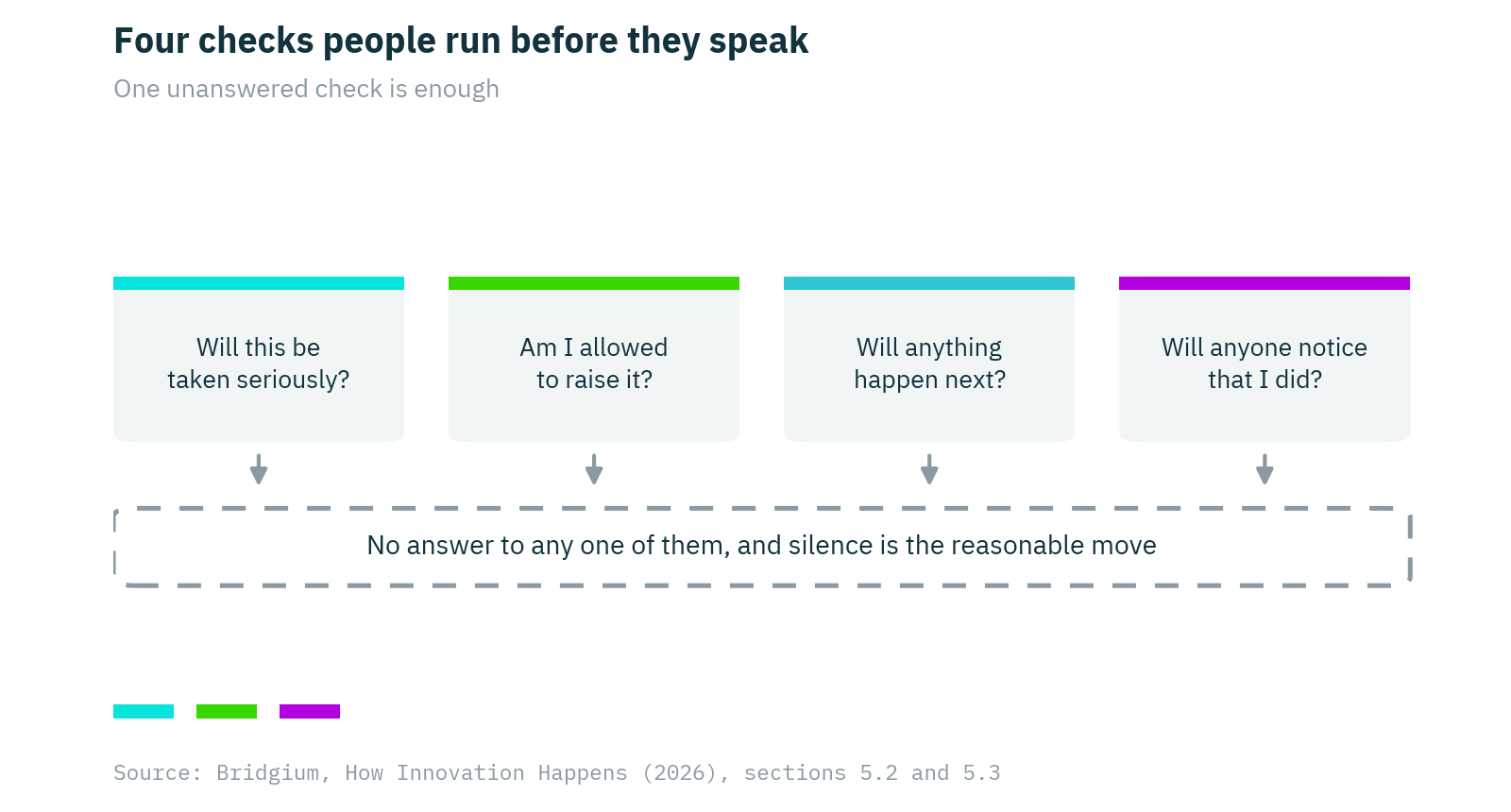
Figure 1. The checks that precede speaking up, and the effect of leaving one unanswered. Source: Bridgium, How Innovation Happens (2026), sections 5.2 and 5.3.
Will this be taken seriously, or judged as routine work?
When innovation is evaluated through the same logic as routine execution, early articulation is filtered out before it happens. Where efficiency, delivery and short-term performance dominate, an incomplete idea fails the routine criteria before anybody has said it out loud, because the person doing the saying can predict the verdict.
“Innovation is often seen as extra work. People don’t really have time to think”
Director · Energy & Utilities · Finland
Am I allowed to raise it?
Formal restrictions are rarely the problem. Informal norms do the work instead. Without explicit legitimation, raising a problem can feel like creating one, or like breaking a rule nobody has written down, and in that situation staying quiet is how a person remains aligned with what is expected of them. The fear attached to it is usually practical rather than political.
“Resistance to change often comes from fear of extra workload or disruption.”
Innovation Lead · Telecommunications · Finland
Will anything happen next?
A clear pipeline is what turns raising a problem into part of expected work rather than a personal initiative. Our study distinguishes two things that are easy to confuse: leadership signals legitimise why speaking up is allowed, and pipelines legitimise how it is done. A pipeline is a set of rules, meaning defined steps, criteria, roles and decision points that make the path of an idea visible. With one in place, a person knows where the idea goes, who assesses it and what outcomes are possible, and speaking up stops being an act of individual exposure.
Will anyone notice that I did?
Recognition does two things at once in our findings. It validates speaking up as real work, and it sustains the effort past the first attempt, which keeps the second and third idea alive. Where it is absent, the first contribution may still arrive, and the fourth one will not.
“Innovation without recognition becomes invisible work”
CEO · IT Services · Finland
| What is missing | How it works | What it looks like from outside |
|---|---|---|
| Separation from routine logic | Incomplete ideas are measured against delivery criteria | Only finished proposals are ever raised |
| Explicit legitimation | Informal norms make raising a problem feel like causing one | Concerns arrive privately, after the meeting |
| A visible pipeline | Nobody can say where an idea goes or who decides | People ask who to talk to, then do not |
| Recognition and feedback | Articulation is unacknowledged, so behaviour adjusts | The same two people contribute, and nobody else |
Table 1. The four missing signals and their visible effects. Source: Bridgium, How Innovation Happens (2026), sections 5.2 and 5.3.
The academic reading
Albert Hirschman’s account of how people respond to decline gives the clearest frame for what is happening. He separates three responses: exit, which is leaving; voice, which is saying something; and loyalty, which holds a person in place while they decide between the first two. Voice is the expensive option, because it requires the person to believe that speaking will change the outcome. Where that belief is absent, the choice narrows to leaving or staying without saying anything, and an organisation with low turnover and no complaints has usually ended up with the second.
Peter Berger and Thomas Luckmann supply the mechanism underneath the first stage of our framework. Externalisation is the point at which something private is put into words and becomes available to others, and until it happens there is nothing for the organisation to work with. A problem that stays inside one person’s head is, for every practical purpose, a problem the organisation does not have. There is also a direct line of research on this question in management studies, under the name of organisational silence, which examines what employees decline to communicate upward and why.
How to check this in your own organisation
Five questions. The first one is the diagnostic.
- When did somebody last bring you a problem you had not asked about, and what visibly happened to that person afterwards? If the honest answer to the second half is nothing, the rest of the organisation drew its conclusion at the same time you did.
- Where does a half-formed observation go in this organisation, and can three people in different teams name the same destination? A pipeline that exists on a slide and not in people’s heads is not a pipeline.
- Is there any time in the week that is protected from delivery pressure and used for discussing problems before solutions are expected? A regular slot that survives a busy month, which a workshop once a quarter does not provide.
- Who contributed to the last three improvements, and how many distinct names are on that list? A short list is the recognition problem showing up as a participation pattern.
- What happened to the last idea that was raised and then declined? A documented no with a reason sustains the next contribution. A silent disappearance ends it, and it ends several others belonging to people who were watching.
| What you observe | What is usually assumed | What to check instead |
|---|---|---|
| The suggestion channel is empty | People have nothing to suggest | Where the last suggestion went and what came back |
| Problems arrive from outside the company | The issue was hard to see internally | How long it had been visible to the people closest to it |
| Concerns are raised privately after meetings | Those people are conflict-averse | What happened the last time a concern was raised in the room |
| The same two people always contribute | They are the engaged ones | Whether anyone else received a response the first time |
| A campaign produced a burst, then nothing | Enthusiasm faded | What followed the ideas the campaign collected |
Table 2. Symptoms of accumulated silence and the checks that locate its cause. Source: Bridgium analysis based on How Innovation Happens (2026), section 5.
The Nordic dimension
The advantage is access. Low hierarchy means the distance between noticing a problem and reaching the person who could act on it is short, and an employee can raise something with a director without an intermediary or an appointment. Our interviews reflect this in how respondents describe horizontal structures.
“Communities are important because they are not based on hierarchy.”
Director, Innovation Communities · Engineering & Consulting · Denmark
The risk is that access alone produces nothing. Where speaking is easy, the reason to speak carries the whole weight, and that reason is the pipeline, the protected time and the response. A Nordic organisation with an open door and none of those three gets the same silence as a hierarchical one, and it gets there without any of the usual warning signs, because nobody can point at a barrier.
Noted as an inference. Our study does not separate Nordic respondents into their own cut of the data, so the pairing above is read from the interview base as a whole rather than from a regional comparison.
The structural response
Four changes, taken from the enabling conditions our first study identifies. None of them is a campaign.
- Publish the pipeline, including the possible outcomes. Defined steps, criteria, roles and decision points, written where people can read them. This is what converts raising a problem from personal exposure into a recognised organisational practice, and it is the cheapest of the four to put in place.
- Protect time, and say what it is for. Allocating time for reflection legitimises innovation work as part of the job rather than as an extra task. It separates exploration from execution, and it signals that incomplete thinking is acceptable before a decision is required.
- Respond to every contribution, including the ones you decline. A reasoned no sustains the next attempt. Silence in response to an attempt teaches everyone watching that the attempt was not worth making, and the lesson spreads further than the original idea would have.
- Keep a horizontal space where problems can be named before they are solved. Open peer communities let people test language, relevance and meaning together, with responsibility shared rather than carried by one person. Our study also finds these spaces hold learning over time, so earlier discussions remain visible and can be picked up again.
The fourth one has a cost that is worth stating plainly, because leaving it unsaid is what usually kills the practice in its second month.
“When people spend time in communities or innovation activities, they are not solving day-to-day customer problems — and they need to be allowed to do that.”
Innovation Leader · Engineering & Infrastructure · Denmark
Conclusion
An organisation where nobody raises problems looks, from the inside, like an organisation without many problems. That is the difficulty with this particular failure. Every other condition announces itself: a stalled pilot, a missed budget line, a handover that takes a week. Silence produces no event at all, and the quarter in which it became permanent is indistinguishable from the one before it.
What the research describes is also what makes the situation recoverable. If silence is a reasonable response to missing signals, then supplying the signals changes the calculation, and it changes it for people who never stopped noticing things. The ideas did not leave the building. They stopped being said out loud, which is a different problem with a cheaper fix.
So the question to take into your next team meeting is a short one, and the answer will probably take a few seconds longer than feels comfortable. When was the last time someone told you something you did not want to hear, and what did it get them?
The findings above come from How Innovation Happens: Insights from Leading Enterprises in Times of Change (2026), a Bridgium study based on 28 interviews with innovation and transformation leaders in Northern Europe. Section 5 covers the articulation stage in full, including the enabling conditions and blockers discussed here. The report is available at bridgium-research.eu/innovation-report-2026
References
- Bridgium (2026). How Innovation Happens: Insights from Leading Enterprises in Times of Change, section 5.
- Bridgium (2026). From Discovery to Practice: How Corporate–Startup Collaboration Becomes Usable.
- Hirschman, A. O. (1970). Exit, Voice, and Loyalty: Responses to Decline in Firms, Organizations, and States. Harvard University Press.
- Milliken, F. J., Morrison, E. W. & Hewlin, P. F. (2003). An Exploratory Study of Employee Silence. Journal of Management Studies, 40(6).
- Berger, P. L. & Luckmann, T. (1966). The Social Construction of Reality. Penguin.
- Weick, K. E. (1995). Sensemaking in Organizations. Sage.
- Kerr, S. (1975). On the Folly of Rewarding A, While Hoping for B. Academy of Management Journal, 18(4).
- March, J. G. (1991). Exploration and Exploitation in Organizational Learning. Organization Science, 2(1).
- Granovetter, M. S. (1973). The Strength of Weak Ties. American Journal of Sociology, 78(6).
- Cohen, W. M. & Levinthal, D. A. (1990). Absorptive Capacity: A New Perspective on Learning and Innovation. Administrative Science Quarterly, 35(1).
- Nonaka, I. & Takeuchi, H. (1995). The Knowledge-Creating Company. Oxford University Press.
- Stinchcombe, A. L. (1965). Social Structure and Organizations. In J. G. March (ed.), Handbook of Organizations.