

Startups can’t solve a problem you never told them about
- The symptom: forty follow-ups and no problem to match them to
- The usual explanation, and why it does not hold
- Where entry breaks: three gaps and four conditions
- How to check this in your own organisation
- The structural response
- Conclusion
- References
Many corporate and startup collaborations fail at the very first step, long before a pilot, because the company never makes its real problems visible, and our research shows that more events, scouting and platforms add contacts faster than they add matches.
The symptom: forty follow-ups and no problem to match them to
On the Friday after a busy startup event week in Helsinki, an innovation manager at a large industrial company walks back to the office with a stack of business cards in her coat pocket. Over three days she has listened to pitches on stage, had coffee with founders in the corridors and promised many of them a follow-up. By Monday there are forty follow-up emails in her inbox, most with a deck attached.
She tries to match each one to a business unit, and it does not work. One founder offers analytics for energy use, another a platform for supplier sustainability data, a third an AI assistant for field service. Each is plausible. None touches what the units are struggling with this year: a spare parts forecast that keeps missing at one plant, or a commissioning process that runs weeks over on customer sites. Those problems were never mentioned at the event, because they have never been written down anywhere a founder could read them. When founders asked what the company was looking for, she pointed to the two strategy themes printed on the stand, digitalisation and sustainability.
The founders did their homework and the manager did her job. Both sides came away with more contacts than they can follow up and almost no matches. The collaboration failed before it began, at a point most companies never measure.
This is the first of four articles on our second study, From Discovery to Practice: How Corporate-Startup Collaboration Becomes Usable. It is based on 48 qualitative interviews: 28 with innovation leaders and senior practitioners in large Nordic and European corporations, conducted between September and December 2025 for our previous study, How Innovation Happens, and 20 with founders and senior representatives of startups and SMEs that work with corporates. The study focuses on Finland, Sweden, Denmark, Norway and the Netherlands, with selected input from Central Europe. It is qualitative and looks for recurring patterns. Of the three stages of the Innovation Flow it follows, Entry / Access, Translation / Pilot Exploration and Integration / Embedding, this article stays with the first: the moment when a company and a startup try to find each other.
The usual explanation, and why it does not hold
Since Henry Chesbrough’s book Open Innovation (2003), most large companies accept that useful ideas can come from outside and that a firm should use external paths to new technology alongside its own research. Scouting teams, event stands and matching platforms follow from that idea. When the results disappoint, the usual diagnosis is volume: the company has not met enough startups, so it adds another event or another platform. More exposure, the reasoning goes, should mean more matches.
Our study points in a different direction. At the entry stage, the report finds that the main breakdown occurs when corporate needs are unclear, ecosystem visibility is fragmented and the two sides communicate through different logics (section 5). Under these conditions extra exposure produces proposals faster than it produces matches. The report calls the result a noise effect: corporates receive large volumes of loosely relevant proposals, while startups struggle to identify real corporate needs. In the report’s words, “Interaction increases, but alignment does not.”
Eric von Hippel’s paper on sticky information (1994) explains why volume cannot fix this. Some information is costly to acquire, move and use in a new setting, and von Hippel calls it sticky. When the sticky information sits at one site, problem solving tends to happen there. A corporate problem is made of exactly this kind of information: the plant data behind a forecast that misses, the operating constraints on a customer site, the history of what has already been tried. A founder on the other side of an event hall holds none of it. Whatever the founder proposes is a guess made from outside, and inviting more founders produces more guesses.
Where entry breaks: three gaps and four conditions
The report describes three gaps at the entry stage (sections 5.1 to 5.3) and then reads them through the four Innovation Flow conditions: legitimacy, predictability, connectivity and innovation memory.
The transparency gap: the problem stays inside
Section 5.1 starts from a simple observation. Corporates work with defined strategies, priorities and internal problem spaces, and these remain largely implicit and inaccessible to external actors. Startups therefore operate on signals: a press release, a keynote, the theme of an open call. A sales leader described it from the startup side:
“Corporates… don’t really tell you about their problems… only when you are already in.”
Sales Leader · IT Services · Finland
The problem is revealed after the startup has got in, while the startup needed it in order to get in. Corporate respondents see the same gap: one pointed to the lack of open, accessible collections of corporate research questions.
Research on broadcast search shows what changes when the problem is disclosed. Lars Bo Jeppesen and Karim Lakhani studied 166 science challenges posted to more than 12,000 outside scientists (2010). Winning solutions were more likely to come from solvers whose expertise lay further from the field of the problem, and the authors argue that disclosing a problem lowers the barriers to entry for contributors nobody would have thought to ask. Allan Afuah and Christopher Tucci (2012) make a related argument in theory: under certain conditions, broadcasting a problem turns distant search into local search for the firm, because those who already hold relevant knowledge can recognise the problem as theirs. Both studies start from a problem that has been written down and made public. In the event week of our opening scene, that first step never happened.
The language gap: business case and product vision
The second gap is about meaning. Section 5.2 describes corporates framing opportunities through business value, integration and risk, while startups communicate through product capabilities, innovation potential and vision, often in language first written for investor pitch decks. Each side works within a different logic of value, so communication turns into translation. An open innovation lead recalled one meeting:
“I didn’t even understand what they were talking about… What are you looking for?”
Open Innovation Lead · Industrial Technology · Germany
The question at the end is the one a corporate listener asks when nothing in a pitch connects to a problem they recognise. Often the startup cannot answer it well, because nobody has described the problem to them, and the meeting ends with goodwill and no next step.
Hila Lifshitz-Assaf’s field study at NASA (2018) shows that the receiving side of this exchange is harder to move than it looks. R&D professionals tend to guard the boundaries of their discipline and often reject good ideas that come from outside their field. At NASA, open innovation produced a breakthrough quickly and cheaply, yet only the professionals who reworked their sense of their own role took up the outside solutions. A proposal written in a startup’s language lands with internal experts who already have their own way of describing the problem. Unless someone on the corporate side has framed the question in terms both sides can read, the expert’s default response is polite indifference.
The visibility gap: access runs through networks
The third gap concerns who can find whom. Section 5.3 finds that entry into collaboration is socially mediated: connections form through recurring events, informal exchanges and introductions within existing networks. Local ecosystems help those already inside, and they also split information across small communities. An innovation manager described it this way:
“…small groups and communities are competing with each other… that stops the flow of information.”
Innovation Manager · Urban Development · Finland
Digital matching platforms are the common answer to fragmentation, and the report finds that they play only a limited role. They increase exposure, but interviews suggest they rarely provide the trust, contextual understanding or translation that alignment needs. One respondent was frank about the result:
“There are so many tools… platforms… we are trying different things… but I’m not super convinced… if it’s really worth the cost.”
Open Innovation Lead · Industrial Technology · Germany
Keld Laursen and Ammon Salter’s study of UK manufacturing firms (2006) found that searching widely and deeply across external sources improves innovation performance only up to a point, after which additional breadth and depth go together with lower performance. Christian Terwiesch and Yi Xu’s model of innovation contests (2008) shows that a larger pool of outside solvers can still benefit a firm, because it produces a more diverse set of solutions. Their contest, however, begins with the firm posting a defined technical problem and an award for the best solution. A platform that collects startup profiles without a posted problem offers the size of the pool and none of the structure that makes it useful.
| Gap | On the corporate side | What the startup experiences | Effect at entry |
|---|---|---|---|
| Transparency gap (5.1) | Strategies, priorities and problem spaces exist but stay internal | Works from signals: press releases, keynotes, themes of open calls | Proposals aimed at guessed problems |
| Language gap (5.2) | Frames opportunities through business value, integration and risk | Pitches product capability and vision, often in investor language | Each side translates, and neither is sure what the other means |
| Visibility gap (5.3) | Relies on trusted intermediaries, known partners and local events | Without network access, finds it hard to be found or to reach a problem owner | Noise effect: many loosely relevant proposals, few real matches |
Table 1. Three gaps that shape the entry stage of corporate and startup collaboration. Source: Bridgium and Albimarketing, From Discovery to Practice (2026), sections 5.1 to 5.4.
What the gaps do to the four conditions
Section 5.4 sums up the entry stage as communication that produces interpretation where alignment was intended. Section 5.5 then applies the four conditions from our earlier study, How Innovation Happens.
Legitimacy stays weak when corporate innovation questions are not stated in explicit and operational terms. The report draws a distinction that matters here: whether the company is looking for exploration, meaning joint problem framing and solution development, or for the embedding of a ready solution into existing operations. Without that distinction, startup approaches tend to be filed as interesting ideas, with no visible link to a recognised priority, an operational problem space or an expected stage of collaboration.
Predictability is low on both sides because intake processes, evaluation criteria and next steps are not visible. From the first meeting, neither side can tell whether the conversation will progress, stall or disappear without feedback. Connectivity is held back by fragmented ecosystems, where access depends on personal networks and local hubs and shared dialogue spaces are scarce. Innovation memory is weak when earlier contacts, scouting attempts and challenge definitions are neither kept nor searchable, so both sides restart the matching process each time.
Teppo Felin and Todd Zenger (2014) offer a way to see why these four conditions hang together. They take the innovation problem as the unit of analysis and argue that different types of problem call for different ways of organising the search for solutions, from markets, partnerships, contests and user communities to internal hierarchy. Their framework assumes that the firm knows which problem it is trying to govern. At the entry stage, as our respondents describe it, that assumption often fails.
| Condition | What corporates need to provide | What startups need to provide |
|---|---|---|
| Legitimacy | Clear innovation questions and problem areas that show why external collaboration matters | An explanation of the solution in corporate terms: the problem addressed, operational relevance and expected value |
| Predictability | Transparent entry pathways, contact points, evaluation criteria, decision steps and possible outcomes | A clear picture of solution maturity, readiness, required resources, timelines and commitment |
| Connectivity | Access through open networks, communities, events, hubs and cross-functional interfaces | Relationships across the ecosystem and active dialogue with problem owners and sponsors |
| Innovation memory | Visible knowledge bases, challenge repositories, pilot records and feedback loops | Reuse of feedback, references and pilot learning to refine the solution and improve fit |
Table 2. What each Innovation Flow condition asks of both sides at the entry stage, in shortened wording. Source: Bridgium and Albimarketing, From Discovery to Practice (2026), section 5.6, Table 3.
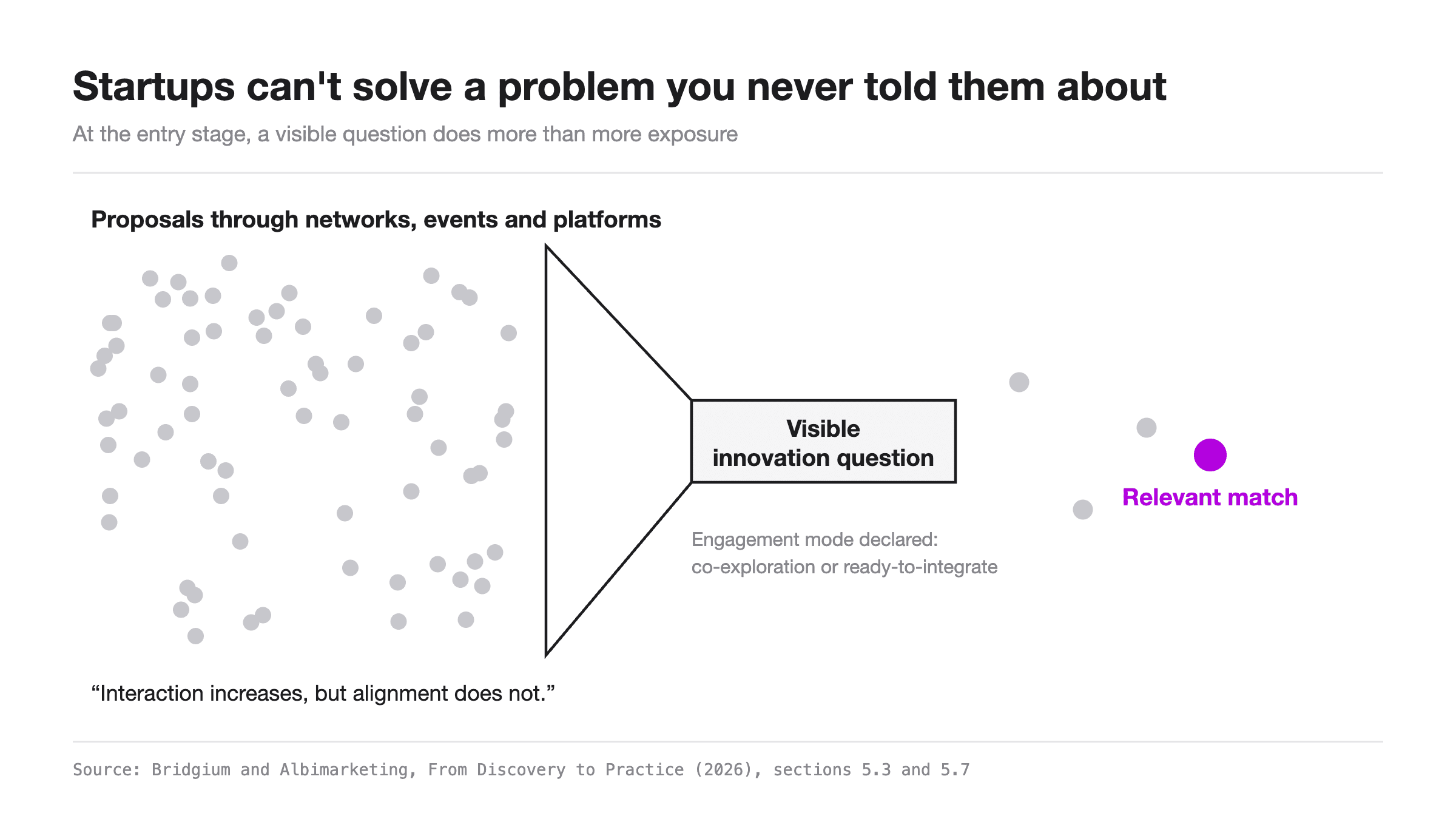
Figure 1. The noise effect at entry: large volumes of loosely relevant proposals arrive, and only a visible innovation question lets the relevant few through to a match. Source: Bridgium and Albimarketing, From Discovery to Practice (2026), section 5.3.
Most corporate requirements in Table 2 cost little money. They ask the company to write things down and make them visible. The obstacle is ownership: innovation teams own the events, business units own the problems, and the translation falls between them.
How to check this in your own organisation
Companies count startups met and pilots started, and rarely the first contacts that reached the person who owns the problem. Five questions help show whether your entry stage produces matches or noise:
- If a founder asked you today which problem your company would most like help with, could you answer in two sentences that make sense to someone outside the building?
- Of the startup conversations from your last event week, how many reached a person in a business unit who owns a problem the startup could address?
- Does your open call, website or event material say whether you are looking for co-exploration or for a solution that is ready to integrate?
- How would a capable startup with no contacts in your region find the right person to talk to?
- When a startup gets in touch, can it see what happens next, who decides and roughly how long that takes?
| Signal | What it suggests | First step |
|---|---|---|
| Follow-ups from events pile up and few reach a business unit | Proposals are being collected without a problem to match them against | Choose one problem from one business unit and describe it in a paragraph an outsider can understand |
| Founders who ask what you are looking for receive the strategy themes | The innovation question is not articulated in operational terms | Turn one theme into a concrete problem with its context and the type of expertise needed |
| Most startup contacts arrive through the same few people and events | Access depends on networks, and connectivity rests on individuals | Publish a contact point and the dialogue formats where startups can meet problem owners |
| A paid platform brings more applications and no more pilots | Exposure is rising without translation | Add a step in which a problem owner reads and answers a short list of proposals |
| A second unit approaches the same startup a year later with no record of the first contact | Innovation memory is weak at entry | Keep one shared log of contacts, challenge definitions and outcomes |
Table 3. Signals of a weak entry stage, what they suggest and where to start. Source: derived from Bridgium and Albimarketing, From Discovery to Practice (2026), sections 5.5 to 5.7.
The Nordic dimension
The strength of the Nordic context is the density of local ecosystems. Respondents describe regions where, after a while, you know the people working on the same questions. Trust lowers the cost of a first contact, and a founder who is already known can reach a real problem owner quickly.
The risk is the other side of the same density. When problems travel by word of mouth, access depends on being inside the circle. The Finnish respondent quoted above saw small groups and communities competing with each other and stopping the flow of information, and the report notes that startups without network access remain difficult to discover. Founders arriving from elsewhere meet a well connected ecosystem that offers them very little in writing. Our reading, which goes beyond what the report states directly, is that the informal openness of Nordic ecosystems can make a written, visible innovation question seem unnecessary to those inside it, while it is exactly what outsiders need, including the international startups that large events in the region attract each year.
The structural response
Section 5.7 of the report argues that filtering at the entry stage does not mean closing access too early. The stronger practice is to combine openness with structure: make the problem area visible, invite external interpretation and then filter opportunities against relevance, strategic fit and a possible integration pathway. It names four actions for leaders.
- Write the innovation question so that an outsider can read it. State the problem area in externally understandable terms: the context, why external collaboration matters and the type of expertise needed. Linus Dahlander and David Gann’s review of openness (2010) separates inbound processes, sourcing and acquiring, from outbound ones, revealing and selling. Writing down a problem is a small act of revealing, and the report shows it can be done without exposing confidential strategy: a company can describe the direction, the expertise it needs and its decision steps.
- Say which engagement mode you are offering. Define upfront whether the company invites co-exploration or is looking for a solution ready to integrate. The report describes clearly formulated problem statements and an explicit engagement mode as an early alignment filter, which helps startups see where they fit and helps corporates reduce noise. Tobias Weiblen and Henry Chesbrough (2015) identified four models that large technology companies use to engage startups, each balancing speed and agility against control and strategic direction. Kevin Boudreau and Karim Lakhani (2013) make the same point for crowds: the problem should decide which format to use.
- Make contacts and dialogue spaces visible beyond closed networks. Name a contact point for each problem area and publish the formats where startups can meet problem owners, such as recurring ecosystem meetings, challenge sessions or thematic calls. Then a capable founder without an introduction also has a route in.
- Make evaluation and decision steps transparent. Tell every startup what happens after first contact, which criteria apply, who decides and roughly when. A clear no, given early, saves the startup months and leaves a record the next unit can find.
The report is equally direct about the startup side (section 5.8). Active exploration is often necessary, but it should not become endless searching inside unclear corporate systems. Startups are advised to qualify an opportunity early: to clarify who owns the problem, who decides and what budget logic shapes continuation; to understand whether the corporate is exploring or ready to implement, and how IP is treated; to ask what counts as success at the next stage and who funds it; and to translate the solution into business, operational and integration terms. The best startups will ask these questions anyway, and move on when the answers are vague.
Conclusion
When startup collaboration produces little, the instinct is to widen the funnel. Our study suggests that at the entry stage the funnel is rarely too narrow. Corporate problem spaces stay implicit, access runs through local networks and events, and platforms add exposure without adding translation. The result is the noise effect the report describes: more proposals, more meetings and more follow-ups, with no more alignment than before.
The remedy is modest in cost and demanding in discipline. It asks a company to write down a few real problems in language an outsider can read and to say what happens next. None of this exposes strategy. It does require someone inside to do the translation that each founder now attempts from the outside.
Had the manager in our opening scene walked into the event week with three problems written down, the conversations would have started somewhere else. If a founder stopped you in a corridor this week and asked what your company is looking for, which real problem could you name?
If you want to see where new ideas lose momentum in your organisation, from the first contact onwards, Find the Gap maps the four Innovation Flow conditions through interviews across departments and shows where new ideas and practices stall.
References
- Bridgium and Albimarketing (2026). From Discovery to Practice: How Corporate-Startup Collaboration Becomes Usable.
- Chesbrough, H. W. (2003). Open Innovation: The New Imperative for Creating and Profiting from Technology. Harvard Business School Press.
- von Hippel, E. (1994). “Sticky information” and the locus of problem solving: Implications for innovation. Management Science, 40(4), 429-439.
- Jeppesen, L. B. and Lakhani, K. R. (2010). Marginality and problem-solving effectiveness in broadcast search. Organization Science, 21(5), 1016-1033.
- Afuah, A. and Tucci, C. L. (2012). Crowdsourcing as a solution to distant search. Academy of Management Review, 37(3), 355-375.
- Lifshitz-Assaf, H. (2018). Dismantling knowledge boundaries at NASA: The critical role of professional identity in open innovation. Administrative Science Quarterly, 63(4), 746-782.
- Laursen, K. and Salter, A. (2006). Open for innovation: The role of openness in explaining innovation performance among U.K. manufacturing firms. Strategic Management Journal, 27(2), 131-150.
- Terwiesch, C. and Xu, Y. (2008). Innovation contests, open innovation, and multiagent problem solving. Management Science, 54(9), 1529-1543.
- Felin, T. and Zenger, T. R. (2014). Closed or open innovation? Problem solving and the governance choice. Research Policy, 43(5), 914-925.
- Dahlander, L. and Gann, D. M. (2010). How open is innovation? Research Policy, 39(6), 699-709.
- Weiblen, T. and Chesbrough, H. W. (2015). Engaging with startups to enhance corporate innovation. California Management Review, 57(2), 66-90.
- Boudreau, K. J. and Lakhani, K. R. (2013). Using the crowd as an innovation partner. Harvard Business Review, 91(4), 60-69.