

Your innovation team shouldn’t own innovation
- The symptom: a team that runs innovation for everyone
- The usual explanation, and why it does not hold
- Three stages, three different jobs
- How to check this in your own organisation
- The structural response
- Conclusion
- References
A central team that runs ideas itself often becomes one more place where they stop, and our research describes a different job for it: coordinating how ideas move through the whole organisation, with a task that changes at every stage.
The symptom: a team that runs innovation for everyone
Two years ago the executive team agreed that innovation was too slow. The answer was a dedicated innovation team: six people, a budget, a bright room on the ground floor and a mandate to make things happen. The team did what it was asked. It ran idea campaigns, built prototypes with external partners and presented a new pilot at almost every leadership meeting. On a slide the portfolio looks healthy. In the business units it looks different. Line managers forward ideas to the team the way one forwards an email that is not really theirs to answer. When a pilot ends, the team goes looking for a unit willing to take it over, and the first question the unit asks is who will pay for maintenance. Several heads of operations refer to the team, without any malice, as “the lab”.
Nobody in this story behaved badly. The difficulty sits in the job description. The team was asked to own innovation: to collect ideas, run them and produce results. In doing so it lifted ideas out of the parts of the organisation where they would eventually have to live, and then had to find a way to put them back.
This article draws together our series on the first study, How Innovation Happens, based on 28 in-depth interviews conducted between September and December 2025 with innovation leaders and senior practitioners in Nordic and European companies of roughly 5,000 to 150,000 employees. Earlier in this series we looked at why innovation stays “extra work” when business targets leave it out, and at why information crosses departmental silos more easily than decisions do. This final piece looks at the role that links them: who coordinates how ideas move, and what that work looks like at each stage.
The usual explanation, and why it does not hold
The usual explanation for slow innovation is ownership. If ideas stall, the reasoning goes, nobody is responsible for them. The remedy is a team that is responsible, with its own budget and mandate. It feels decisive, and it is easy to present to a board.
The findings of our study point somewhere else. Across the interviews, innovation rarely fails because organisations lack ideas or technology. It fails because ideas do not move, and the breakdowns happen mainly at transitions: between articulation and alignment, between alignment and piloting, and between piloting and operational embedding. A team that takes ownership of ideas leaves those transitions in place and adds one more. Every idea it runs must eventually be handed back to a business unit that had no part in shaping it, at the point where the report finds adoption most often fails.
“Large organisations often look at startups and wonder how they move so fast. The answer is not culture or creativity. It is that startups have fewer places for ideas to die.”
Louis Strydom · Director of Growth & Development (Europe & Africa) · Wärtsilä Energy
An innovation team that owns ideas can easily become one more of those places: a room where ideas are welcomed and developed with care, then left without a route into normal work. Julian Birkinshaw and Cristina Gibson’s article on organisational ambidexterity (2004) describes the same risk from the side of organisation design. Putting exploration into a separate unit, which they call structural ambidexterity, can work, but such units often become isolated from the core business and struggle to get their ideas adopted. They suggest treating the separation as temporary. Robert Wolcott and Michael Lippitz’s study of corporate entrepreneurship in close to 30 large companies (2007) adds that a full-service group with its own mandate and funding, their producer model, is only one of four options. In their advocate model, a central group promotes new ventures strongly while business units provide the main funding. A team that runs everything itself is a design choice, and in many companies nobody made it deliberately.
Our study describes a different arrangement. One respondent described innovation management as orchestration, which the report characterises as “a coordinating hub that guides, aligns, and manages the innovation pipeline across departments”, without owning or executing all innovation itself.
“For innovation to work in any organization, a necessary and sufficient condition is having a central innovation team that orchestrates the process. Without central orchestration—clear rules, criteria, and pathways—innovation initiatives don’t work.”
Enterprise Product & Transformation Leader · IT Services · Netherlands
At first glance this argues for the team in the opening scene. It does call for a central team, but asks it to provide rules, criteria and pathways: the route an idea travels, while the ideas stay with the units who will carry them. The report’s conclusion describes leadership of this kind as focusing on “coordinating people, timing, decision points and handovers rather than directing ideas or owning solutions.”
Charles Dhanaraj and Arvind Parkhe’s article on orchestrating innovation networks (2006) gives this idea an academic footing. They ask how a hub firm can lead a network of independent companies it does not control. Their answer is orchestration, defined as the deliberate, purposeful actions a hub takes to create value through the network and to capture value from it. The hub cannot give orders. It works through what the authors call subtle leadership and three processes: managing knowledge mobility, the ease with which knowledge is shared, acquired and deployed; managing innovation appropriability, so members trust that value will be shared fairly and do not hold back what they know; and managing network stability, so the network keeps working while members come and go.
Dhanaraj and Parkhe wrote about networks of firms. Our reading is that the departments of a large company relate to a central innovation team in a similar way. Each has its own goals and budget, and the innovation team has little formal authority over any of them. A team that tries to own ideas behaves like a hub trying to absorb its network. An orchestrating team keeps the network intact and works on how knowledge moves through it.
| Question | Innovation team as owner | Innovation team as orchestrator |
|---|---|---|
| Where do ideas live? | In the team’s own portfolio | In the units and groups that will use them |
| Who runs pilots? | The innovation team, often with external partners | Cross-functional groups that include the unit expected to adopt the result |
| What happens after a pilot? | The team looks for a unit to take it over | A decision point agreed in advance: invest, stop or scale |
| Who holds the learning? | The team | A shared record open to every unit |
| How the business sees the team | A destination for ideas | The people who know how ideas get through |
Table 1. Two ways to design a central innovation team. Source: derived from Bridgium and Albimarketing, How Innovation Happens (2026), sections 7.1 and 8.1.
Three stages, three different jobs
The most useful thing the report adds is that orchestration changes as ideas move. Leaders orchestrate by balancing management mechanisms with communication structures. Structural components are hierarchical and need clear leadership signals, while communication flows move across departments and countries without regard to hierarchy. Both have to operate in parallel, and each stage of the Innovation Flow has its own dominant risk.
Henry Mintzberg’s synthesis of research on organisational structure (1979) offers a vocabulary for this shift. He described coordinating mechanisms ranging from mutual adjustment, where people coordinate through informal communication, to direct supervision and the standardisation of work processes, outputs and skills. Early in the flow, ideas move through mutual adjustment. By the end, they have to fit the standardised processes of normal operations. The sections below follow the three stages, plus one condition that runs through all of them.
Stage 1. Legitimise speaking
In the first stage ideas become speakable, and the dominant risk is silence. Problems are noticed but not put into words when speaking up feels optional or disconnected from daily work. The report’s enablers include leaders explicitly legitimising talk about problems, time outside delivery pressure, and a clear pipeline for what follows once something has been said. Legitimacy, the report notes, answers a practical question every employee asks: “Am I expected to do this, and will it be taken seriously?”
The owning model’s typical move here is a central idea campaign, which routes suggestions away from the teams where the problems live. The orchestrating task is to help line leaders give the signal in their own units, to keep regular moments for raising problems close to the work, and to make visible what happens to an idea once it is raised. Rosabeth Moss Kanter’s article on the middle manager as innovator (1982) explains why. She argued that innovative accomplishments in large companies depend heavily on middle managers, and that even enterprising managers need a collaborative organisation, ample information, support and resources, and the power to act beyond their formal roles. An orchestrating team strengthens those managers. An owning team tends to bypass them.
Stage 2. Protect sensemaking spaces
In the second stage ideas take a shared, concrete form, and the dominant risk is fragmentation: ideas are discussed but never settle into shared concepts, pilots or decisions. The report finds this stage is carried by small groups doing collective sensemaking and validation, with synchronised dialogue, follow-up loops and flat, cross-functional participation. The organisational enablers are deliberately light, including protected experimentation space separated from early evaluation. The report’s phrase for leadership’s role is to “orchestrate spaces where ideas can live before being forced to perform.”
This is where the temptation to own is strongest: a promising idea appears in a cross-functional conversation, and the innovation team takes it into its own project to move faster. In Dhanaraj and Parkhe’s terms this is an appropriability problem: people stop sharing half-formed ideas when they cannot trust they will keep a stake in what follows. Applied inside a company, the orchestrating task is to protect the group’s ownership at this point, convene it and keep premature business cases away.
Jay Galbraith’s information processing view of organisation design (1974) explains why this stage needs its own kind of structure. Galbraith argued that the more uncertain a task, the more information must be processed while doing it, until rules, plans and the hierarchy are overloaded. One of the main ways to add capacity is lateral relations: direct contact, liaison roles, task forces, teams and integrating roles. In the second stage uncertainty is highest, and the small cross-functional group is exactly such a lateral relation.
Stage 3. Structure decision points and handovers
In the third stage ideas are embedded in routine practice, and the dominant risk is drop-off after pilots. Solutions exist, but ownership is not reassigned and ideas do not enter normal operations. Here organisational enablers dominate: a pipeline beyond pilots, explicit transfer of ownership to operations or business units, defined decision points to invest, stop or scale, and integration into operational systems. When these conditions are met, the report concludes, “innovation becomes habitual and no longer labeled as innovation.”
The orchestration task now turns structural: agree decision points before a pilot starts, name the receiving owner, and time the handover for when the unit can absorb it. Thomas Malone and Kevin Crowston’s interdisciplinary review of coordination (1994) defines coordination as managing dependencies between activities. One dependency they describe is the producer and consumer relationship, where one activity produces something another will use, and one way to manage its usability is participatory design. A pilot handed to operations is exactly this kind of dependency, which is why the receiving unit belongs in the pilot from the start. Strydom’s foreword names what happens otherwise: ideas stall at handovers, dissolve when ownership shifts, or disappear after a successful pilot that nobody adopts.
Across all stages: keep the memory
One condition runs through every stage. The report calls it innovation memory: mechanisms that retain learning from pilots and discussions and keep ideas visible over time. The collaborative structures of each stage also act as containers of this memory. When it is lost, the same idea returns every few years as if it were new.
A central team is well placed to keep it, provided the memory belongs to the organisation. Andrew Van de Ven’s essay on the central problems in the management of innovation (1986) named among them the structural problem of managing part-whole relationships: innovation unfolds in many places at once, and someone has to keep track of how the parts relate to the whole. In Dhanaraj and Parkhe’s language, shared memory also supports network stability, because people stay engaged in a system that visibly remembers what they contributed.
| Stage | Dominant risk | What orchestration does | What it should not do |
|---|---|---|---|
| 1. Ideas become speakable | Silence | Helps line leaders signal that raising problems is expected; sets regular moments for sharing problems close to the work; shows what happens after an idea is raised | Run central idea campaigns that pull ideas away from the teams where the problems live |
| 2. Ideas take shared, concrete form | Fragmentation | Convenes small cross-functional groups; protects experiments from early evaluation; keeps follow-up loops going | Take promising ideas into its own projects, or demand a business case before the idea has settled |
| 3. Ideas are embedded in routine practice | Drop-off after pilots | Agrees invest, stop and scale decision points in advance; names the receiving owner before the pilot ends; coordinates timing with operations | Keep running the solution itself after the pilot, outside normal operations |
| Across all stages | Lost innovation memory | Keeps a shared record of what was tried, decided and learned | Hold that record inside the innovation team only |
Table 2. What orchestration does at each stage of the Innovation Flow, and what it should avoid. Source: derived from Bridgium and Albimarketing, How Innovation Happens (2026), sections 8.1 and 8.2.
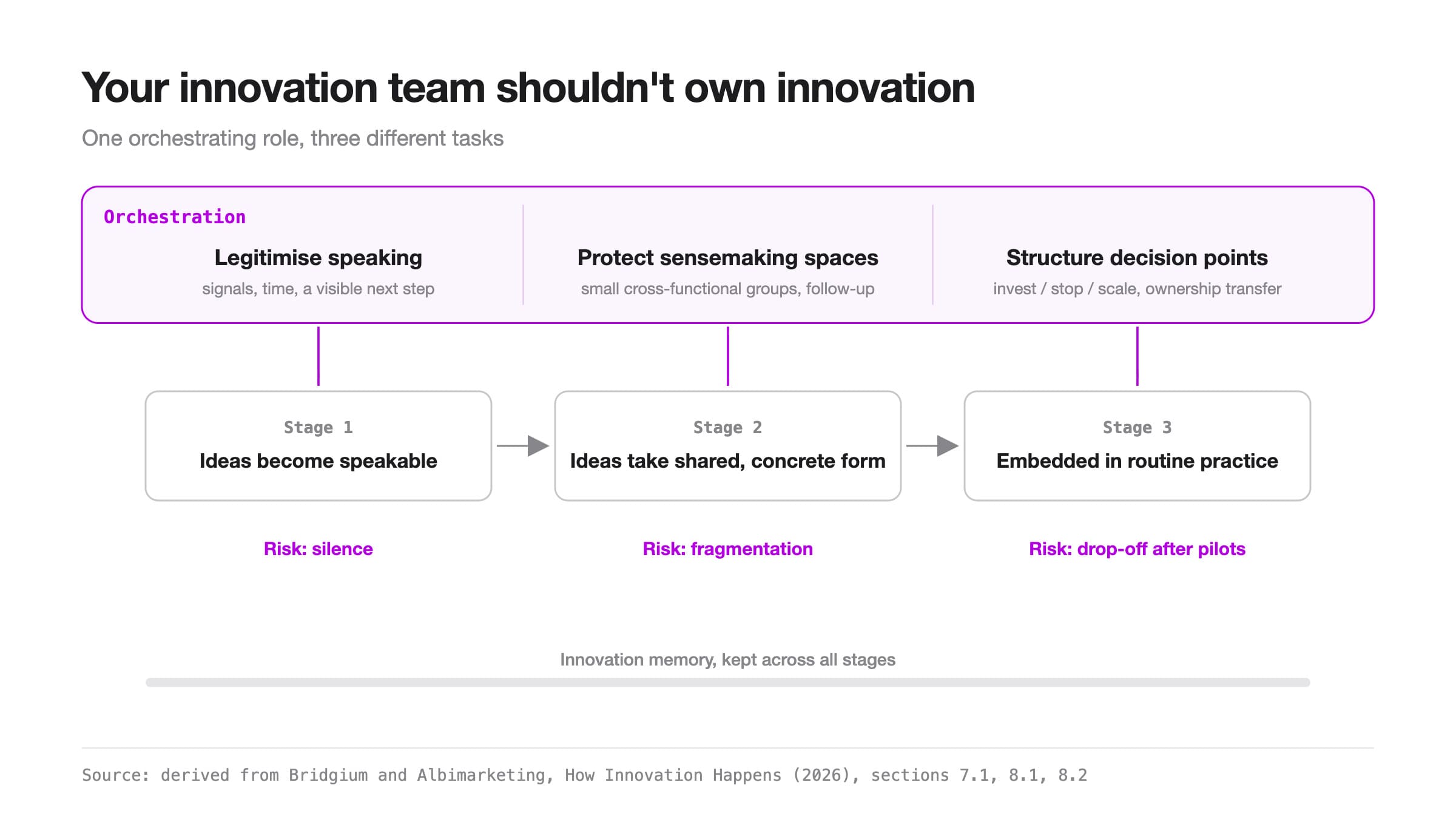
Figure 1. One orchestrating role, three different tasks: the stages of the Innovation Flow with their dominant risks, and the orchestration task above each stage. Source: derived from Bridgium and Albimarketing, How Innovation Happens (2026), sections 7.1, 8.1 and 8.2.
Satish Nambisan and Mohanbir Sawhney’s field study of network-centric innovation (2011) found that orchestration involves an interplay between designing the innovation and designing the network around it. The stage logic points the same way: in the first two stages orchestration works mostly on the network of people, and in the third increasingly on the decision itself.
How to check this in your own organisation
Morten Hansen and Julian Birkinshaw’s article on the innovation value chain (2007) argued that companies struggle with innovation in different places and should diagnose their own weaknesses before adopting popular remedies. The report presents the first practical value of its framework in the same spirit: telling silence, fragmentation and adoption failure apart, and intervening at the right stage. Five questions help locate where your innovation team is working, and where it is missing:
- When your innovation team reports progress, does it describe ideas and pilots it owns, or transitions it has helped other units make?
- For the last three pilots that ended, who was named as the receiving owner in the business, and at what point?
- Where are problems raised today: in central campaigns, or in regular moments inside the units where the work happens?
- Is there a place where a small cross-functional group can work on an idea before anyone asks for a business case?
- If someone wanted to know what was tried on a given problem three years ago, and why it stopped, where would they look?
| What you observe | What it usually indicates |
|---|---|
| Business units call the innovation team “the lab” | The team owns ideas and has become a destination for them |
| Pilots end with a search for someone to adopt them | Decision points and receiving owners were not set before the pilot began |
| Lively discussion, few shared concepts or decisions | The second stage lacks protected spaces and follow-up loops |
| Idea campaigns attract fewer entries each round | People cannot see what happened to earlier ideas |
| The same idea returns every few years as if it were new | Innovation memory is held by individuals and is lost when they move |
Table 3. Signals that a central innovation team owns ideas instead of orchestrating their movement. Source: derived from Bridgium and Albimarketing, How Innovation Happens (2026), sections 8.1 to 8.3.
The Nordic dimension
Our study draws on organisations in Finland, Sweden, Denmark and the Netherlands, and many of the enablers respondents name for the first two stages are communicative and non-hierarchical: flat peer networks, trust-based dialogue, small autonomous groups and cross-functional participation. The report also observes that communication flows in the companies studied are non-hierarchical, moving across departments and countries. That is an advantage in exactly the stages where an owning team does the most harm. Where lateral communication already works, an orchestrating team only has to protect it and connect it across units.
The risk sits in the third stage. The report describes structural components as hierarchical and dependent on clear leadership signals, and finds that organisational enablers dominate embedding. It is also telling that the respondent most explicit about central orchestration, a Dutch leader, frames it as clear rules, criteria and pathways. Our reading, which goes beyond what the report states directly, is that consensus-oriented Nordic organisations may be more comfortable with the communicative side of orchestration than with its structural side. A team relying on what Dhanaraj and Parkhe call subtle leadership can carry ideas a long way through trust, then find that nobody will say stop, or tell a business unit that the result is now its own. Christopher Bartlett and Sumantra Ghoshal’s article on matrix management (1990) argued that coordination across a complex company needs managers who have internalised shared priorities and can negotiate agreements, beyond formal structure alone. Many Nordic organisations have that. The third stage asks in addition for a few explicit decision points that do not depend on everyone agreeing in the room.
The structural response
- Write the innovation team’s mandate around transitions. Describe the team’s work as helping ideas move from one stage to the next, and judge it by the transitions completed. Its product is the route, and the pilots belong to the units that will carry them.
- Give the team a different task at each stage. In the first stage it helps line leaders legitimise speaking and makes the next step visible. In the second it convenes and protects small cross-functional groups. In the third it structures decision points and handovers.
- Name the receiving owner before the pilot starts. No pilot begins without a person in the business who will own the result if it succeeds, and an agreed decision point to invest, stop or scale. That person takes part in the pilot from the first day.
- Make innovation memory a shared service. Keep one open record of what was tried, decided and learned, across all units and stages. The innovation team maintains it, and every unit can read and add to it.
Conclusion
When innovation is slow, building a team to run it is an understandable response. It gives the problem a budget and a room, and our study suggests that the room is the risk. In large organisations, ideas mostly die at transitions, and a team that owns ideas adds one more transition at the end, where they must be handed back to a business that did not shape them. Even the respondent who argued most strongly for a central team asked it for rules, criteria and pathways, which are things a team provides to others.
Orchestration is harder to show on a slide. Its work changes by stage: legitimising speaking where problems are first noticed, protecting the small groups where ideas take shape, and structuring the decision points and handovers where they become normal work. The report closes by asking what kind of community can sustain innovation and transformation, and how leadership should enable it to function across stages. A central team that orchestrates is one practical answer.
It is worth placing your last few pilots against the three stages and asking where each one slowed, and who was present at that moment. If you did that honestly, at which stage of the flow would you find your innovation team absent?
If you want to see where ideas lose momentum in your organisation, and which stage your orchestration is missing, Find the Gap maps the four conditions of the Innovation Flow through interviews across departments and shows where new ideas and practices stall.
References
- Bridgium and Albimarketing (2026). How Innovation Happens: Insights from Leading Enterprises in Times of Change.
- Dhanaraj, C. and Parkhe, A. (2006). Orchestrating innovation networks. Academy of Management Review, 31(3), 659–669.
- Galbraith, J. R. (1974). Organization design: An information processing view. Interfaces, 4(3), 28–36.
- Malone, T. W. and Crowston, K. (1994). The interdisciplinary study of coordination. ACM Computing Surveys, 26(1), 87–119.
- Birkinshaw, J. and Gibson, C. (2004). Building ambidexterity into an organization. MIT Sloan Management Review, 45(4), 47–55.
- Wolcott, R. C. and Lippitz, M. J. (2007). The four models of corporate entrepreneurship. MIT Sloan Management Review, 49(1), 75–82.
- Mintzberg, H. (1979). The Structuring of Organizations: A Synthesis of the Research. Prentice-Hall.
- Kanter, R. M. (1982). The middle manager as innovator. Harvard Business Review, 60(4), 95–105. Reprinted in Harvard Business Review, July–August 2004.
- Van de Ven, A. H. (1986). Central problems in the management of innovation. Management Science, 32(5), 590–607.
- Nambisan, S. and Sawhney, M. (2011). Orchestration processes in network-centric innovation: Evidence from the field. Academy of Management Perspectives, 25(3), 40–57.
- Hansen, M. T. and Birkinshaw, J. (2007). The innovation value chain. Harvard Business Review, 85(6), 121–130.
- Bartlett, C. A. and Ghoshal, S. (1990). Matrix management: Not a structure, a frame of mind. Harvard Business Review, 68(4), 138–145.