

You invited a startup, then judged it like a supplier
- The symptom: a demo answered with a supplier questionnaire
- The usual explanation, and why it does not hold
- Where the switch happens
- How to check this in your own organisation
- The structural response
- Conclusion
- References
Corporates turn to startups for new ideas and speed, then assess them from the first meeting with the criteria they use for established vendors. Our research shows how an undeclared collaboration mode costs a startup its legitimacy before anyone knows whether its solution fits.
The symptom: a demo answered with a supplier questionnaire
The demo went well. For twenty minutes the founder of a three-year-old company showed a steering group how her team’s software reads vibration data from older machines and flags faults weeks before the current inspection routine would. The head of maintenance leaned forward and asked to see one chart again. Then the questions started. The IT security lead asked where the data would be stored and whether the company held a security certification. Procurement asked how many people it employed and whether it was on the approved supplier list. Finance asked about cash runway and whether the company could guarantee support for five years. Someone asked about support hours at weekends. The founder answered honestly, which meant that several answers began with “not yet”.
The innovation manager who had met her at an ecosystem event and invited her sat at the end of the table and said nothing. The minutes recorded the item as “interesting, but not mature enough”, and it did not return to the agenda.
Every question in that meeting was reasonable, and every function at the table was doing its job. What went wrong was the frame. The startup had been invited to explore a problem with the company, and was then assessed as if it had applied for a framework contract. Nobody had said which of the two meetings it was.
This article is part of our series on our second study, From Discovery to Practice, based on 48 qualitative interviews: 28 with innovation leaders and senior practitioners in large Nordic and European corporations, conducted between September and December 2025 for our previous study, and 20 with founders and senior representatives of startups and SMEs. The study focuses on Finland, Sweden, Denmark, Norway and the Netherlands, with selected input from Central Europe. It is qualitative and describes recurring patterns, without statistical claims. Here we look at what happens once a startup is in the room: how it is judged, and against which standard.
The usual explanation, and why it does not hold
The usual explanation for meetings like this is maturity. The startup was too early, the reasoning goes, and should come back when it has more customers and a longer track record.
There is a real pattern behind this view. John Freeman, Glenn Carroll and Michael Hannan (1983) documented a liability of newness: in labour unions, semiconductor manufacturers and newspaper publishers alike, younger organisations faced a higher risk of failure, and controlling for size did not remove the effect of age. A finance director who asks about runway is acting on evidence.
The difficulty is that corporates do not invite startups for their maturity. In section 4.1 of the report, respondents describe turning to external partners when internal structures lack speed, flexibility or specific expertise.
“Alternative solutions… you never thought about.”
Innovation Practitioner · Technology / Corporate Environment · Finland
“We cannot innovate everything ourselves… we need partners.”
Group Vice President / Innovation Leader · Industrial Technology · Global
Startups arrive with a matching hope. Section 4.2 shows founders looking for environments where a solution can be tested, refined and made credible before it scales.
“A free pilot in a corporate environment gives us the opportunity to test and pivot. Only from inside can we understand the real needs and issues. Second, we need references and use cases to approach VCs.”
Startup Founder · B2B HR-Tech · Finland
Read together, the two sides describe a fair exchange: new perspectives for the corporate, a real problem and a reference for the startup. The exchange breaks when the corporate side changes its standard halfway through. The report calls this the expectation paradox: corporates search for novelty but evaluate predictability, while startups seek fast validation but must prove reliability and operational fit. If every young company is judged on its survival odds in the first meeting, the corporate screens out the very category it set out to find. “Not mature enough” describes the outcome of that switch. It does not explain why the switch happened so early.
Where the switch happens
The report allows us to trace the switch to four mechanisms. Together they cost a startup its legitimacy before there is evidence about its solution.
1. Invited for novelty, assessed for predictability
Section 4.4 describes the structural mismatch underneath the paradox. Corporates are oriented toward execution: stability, governance, compliance and operational continuity. Startups operate through exploration: speed, experimentation, adaptation and problem solving under uncertainty. The report’s Table 2 sets the two logics side by side. The startup reduces risk through experimentation, the corporate reduces risk before acting. The startup works toward survival and rapid growth, the corporate toward long-term continuity. The startup counts validation and traction, the corporate counts ROI and operational fit.
The problem begins when a corporate invites a startup for the first set of qualities and evaluates it on the second. Howard Aldrich and Marlene Fiol (1994) explain why young ventures are so exposed at this moment. New ventures lack cognitive legitimacy, a settled understanding among others of what they are and how to judge them, and socio-political legitimacy, the acceptance of key stakeholders. Without a ready category, people fall back on the nearest one they know. In a steering group, the nearest category for an outside company with a product is “supplier”, and suppliers come with a questionnaire.
“Would you really like to use this technology? What happens if the startup in one year is not existing anymore?”
Open Innovation Lead · Industrial Technology · Germany
The question is fair, and timing decides what it does. Babke Hogenhuis, Ellis van den Hende and Erik Jan Hultink (2016) found that large firms often begin collaborations with young ventures without a clear plan and underestimate the difficulty of unequal partnerships. They propose deciding, stage by stage of the innovation process, when such collaboration makes sense. Read that way, the continuity question belongs to a stage. Asked before a solution moves into operations, it is due diligence. Asked in the first exploratory meeting, it ends the conversation before anyone learns whether the startup understands the problem better than the company does.
2. Two logics in one meeting, and nobody said which applied
Section 4.3 distinguishes two collaboration logics. In exploration logic, corporates look for new perspectives and alternative ways to approach unclear problems, and startups seek real problem contexts, expert feedback and a chance to test early concepts. In implementation logic, corporates look for solutions that can be tested, integrated and used within existing operations, and startups seek credible pilots, reference cases, paid continuation and a route to scaling.
The report finds that many collaboration problems appear when these logics are mixed. A startup may enter with an exploratory proposal while the corporate evaluates it as a ready vendor solution. Appendix 2 adds that corporates often evaluate startups through innovation logic and operational logic at the same time. The opening scene is a clean example: the innovation manager invited the founder under the first logic, and everyone else assessed her under the second.
Mark Suchman (1995) shows why this mix is costly. Legitimacy is granted by audiences, and it comes in kinds: pragmatic legitimacy rests on what the audience stands to gain, cognitive legitimacy on whether the organisation is understood and accepted as a matter of course. A steering group holds several audiences at once. The maintenance lead weighed pragmatic value. Security, procurement and finance checked whether the company fitted categories their processes recognise. Greg Fisher, Suresh Kotha and Amrita Lahiri (2016) add that a new venture meets audiences with different norms as it grows, and must cross several legitimacy thresholds in sequence. In the steering group, the startup was asked to cross the implementation threshold before the exploration one.
Monica Zimmerman and Gerald Zeitz (2002) treat legitimacy as a resource new ventures need for growth, and describe strategies for gaining it, from conforming to existing expectations to selecting an environment whose standards suit the venture. In a mixed meeting only conformance is open to the founder, and a startup presented as a small version of an established vendor looks weak on every count. Selection depends on the corporate having said which environment the meeting belongs to. Section 6.6 of the report names the result: exploratory solutions may lose legitimacy before the fit between problem and solution is developed.
| Question | Exploration logic | Implementation logic |
|---|---|---|
| What the corporate looks for | New perspectives and alternative ways to approach an unclear problem | A solution that can be tested, integrated and used within existing operations |
| What the startup seeks | A real problem context, expert feedback, a chance to test early concepts | A credible pilot, reference cases, paid continuation, a route to scaling |
| How success is read | Validation and learning about the problem | ROI and operational fit |
| The question that fits | Does this help us see the problem differently? | “Can this solution survive, integrate and operate inside our organization?” |
| A question asked too early | Five-year support guarantees, approved supplier status | None: continuity and integration questions are now due |
Table 1. Two collaboration logics and the evaluation questions each one supports. Source: derived from Bridgium and Albimarketing, From Discovery to Practice (2026), sections 4.3 and 4.4 and Appendix 2.
3. Same words, different meanings
The third mechanism hides in vocabulary. Section 4.4 observes that different assumptions sit behind the same words. Pilot, validation, readiness, scalability, partnership and implementation may sound shared while carrying different meanings for each side. When needs, criteria and next steps are not explicit, both sides read the collaboration through their own logic, and communication produces noise instead of alignment.
“Pilot” is the clearest case. For the founder quoted above, a free pilot is a place to test and pivot. Section 6.3 finds that corporates may expect measurable impact or operational readiness from a pilot from the start. Appendix 2 records the reverse misunderstanding later on: many startups expect pilot success to lead naturally to adoption, while corporates require structured embedding pathways. The report’s Table 6 advises corporates to state whether they are inviting exploration, co-creation, a proof of concept, a pilot, a prototype, an MVP or ready implementation, and to replace vague “partnership” language with clear problem-solving wording.
Tim Minshall, Letizia Mortara, Stelios Elia and David Probert (2008) developed practitioner guidelines for partnerships between start-ups and large firms, cataloguing the problems that arise when partners differ greatly in age and size. Firms in their study learned best from others’ experience through direct support and multi-company workshops. Shared definitions are learned in conversation more readily than from a policy document.
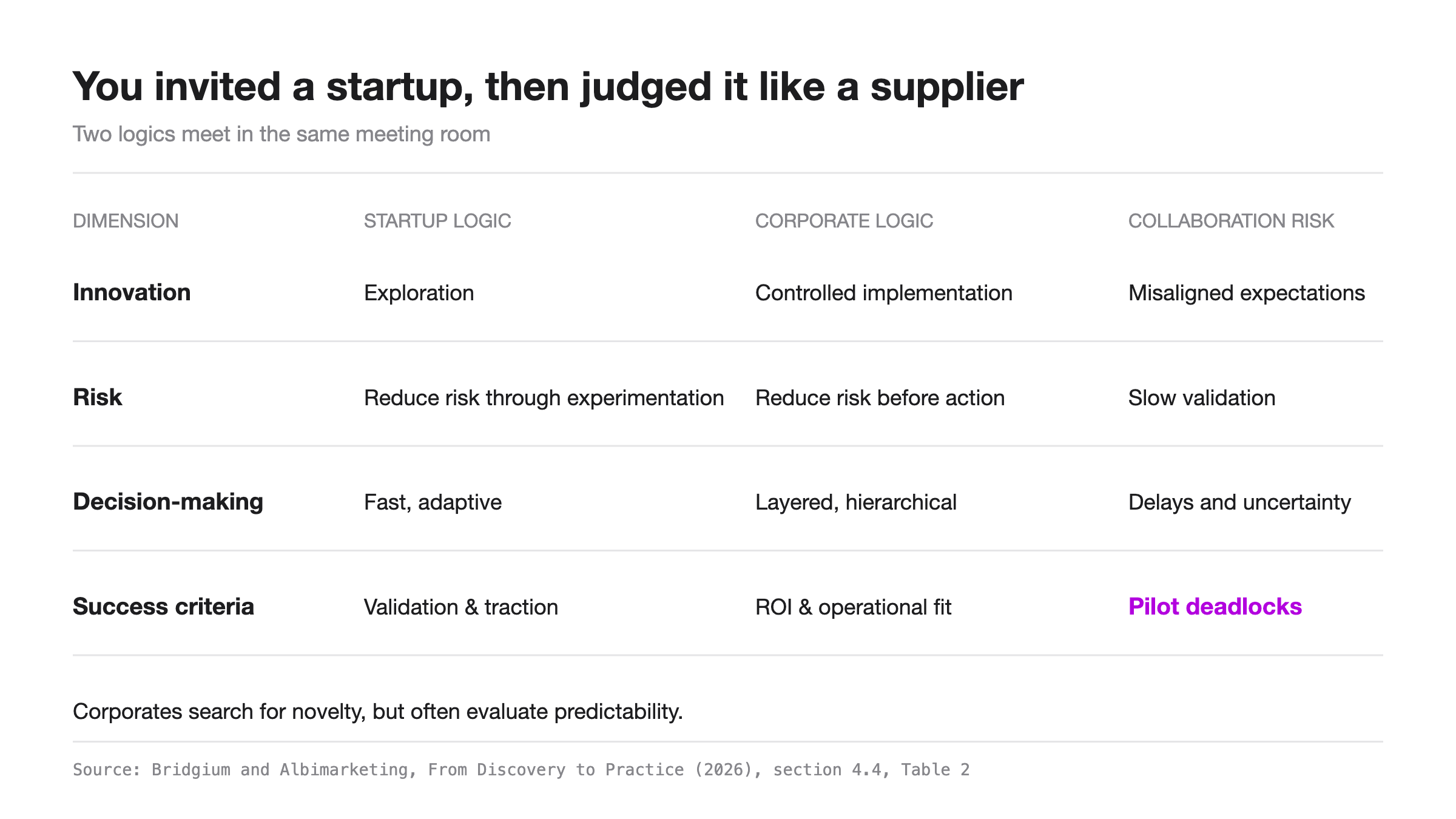
Figure 1. Two logics in the same meeting room: how startup logic and corporate logic differ on four dimensions, and the collaboration risk each difference creates. Source: Bridgium and Albimarketing, From Discovery to Practice (2026), section 4.4, Table 2.
4. Nine questions for a company that is two years old
Appendix 2 sets out how corporates evaluate startups in practice. Startups often assume that corporates mainly assess novelty, technological quality and pilot results. The interviews show corporates also looking at organisational reliability, implementation risk, communication behaviour, governance compatibility and founder maturity, and assessing teams much as they would assess vendors, or even job candidates. The report condenses this into one question, set against “Is this idea innovative?”: “Can this solution survive, integrate and operate inside our organization?” Collaboration may weaken, it concludes, because the startup does not yet appear predictable, legible or operationally trustworthy within the corporate system, even when the idea has value.
| Evaluation dimension | Typical corporate concern | Our reading: when it fits |
|---|---|---|
| Problem relevance | Does this solve something important for us now? | Exploration, as shared work on the problem |
| Business case and ROI | Can this justify investment and operational effort? | Before a paid pilot |
| Team credibility | Can these people deliver in a complex environment? | Light in exploration, fuller before a pilot |
| Stability and continuity | Will this company still exist in one or two years? | Before implementation |
| Operational fit | Can this realistically work inside our structure? | When the pilot is designed |
| Predictability | Can we coordinate this safely? | Throughout, as agreed checkpoints |
| Cultural and communication fit | Can they work with the organisation without creating resistance? | Exploration, as a shared learning task |
| Integration readiness | Can this become part of operations? | Before scaling |
| Internal legitimacy | Can I justify supporting this initiative? | From the first meeting, held by the sponsor |
Table 2. How corporates evaluate startups: nine dimensions from the interviews, with our reading of the stage at which each fits. Source: derived from Bridgium and Albimarketing, From Discovery to Practice (2026), Appendix 2 (Table 7). The last column is our interpretation.
The last row explains the silent innovation manager in the opening scene. Internal legitimacy is the sponsor’s own concern: whether supporting the initiative can be justified. With no agreed mode for the meeting, the sponsor had only personal enthusiasm to offer, and enthusiasm does not answer a security lead.
The evaluation also runs the other way. Riitta Katila, Jeff Rosenberger and Kathleen Eisenhardt (2008) found that technology ventures weigh their need for a large partner’s resources against the risk that the partner will misappropriate their technology, and form ties when defence mechanisms such as trade secrets or the timing of the relationship are in place. Sharon Alvarez and Jay Barney (2001) made the same point for alliances: entrepreneurial firms can gain a great deal from large partners, and also risk seeing the value they create taken by the larger side. Section 4.2 of the report shows founders needing clarity on IP and on what happens if the corporate later builds the solution internally. The founder in the steering group was asked about her survival odds while showing her best ideas to a company that had told her nothing about what it would do with them.
Shameen Prashantham and Julian Birkinshaw (2008) suggest that small firms gain most from partnering with multinationals when they make use of the differences between themselves and the large firm, since those differences are the reason for the interest. A startup that tries to look like a small vendor gives up what it was invited for.
How to check this in your own organisation
The report presents its framework as diagnostic. Five questions help locate whether your organisation invites startups under one logic and judges them under another:
- When you last invited a startup, did the invitation say whether you were exploring a problem together or looking for a solution to implement?
- Who attended the first meeting, and which of them had been told what kind of meeting it was?
- Which of the nine evaluation dimensions were raised in that first meeting, and which of them belong to a later stage?
- When your teams say “pilot”, do they mean a learning space or the first step toward a supplier contract, and would the startup give the same answer?
- When an exploratory conversation ends, does the startup learn why, and does anyone record what was learned about the problem?
| Signal | What it suggests | First step |
|---|---|---|
| Startups are asked for certifications and support guarantees in the first meeting | Implementation logic applied at the exploration stage | State the engagement mode in the invitation and on the agenda |
| Minutes record “interesting, but not mature enough” | The startup was judged as a vendor before fit was tested | Record what was learned about the problem and which question would decide a next step |
| The person who invited the startup stays silent when others object | The sponsor has no agreed frame to defend | Agree the mode and the evaluation questions with the steering group beforehand |
| Different functions give the startup contradictory feedback | Each function applies the criteria of its own stage | Sequence the nine dimensions by stage and say which apply now |
| Startups hesitate to share details or send junior staff | They expect unpaid exploration with no route forward and no IP clarity | Say what a successful exploration leads to, who funds the next step and how IP is treated |
Table 3. Signals that startups are judged by the wrong standard, and a first step for each. Source: derived from Bridgium and Albimarketing, From Discovery to Practice (2026), sections 4.2 to 4.4, 5.7 and 6.3, Table 6 and Appendix 2.
The Nordic dimension
The Nordic context brings a real strength to the exploration stage. Several practice cases in Appendix 1 come from the region: an innovation lab in Finnish energy technology that starts from a business unit need and opens the challenge to external actors, and a Swedish engineering and consulting company that scouts broadly and moves a small number of startups into deeper pilot and co-creation programmes. Short distances between people and a habit of open, cross-functional dialogue make it easy to bring a founder and a problem owner into the same conversation early.
The risk sits in the same habit. Section 6.1 notes that in regulated and asset-heavy sectors, long implementation cycles may reflect structural constraints such as certification, safety cases, OT and IT security, production continuity and asset lifecycles measured in decades. Much of Nordic industry works under exactly these constraints. In a meeting that includes everyone, a consensus culture gives each of those standards a voice from the start. Our reading, which goes beyond what the report states directly, is that in consensus-oriented Nordic steering groups the strictest operational criterion in the room tends to become the shared standard by default, unless someone states at the outset which stage of collaboration the conversation belongs to.
The structural response
- Declare the engagement mode before the first meeting. Section 5.7 advises leaders to define the engagement mode upfront: co-exploration or a ready-to-integrate solution. Put it in the invitation, on the agenda and in the briefing to every function that attends. The startup then knows which questions to prepare for, and the steering group knows which questions belong to this meeting.
- Sequence the evaluation by stage. Use the nine dimensions in Table 2 as a sequence. In exploration, the useful questions concern problem relevance, communication fit and whether the sponsor can justify further work. Continuity, operational fit and integration readiness come in before a pilot turns into implementation. Thomas Kohler (2016) found that collaboration between large companies and startups needs deliberate design of proposition, process, people and place, because the two sides differ so much.
- Write down what the shared words mean. Before a pilot starts, agree on one page what is being tested, what success looks like, who gives feedback and what decision follows, as the stronger cases in section 8 do. Add who funds the next step if the answer is positive.
- Give the person who invited the startup a mandate to hold the frame. The sponsor opens the meeting by stating the mode and the questions that apply, with the steering group’s prior agreement. The same person tells the startup what stays protected during exploration and how IP is treated, so the founder can share openly.
Conclusion
Corporates invite startups for what they cannot produce themselves: alternative solutions and a different way of seeing a problem. Startups accept because a corporate environment lets them test, pivot and earn the references investors ask for. Our study shows how often this exchange breaks in the first meeting, because the company applies the standard of a later stage and nobody has said which stage the meeting belongs to.
The fix keeps every standard in place. Continuity, security and operational fit all matter, and the report is clear that integration remains the hardest point. What changes is the order. A declared mode, an evaluation sequenced by stage, shared definitions and a sponsor with a mandate let each function ask its question when the answer can be useful.
It is worth looking back at the last few startups your organisation invited and asking at which stage each was evaluated, and whether anyone in the room knew. If you placed the questions from those first meetings against the nine dimensions, how many would belong to a stage the startup had not yet reached?
If you want to see where external ideas lose legitimacy in your organisation, and at which stage your evaluation arrives too early, Find the Gap maps the four Innovation Flow conditions through interviews across departments and shows where new ideas and practices stall.
References
- Bridgium and Albimarketing (2026). From Discovery to Practice: How Corporate–Startup Collaboration Becomes Usable.
- Aldrich, H. E. and Fiol, C. M. (1994). Fools rush in? The institutional context of industry creation. Academy of Management Review, 19(4), 645-670.
- Suchman, M. C. (1995). Managing legitimacy: Strategic and institutional approaches. Academy of Management Review, 20(3), 571-610.
- Zimmerman, M. A. and Zeitz, G. J. (2002). Beyond survival: Achieving new venture growth by building legitimacy. Academy of Management Review, 27(3), 414-431.
- Fisher, G., Kotha, S. and Lahiri, A. (2016). Changing with the times: An integrated view of identity, legitimacy, and new venture life cycles. Academy of Management Review, 41(3), 383-409.
- Freeman, J., Carroll, G. R. and Hannan, M. T. (1983). The liability of newness: Age dependence in organizational death rates. American Sociological Review, 48(5), 692-710.
- Katila, R., Rosenberger, J. D. and Eisenhardt, K. M. (2008). Swimming with sharks: Technology ventures, defense mechanisms and corporate relationships. Administrative Science Quarterly, 53(2), 295-332.
- Alvarez, S. A. and Barney, J. B. (2001). How entrepreneurial firms can benefit from alliances with large partners. Academy of Management Executive, 15(1), 139-148.
- Prashantham, S. and Birkinshaw, J. (2008). Dancing with gorillas: How small companies can partner effectively with MNCs. California Management Review, 51(1), 6-23.
- Minshall, T., Mortara, L., Elia, S. and Probert, D. (2008). Development of practitioner guidelines for partnerships between start-ups and large firms. Journal of Manufacturing Technology Management, 19(3), 391-406.
- Kohler, T. (2016). Corporate accelerators: Building bridges between corporations and startups. Business Horizons, 59(3), 347-357.
- Hogenhuis, B. N., van den Hende, E. A. and Hultink, E. J. (2016). When should large firms collaborate with young ventures? Research-Technology Management, 59(1), 39-47.