

Retaining the Invisible Contributors: Why Companies Lose the People They Don’t Track
They don’t ask for promotion. They don’t burn out. But when they leave — everything slows down.
- Your performance dashboard shows who’s fast
- 1. Who Are the Invisible Contributors?
- 2. Why They Leave (It’s Not What You Think)
- 3. Why HR Systems Miss Them
- 4. What to Do (Tactics With Trade-Offs)
- What HR Tracks vs What Actually Holds Teams Together
- 5. Infrastructure, Not Features
- Final Insight
Your performance dashboard shows who’s fast
It doesn’t show who makes others faster.
They didn’t ask for anything. They didn’t disengage. They just left — and everything got harder.
Invisible contributors are not your loudest, most ambitious, or most measured employees. But they are your most stabilizing force. And in distributed, hybrid teams across Europe, they’re vanishing quietly — long before HR systems even notice the risk.
1. Who Are the Invisible Contributors?
You won’t find them topping leaderboards or self-nominating for awards.
These are the people who:
- Quietly onboard and mentor others — without being asked.
- Defuse tensions before they escalate.
- Fill gaps between departments.
- Remember the “why” behind operational decisions.
- Absorb emotional weight without broadcasting it.
They’re the ones others instinctively go to when they’re stuck, uncertain, or overwhelmed. But in the latest review cycle, they were marked as “reliable,” not “critical.”
When Maya left, no one replaced her. She wasn’t a manager. But three teams slowed down. Knowledge transfer stalled. Small conflicts multiplied.
In distributed European teams — spread across time zones and cultures — these people are often the quiet glue. Their value is emotional, behavioral, and connective. And it’s almost never formally recognized.
2. Why They Leave (It’s Not What You Think)
Invisible contributors don’t leave because of low engagement or toxic culture.
They leave because they feel systemically unseen.
Over time, they notice:
- Their behavior isn’t tracked or recognized.
- Their influence isn’t promotable.
- Their loyalty is taken for granted.
McKinsey reports that 61% of employees who quit showed no signs of disengagement in the six months prior.
(McKinsey, The Great Attrition 2022)
This isn’t burnout. It’s psychological erosion. They keep contributing — until the slow realization dawns: “It doesn’t matter that I’m here.”
And so they leave. Often without drama. Often without another job lined up. And often with no one in HR understanding why.
3. Why HR Systems Miss Them
HR systems track what’s visible:
- KPIs
- Promotions
- Engagement survey scores
- Performance ratings
But invisible contributors operate in the white space between metrics.
They hold together hybrid teams. They’re sought out for informal help. They model culture without needing to perform it. But none of this fits neatly into goal-based reviews or gamified recognition tools.
Traditional systems measure delivery. But they rarely measure dependency — who others depend on to function.
(MIT Sloan, Invisible Work 2021)
Recognition is often top-down, favoring extroverts or those adept at self-promotion. Surveys miss nuance. Talent reviews overlook quiet strength.
As a result, succession plans, promotion tracks, and retention strategies ignore the very people who hold your operations stable.
4. What to Do (Tactics With Trade-Offs)
This isn’t about more surveys or another round of “employee of the month.”
It’s about signal infrastructure: surfacing contribution patterns that exist — but aren’t captured.
Here’s how:
Peer-Based Recognition Logs
Let teams log who helped them — not in formal projects, but in real, daily ways: unblocking, supporting, coaching.
Trade-off: Requires trust culture; must avoid “popularity” dynamics.
Mapping Informal Networks
Use social network analysis or structured conversations to surface who employees turn to for help.
Trade-off: Raises privacy and ethics questions — needs clear boundaries.
Value Heatmaps
Visualize recurring behaviors like bridging teams, mentoring, and quiet problem-solving.
Trade-off: Shows patterns, not individual stories — qualitative context matters.
Ambient Signal Platforms
Tools like AlbiCoins track real-time behavioral and emotional signals from daily work — without gamifying or over-structuring recognition. These systems reflect who’s building culture, sharing knowledge, or losing visibility — especially in distributed settings.
Trade-off: Needs intentional integration; not a quick fix.
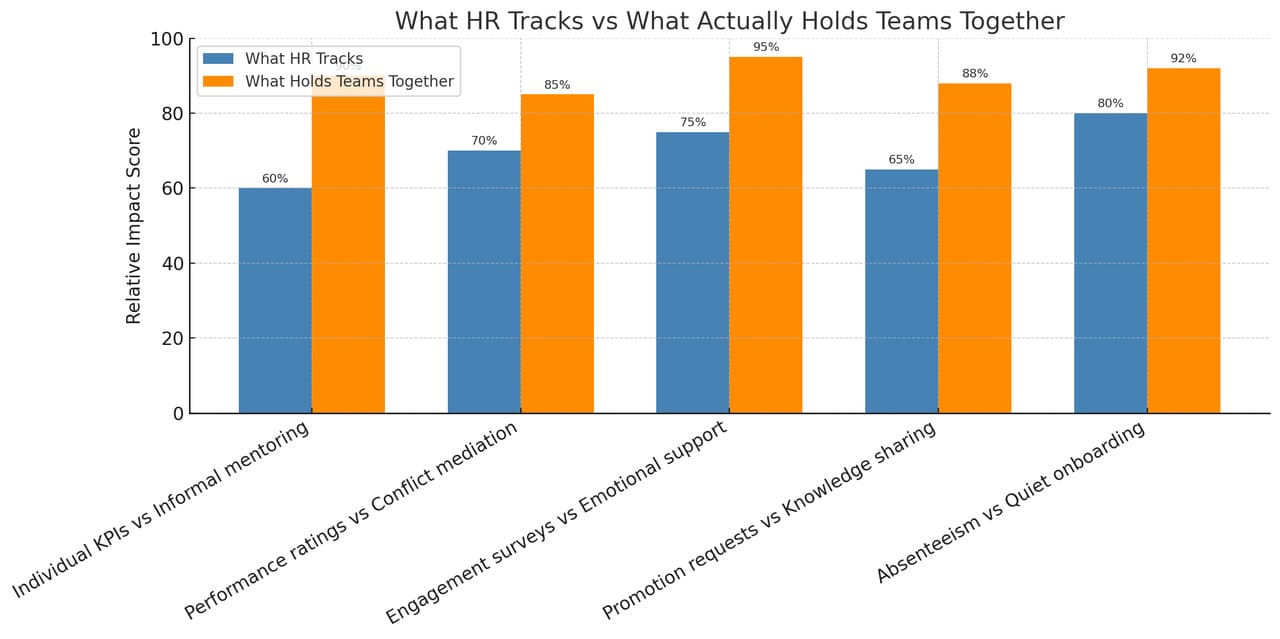
What HR Tracks vs What Actually Holds Teams Together
| What HR Tracks | What Actually Holds Teams Together |
|---|---|
| Individual KPIs | Informal mentoring |
| Performance ratings | Conflict mediation |
| Engagement survey scores | Emotional support during change |
| Promotion requests | Cross-team knowledge sharing |
| Absenteeism | Quiet onboarding of new hires |
5. Infrastructure, Not Features
Systems like AlbiCoins don’t replace human insight — they support it.
They help HR teams detect early signs of emotional withdrawal, horizontal contribution, and informal leadership — long before performance metrics shift.
In hybrid organizations, where hallway signals are lost, this ambient layer becomes essential.
Final Insight
If your system only sees those who speak up —
how do you protect those who quietly hold it together?
References:
- McKinsey & Company: The Great Attrition (2022)
- MIT Sloan Management Review: Invisible Work and Informal Influence (2021)
- Harvard Business Review: The Emotional Labor of Leadership (2023)
- Josh Bersin: The Human-Centered Organization (2022)
- CIPD: Recognition Beyond Performance