

The information got there. The decision didn’t.
- The symptom: everyone was informed, nobody decided
- The usual explanation, and why it does not hold
- Four mechanisms: why information crosses and decisions do not
- How to check this in your own organisation
- The structural response
- Conclusion
- References
In most large organisations, news of a good pilot travels across units without difficulty, while the decision about what to do with it stays inside one unit and waits for that unit’s own timetable.
The symptom: everyone was informed, nobody decided
An innovation team has spent five months on a pilot that uses order data to predict which customer deliveries will arrive late. The results are good, and people know it. The pilot has been shown at the quarterly demo day, written up in the internal newsletter and discussed in a Teams channel with well over a hundred members. The logistics director has seen the slides twice and calls the work impressive. When the innovation lead asks what happens next, the answer is that logistics will look at it once this year’s delivery targets are safe. Nobody has said no. Nobody has said yes either, and nobody can say who would.
Ask anyone involved whether there was a communication problem and they will be puzzled. Information was everywhere. The logistics director knew about the pilot, and the channel held a full record of every discussion about it. What never travelled from one unit to the other was the decision.
Our first study, How Innovation Happens, is based on 28 in-depth interviews conducted between September and December 2025 with innovation leaders and senior practitioners in Nordic and European companies of roughly 5,000 to 150,000 employees. Its section on silos makes a distinction that is easy to state and hard to act on. Knowledge may flow across units, while responsibility and decision-making stay inside them. This article is about that gap, and about why more communication rarely closes it.
The usual explanation, and why it does not hold
The usual explanation is that the units do not talk enough. The innovation team works in its own bubble, the business does not know what is being developed, and the remedy is visibility. Organisations add a newsletter, a demo day, a shared channel and an innovation ambassador in each division. Most large companies have built some version of each.
In the scene above, all of that was in place, and it worked as designed. The logistics director was informed, more than once, through several channels. Our study describes this pattern directly. In the report’s words, “Departmental silos appear in interviews not as hostility, but as misaligned logics.” People in the two units were friendly and in regular contact. They simply worked under different rules.
“It’s still happening in silos… there are synergies, but not too much happening between divisions.”
Innovation Partnerships Lead · Energy · Finland
The report’s explanation is structural. Innovation units operate under different rules, while business units are measured on delivery, and nobody holds shared accountability at the interface between them. The consequence it draws is precise: silos “are not resolved by communication alone: knowledge may flow across units, but responsibility and decision-making do not.”
Paul Lawrence and Jay Lorsch’s study of differentiation and integration in complex organisations (1967) explains why the different rules are no accident. They compared firms in the plastics industry and found that departments dealing with different parts of the environment developed different orientations: different goals, different time horizons, different ways of relating to colleagues and different degrees of formality in how they were organised. Research, sales and production did not think alike, and in a demanding environment they had good reason not to. The same study found that the more departments differed, the harder it became to bring their work together, and that the firms performing best were those that achieved both. They had strongly differentiated departments and strong integrating mechanisms to connect them.
That finding changes the question. In Lawrence and Lorsch’s account, differentiation is what allows specialised units to do their work well. The weakness lies in leaving integration to chance. Read through this lens, the innovation unit and the business unit in the opening scene are both doing their jobs. One explores, the other delivers. Adding communication between them puts more information into a system whose problem was never a shortage of information.
Gillian Tett’s book The Silo Effect (2015) reaches a similar view from anthropology. She traces silos to the classification systems organisations use to divide work, which become so familiar that insiders stop seeing them, and her cases include organisations that learned to manage silos instead of suffering from them. A silo is a way of organising. Telling people more about each other does not dissolve it.
Four mechanisms: why information crosses and decisions do not
The report’s account of how innovation becomes practice (section 7.1) supplies the frame. Structural components are hierarchical and depend on clear leadership signals. Communication flows are non-hierarchical and move across departments and countries. The report concludes that “both flows must operate in parallel rather than sequentially.” The silo pattern is what happens when only one of them runs. Communication crosses the boundary, while the structure that would turn information into a decision stays on each side of it. Four mechanisms keep this pattern in place.
Different rules, different clocks
Innovation units are usually set up to explore, on longer horizons, with room for things to fail. Business units are set up to deliver, and they are judged on whether this quarter’s output arrived on time and within budget. When a result from the first unit reaches the second, it is read against the second unit’s rules. A pilot that looks like progress in one place looks like a distraction in the other.
“Sometimes you end up with innovation departments that people quite often ignore… because it’s like, ‘those are the flaky guys with interesting ideas’.”
Director, Growth & Development · Energy & Industrial Systems · Finland & Global
Deborah Dougherty’s study of product innovation in large firms (1992) describes this at the level of meaning. She found that people in different departments live in separate thought worlds: they notice different aspects of the same product, attach different importance to them and draw different conclusions. These differences kept innovators from combining their expertise, and the firms’ established product routines made the learning problems worse. Successful innovators got past these barriers by working through them collaboratively. A message from the innovation unit can arrive in full and still be understood as something other than what was meant. The information got there. Its meaning changed on the way.
Decisions stay where accountability lives
Even when the meaning survives, the decision does not move. The business unit owns the budget and the risk if something goes wrong. The innovation unit can recommend, but it cannot commit logistics to anything. So the decision is taken where the consequences fall, inside the business unit, on its planning cycle, alongside everything else it is accountable for.
“Information moves quite well, but decisions are still made within units. That’s where things slow down”
Digital Innovation Leader · Telecommunications · Finland
Paul Rogers and Marcia Blenko’s work on decision roles (2006) found that decisions in many organisations stall because people do not know who owns them, and that the stalls cluster at predictable bottlenecks: between the centre and the business units, between one function and another, between global and local. Their remedy was to make roles explicit for each important decision, so that one person holds the decision and others recommend, give input, agree or carry it out. The innovation-to-business interface is a textbook case of the centre and business unit bottleneck, and in most organisations nobody has written down who holds the decision there.
James Thompson’s Organizations in Action (1967) offers a reason why this bottleneck is so persistent. Thompson distinguished between pooled, sequential and reciprocal interdependence, and argued that organisations group their units so as to keep the most costly coordination inside unit boundaries. Reciprocal interdependence, where each party’s output becomes the other’s input, is the hardest to coordinate and depends on mutual adjustment. Taking a pilot into operations is reciprocal work: logistics needs the solution adapted to its routines, and the innovation team needs logistics’ data and people to adapt it. Many organisations treat the step as sequential, a handover from one unit to the next, and leave the mutual adjustment to goodwill.
Communication becomes a substitute for deciding
Demo days, newsletters and open channels all produce awareness, and awareness feels like progress. After a well-attended demo day, everyone knows about the pilot, and that can remain true for months while nobody decides anything.
Morten Hansen’s study of knowledge sharing across subunits (1999), based on new product development projects in a large electronics company, found that weak ties between units help a team search for useful knowledge elsewhere, while making it harder to transfer complex knowledge, which usually needs a strong relationship. Broadcast channels are weak ties at scale. They are good at letting people find out that something exists. They are poor at moving a complex, context-dependent solution into another unit’s daily work, and they carry no authority to commit anyone.
Hansen’s later article on internal collaboration (2009) adds a cost. He argued that collaboration is not automatically valuable, that it consumes time and attention, and that leaders should ask whether a particular collaboration creates more value than it costs. Every additional forum built to inform the business about innovation work takes time from both sides while leaving the decision exactly where it was. The report draws the line between knowing and acting: where pipelines, decision rules and ownership are in place, organisations can act on what they know. Without them, awareness is what communication alone produces.
The interface nobody owns
The report’s cross-cutting findings (section 8.1) are blunt about where the damage occurs: “Most failures occur at handovers between teams, functions, or units.” In the silo pattern, the handover zone is empty. The innovation unit considers its part done once the pilot is validated and presented. The business unit considers the pilot a proposal it may take up when it can. Each side assumes the other will move next.
Organisations usually have people who carry information across that zone. Michael Tushman and Ralph Katz’s study of gatekeepers in an R&D organisation (1980) showed how certain individuals link project groups to outside sources of information, and that this worked for some kinds of tasks while direct contact worked better for others. Today’s equivalents are innovation ambassadors and network coordinators. Very few organisations have someone at the interface with standing to decide, or to bring the people who can decide into one room.
Beth Bechky’s study of engineers, technicians and assemblers on a production floor (2003) shows why the interface needs more than a messenger. She found that the three groups misunderstood each other because their work settings, their language and their ways of thinking about the product differed, and that shared understanding emerged when they worked through concrete problems together and each group’s understanding of the product changed. An interface where people only exchange updates does not produce that. It takes joint work on a specific question, which is usually the decision itself.
In a companion article (1967), Lawrence and Lorsch described the integrator as a new management job, needed because rapid market and technological change was pulling specialisation and coordination apart. The interface in our scene is that job left unfilled.
| Mechanism | What crosses the boundary | What stays inside the unit | What it looks like in practice |
|---|---|---|---|
| Different rules, different clocks | Results, slides, reports | The criteria each unit uses to judge them | “Interesting, but not for us right now” |
| Decisions stay where accountability lives | Recommendations | Budget, risk and the final yes or no | The pilot waits for the business unit’s planning cycle |
| Communication becomes a substitute for deciding | Awareness | Commitment | Many forums, no decision dates |
| The interface nobody owns | Information carried by go-betweens | Responsibility for the handover | Each side waits for the other to move |
Table 1. Four mechanisms that let information cross units while decisions stay inside them. Source: derived from Bridgium and Albimarketing, How Innovation Happens (2026), sections 7.1 and 7.4.3.
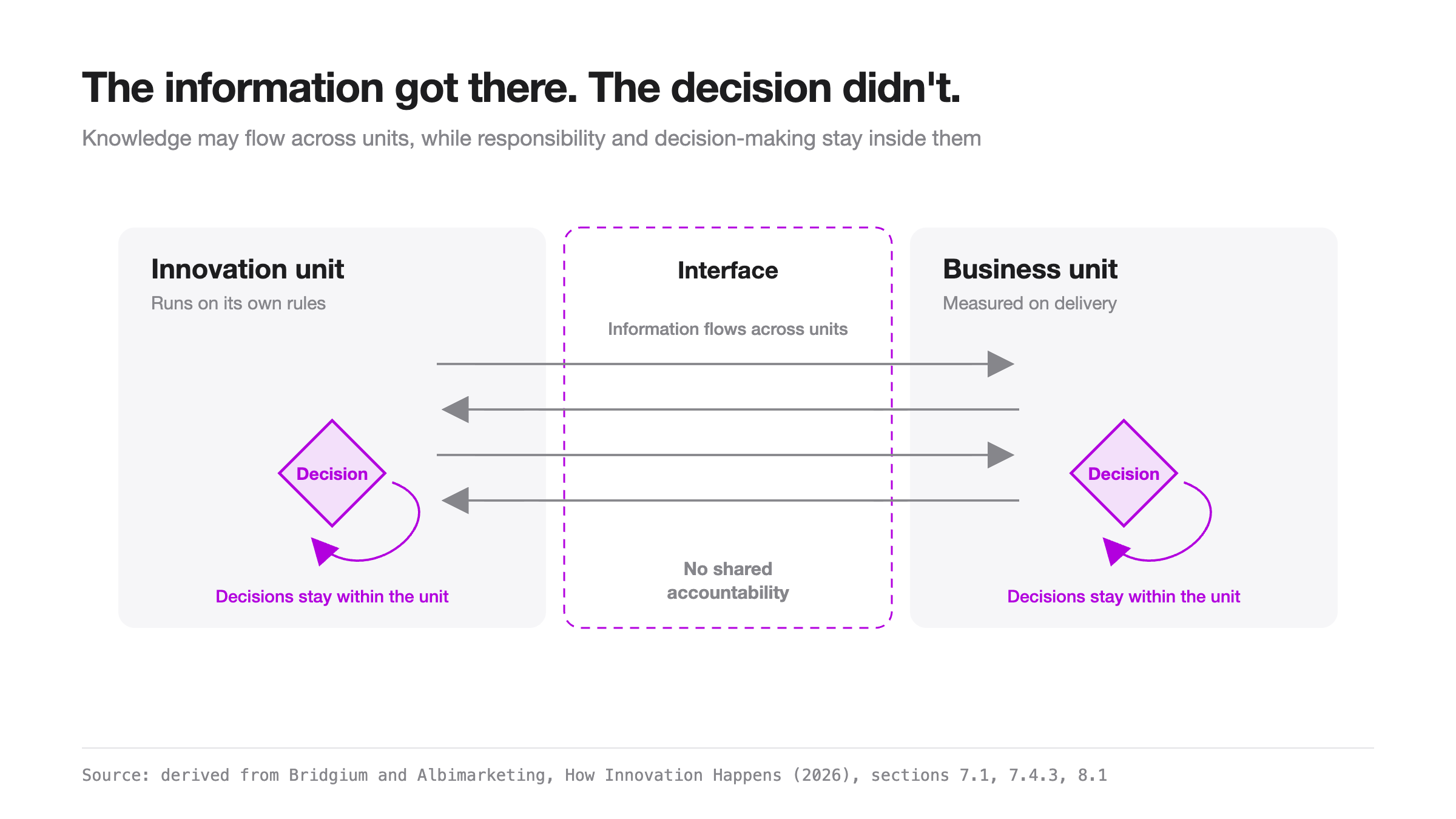
Figure 1. Information crosses freely between the innovation unit and the business unit, while decisions stay inside each unit and the interface between them has no shared accountability. Source: derived from Bridgium and Albimarketing, How Innovation Happens (2026), sections 7.1, 7.4.3 and 8.1.
The four mechanisms point to the same conclusion. Communication and decisions are different kinds of work, and one cannot stand in for the other. The table below sets out the division of labour.
| What communication across units can do | What only a decision at the interface can do |
|---|---|
| Make a pilot visible to the people it affects | Commit people and budget to the next step |
| Help people find out who knows what | Settle which criteria the result will be judged by |
| Spread a working solution to other teams and countries | Set a date by which the business unit says yes or no |
| Collect feedback and use cases | Assign who carries the risk once the pilot ends |
Table 2. The division of labour between communication and decisions at the boundary between units. Source: derived from Bridgium and Albimarketing, How Innovation Happens (2026), sections 7.4.3 and 7.5.
The report’s findings on embedding (section 7.5) treat both columns as necessary: horizontal communication lets solutions travel, while pipelines, decision rules and ownership signal that ideas can move from pilot to operations. Organisations in the silo pattern have invested in the left column and left the right one empty.
How to check this in your own organisation
Five questions show whether your organisation has a communication gap or a decision gap at its internal boundaries:
- For the last pilot that was called a success, can you name the person who decided whether it would go into operations, and the date on which they decided?
- When an innovation result is presented to a business unit, does the meeting end with a decision, or with a request to keep everyone informed?
- Is there any regular meeting where the innovation unit and a business unit sit together with authority to commit resources, as opposed to sharing updates?
- Were the criteria for taking the pilot into operations agreed with the business unit before the pilot began, or discussed after the results came in?
- If you count the channels that tell people about innovation work and the meetings where decisions about it are taken, which list is longer?
| What you observe | What it usually indicates |
|---|---|
| Pilots are presented widely and praised, then wait | Communication runs, the decision structure does not |
| Business units describe the innovation team as interesting but not serious | Different rules are being read as a lack of rigour |
| Decisions about pilots surface only in the business unit’s annual planning | There is no decision point at the interface |
| Handover meetings end with “let’s stay in touch” | Nobody owns the interface |
| A stalled pilot is followed by a new newsletter or channel | A decision gap is being treated as an information gap |
Table 3. Signals that information crosses your internal boundaries while decisions do not. Source: derived from Bridgium and Albimarketing, How Innovation Happens (2026), section 7.4.3.
The Nordic dimension
Nordic organisations start with an advantage on the communication side. All three respondents quoted in this article are based in Finland, and the telecommunications leader among them says plainly that information moves quite well. The report’s findings on embedding describe cross-functional and cross-country communities, internal platforms and informal channels that let solutions travel beyond local teams. Flat structures and easy access to colleagues in other units make the left column of Table 2 comparatively cheap to build.
The risk sits in the same sentence that describes the strength. Information moves, and decisions are still made within units. Our reading, which goes beyond what the report states directly, is that in organisations with low hierarchy and a strong preference for consensus, deciding something on behalf of another unit can feel like overstepping. Nobody wants to impose a decision on a colleague who runs logistics, and the colleague who runs logistics does not want to be seen rejecting a well-meant idea. A friendly conversation then stands in for a decision, and the pilot waits in a state where it has been neither accepted nor declined.
Lawrence and Lorsch’s integrator article (1967) points to the habit that helps here. They found that effective integrators resolved conflicts between departments by confronting them openly. The disagreement was worked through on its merits, instead of being smoothed over or settled by authority alone. In a culture that values agreement, that kind of open confrontation needs a legitimate place to happen. Without one, disagreement goes unspoken and the decision is postponed. Ranjay Gulati’s study of silo busting (2007) makes a related point from the other side: companies that organised successfully across their internal boundaries had to make decision-making work across departments, and coordination in that sense meant more than sharing information.
The structural response
- Name the decisions that sit at the interface. Before a pilot starts, write down the decisions it will need from the business unit: whether to continue after the test, whether to fund the next stage, whether to take the solution into operations. A decision that has a name can be given a place and a date. The report links stalled pilots to missing pipelines, with unclear stages after piloting and no visible decision points, and naming the decisions is the first step towards making them visible.
- Give each interface decision one owner, one forum and one date. Following Rogers and Blenko, one person holds each decision. In most cases that is a named business unit leader, with the innovation unit recommending and giving input. The decision is taken in a specific meeting where both sides are present, by a date agreed when the pilot is approved. If the organisation can afford it, someone in an integrating role convenes that meeting and makes sure it ends with an answer.
- Agree the criteria before the results arrive. At the start of the pilot, the innovation unit and the business unit agree what result would justify the next step and what result would end the work. The outcome is then judged against criteria both sides accepted in advance, instead of being read afterwards through two different thought worlds. This also gives the business unit a fair way to say no, which is as useful to the organisation as a yes.
- Turn communication rituals into decision moments. Keep the demo days, newsletters and channels, because they do work that decisions cannot. Add a fixed decision slot to the rituals that matter: at the end of a demo day, the relevant business owner says yes, no or what is still missing, and by when. The report’s point is that structure and communication must run in parallel. In practice that means every forum where information crosses the boundary should have a clear route to a forum where something is decided.
Conclusion
Most silos in large organisations look nothing like walls. People across units know each other, talk often and share what they are working on. What stays behind the boundary is the decision, because each unit runs on its own rules and answers for its own results, and nobody answers for what happens between them. The interviews in our research describe this pattern even where communication works well, and good communication is part of what keeps it hidden.
That is why the familiar remedies disappoint. Another newsletter or demo day improves awareness, and awareness was already high. What is missing is a place where the decision can be taken jointly: a named decision, an owner, criteria agreed in advance and a date. Where those exist, information that crosses the boundary has somewhere to land. Where they do not, the organisation keeps acknowledging what it knows without acting on it.
So it is worth taking one recent example and following it to the end. Pick the last pilot your organisation described as a success, and trace what happened after the final presentation. If the trail ends in a channel or a newsletter, the question to ask is a narrow one: for that pilot, which named person was responsible for deciding whether it would become normal work, and by what date?
If you want to see where information arrives but decisions do not in your own organisation, Find the Gap maps the four conditions of the Innovation Flow through interviews across departments and shows where new ideas and practices lose momentum between units.
References
- Bridgium and Albimarketing (2026). How Innovation Happens: Insights from Leading Enterprises in Times of Change.
- Lawrence, P. R. and Lorsch, J. W. (1967). Differentiation and integration in complex organizations. Administrative Science Quarterly, 12(1), 1–47.
- Lawrence, P. R. and Lorsch, J. W. (1967). New management job: The integrator. Harvard Business Review, November 1967.
- Thompson, J. D. (1967). Organizations in Action: Social Science Bases of Administrative Theory. McGraw-Hill (reissued by Routledge, 2003).
- Dougherty, D. (1992). Interpretive barriers to successful product innovation in large firms. Organization Science, 3(2), 179–202.
- Bechky, B. A. (2003). Sharing meaning across occupational communities: The transformation of understanding on a production floor. Organization Science, 14(3), 312–330.
- Tushman, M. L. and Katz, R. (1980). External communication and project performance: An investigation into the role of gatekeepers. Management Science, 26(11), 1071–1085.
- Hansen, M. T. (1999). The search-transfer problem: The role of weak ties in sharing knowledge across organization subunits. Administrative Science Quarterly, 44(1), 82–111.
- Hansen, M. T. (2009). When internal collaboration is bad for your company. Harvard Business Review, April 2009.
- Gulati, R. (2007). Silo busting: How to execute on the promise of customer focus. Harvard Business Review, May 2007.
- Rogers, P. and Blenko, M. W. (2006). Who has the D? How clear decision roles enhance organizational performance. Harvard Business Review, January 2006.
- Tett, G. (2015). The Silo Effect: The Peril of Expertise and the Promise of Breaking Down Barriers. Simon & Schuster.