

Engineering Belonging: How to Reconnect Hybrid Teams with Precision Data
- Executive Summary: The End of “Vibes-Based” Culture
- The Science: The Decay of Weak Ties
- 2.1 The Siloing of the Hybrid Enterprise
- 2.2 Granovetter’s “Strength of Weak Ties”
- 2.3 The Network Architecture Shift
- Figure 2: Network Topology — Pre-Hybrid vs. Post-Hybrid
- 2.4 The Financial Premium of Belonging
- Figure 3: The Belonging Premium — Performance Impact
- Figure 4: The Belonging ROI Model (Illustrative — 500-Person Organisation)
- The Nordic Context: Janteloven in the Dark
- The Solution: Engineering Data-Driven Connections
- Strategic Checkpoint: The Culture Engineering Audit
- Conclusion: Stop Guessing, Start Engineering
- References
1. Executive Summary: The End of “Vibes-Based” Culture
For decades, organisational culture was largely a byproduct of physical architecture. Trust, collaboration, and belonging were generated organically in the spaces between formal work—hallways, cafeterias, the spontaneous exchange at a colleague’s desk. These interactions were unplanned, unmeasured, and deeply consequential. They were the invisible scaffolding on which organisational cohesion rested.
When hybrid work removed the physical architecture, the scaffolding collapsed. And the dominant response—virtual events, mandated socialization, annual engagement surveys—has revealed a fundamental misunderstanding of what was lost. Organisations have treated culture as a sentiment to be managed rather than a system to be engineered.
In 2026, the evidence is unambiguous: culture is an engineering problem. It has measurable inputs (interaction frequency, recognition distribution, cross-functional connectivity), observable structures (network density, tie strength, Structural Holes), and quantifiable outputs (performance, retention, innovation velocity). It can be diagnosed, designed, and optimised—but only if leadership is willing to move from intuition to instrumentation.
The gap between intent and capability remains striking:
Figure 1: The Culture Measurement Gap
| Dimension | Percentage | Source |
|---|---|---|
| HR leaders who cite “strengthening culture” as their #1 priority | 82% | Gartner |
| Organisations that use objective data to measure culture | 18% | Gartner |
| Executives who lack tools to understand remote interaction patterns | 68% | Gartner |
| Cross-functional collaboration decline since hybrid adoption | 30% | Microsoft Work Trend Index |
This table describes an organisation building a skyscraper without a blueprint—committing to an engineering outcome while declining to use engineering instruments. The result is predictable: structures that appear intact from the outside but lack the connective integrity to withstand stress.
This article examines the sociological mechanism behind hybrid culture decay (the erosion of Weak Ties), the financial premium of engineered belonging, the specific Nordic amplifier of Janteloven, and how Organisational Network Analysis (ONA) provides the architectural toolset to rebuild fragmented teams with precision.
2. The Science: The Decay of Weak Ties
To engineer belonging, we must first understand, with structural precision, what broke when the office disappeared. The answer is not what most leaders assume.
Hybrid work did not, in most cases, destroy employees’ connections to their immediate teams. Strong Ties—the relationships with close colleagues, direct collaborators, and regular working partners—have largely survived the transition, sustained by project dependencies, scheduled meetings, and shared deliverables.
What hybrid work destroyed is the broader connective tissue: the Weak Ties that link clusters to one another and give the organisation its coherence as a single network rather than a collection of isolated silos.
2.1 The Siloing of the Hybrid Enterprise
Microsoft’s Work Trend Index documents the structural consequence: the shift to hybrid work has caused cross-functional collaboration to decline by 30%. Teams have become hyper-connected internally—creating dense, insular clusters—while losing connectivity to the wider organisational network.
This is not a communication failure that can be resolved with better tools or more meetings. It is a network architecture failure: a systematic contraction of the pathways through which information, perspective, and relational trust flow across the organisation.
2.2 Granovetter’s “Strength of Weak Ties”
The theoretical framework for understanding why this matters was established by sociologist Mark Granovetter in his foundational 1973 paper, The Strength of Weak Ties. Granovetter demonstrated a counter-intuitive finding that has since been replicated across multiple domains: the most valuable connections in a network are not the strongest ones.
Strong Ties—close relationships within one’s immediate circle—provide emotional support and operational reliability. But they are informationally redundant: the people you interact with most frequently tend to know what you already know, think the way you already think, and have access to the same resources you already have.
Weak Ties—the acquaintances in other departments, the colleagues encountered occasionally in cross-functional contexts, the connections maintained through infrequent but meaningful interactions—serve a fundamentally different function. They are bridges between otherwise disconnected clusters, carrying novel information, diverse perspectives, and access to resources that the individual’s Strong Tie network cannot provide.
Granovetter’s insight explains why hybrid work’s impact on culture is so disproportionate to what appears, on the surface, to have changed. Teams still function. Projects still deliver. But the cross-pollination of ideas, the informal knowledge transfer, the serendipitous connections that drive innovation and sustain a sense of organisational wholeness—these have been structurally severed.
2.3 The Network Architecture Shift
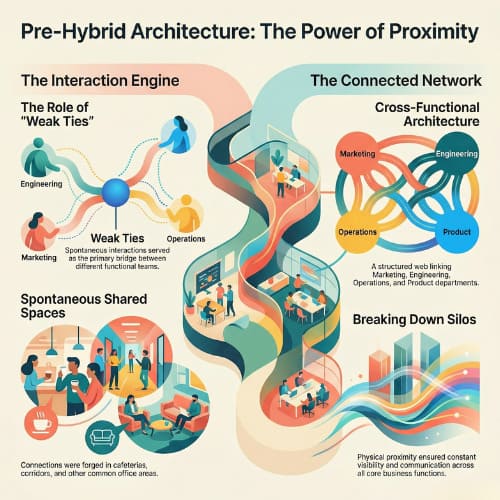
The following visualisation illustrates the structural transformation:
Figure 2: Network Topology — Pre-Hybrid vs. Post-Hybrid
Pre-Hybrid Architecture:
Dense cross-cluster connectivity. Weak Ties maintained passively through physical proximity. Information and Social Capital flow freely across Structural Holes.

Internal cluster density preserved. Cross-cluster Weak Ties severed. Structural Holes widen. Information and Social Capital cease to flow between silos.
The organisation has not lost its people or its capabilities. It has lost its connective architecture—the network pathways that enabled the whole to be greater than the sum of its parts.
2.4 The Financial Premium of Belonging
The economic consequences of this structural decay—and the corresponding premium of repairing it—are substantial. Research by BetterUp and Harvard Business Review has quantified the organisational impact of high belonging across multiple dimensions:
Figure 3: The Belonging Premium — Performance Impact
| Metric | Impact of High Belonging | Source |
|---|---|---|
| Job performance increase | +56% | BetterUp / HBR |
| Reduction in turnover risk | -50% | BetterUp / HBR |
| Decrease in sick days | -75% | BetterUp / HBR |
| Increase in employer recommendation (advocacy) | +167% | BetterUp / HBR |
These are not marginal improvements. A 56% increase in job performance, combined with a 50% reduction in turnover risk and a 75% decrease in absenteeism, represents a compound operational advantage that fundamentally alters the organisation’s cost structure and execution capacity.
Figure 4: The Belonging ROI Model (Illustrative — 500-Person Organisation)
| Variable | Low Belonging (Baseline) | High Belonging (Engineered) | Delta |
|---|---|---|---|
| Avg. performance index | 1.00 | 1.56 | +56% |
| Annual voluntary turnover | 18% (90 employees) | 9% (45 employees) | -45 departures |
| Avg. replacement cost (@ 50% salary) | €3.15M | €1.58M | €1.57M saved |
| Sick days (avg. per employee/year) | 12 | 3 | -75% |
| Aggregate sick day cost (@ €250/day) | €1.50M | €0.38M | €1.12M saved |
| Estimated annual belonging dividend | – | – | €2.69M+ |
Note: Illustrative model based on published belonging premium data applied to a 500-person Nordic enterprise with €70K average salary. Actual figures vary by industry and geography.
Belonging is not a cultural aspiration. It is a hard operational asset with a quantifiable return.
3. The Nordic Context: Janteloven in the Dark
In Northern Europe, the hybrid fragmentation of Weak Ties is amplified by a specific cultural dynamic that most global frameworks fail to account for: the Law of Jante (Janteloven).
3.1 The Modesty Norm
Janteloven—the unwritten Nordic social code that discourages individual self-promotion and emphasises collective equality—is one of the defining features of Scandinavian organisational culture. In its healthiest expression, it produces workplaces characterised by egalitarianism, collaborative orientation, and a deep distrust of empty self-aggrandisement.
However, in a hybrid environment where visibility is no longer a passive property of physical presence, Janteloven creates an unintended blind spot.
3.2 The Invisibility of the Silent Architect
In a co-located office, the employee who consistently stays late to help colleagues from other departments, who mentors new hires informally, who bridges gaps between teams through quiet cross-functional support—this individual is eventually noticed. Physical presence provides ambient visibility. The culture of modesty is naturally balanced by the observability of the workspace.
In a hybrid environment, this balance collapses. The Silent Architect—the individual generating disproportionate Social Capital through cross-functional support, informal mentoring, and network-bridging behaviour—becomes entirely invisible to formal systems.
The Nordic employee operating under Janteloven norms will almost never self-report this connective work to management. To do so would feel like boasting—a violation of the modesty code. And because traditional performance metrics measure task completion (deliverables, KPIs, project milestones) rather than network contribution (Weak Tie maintenance, cross-functional support, Social Capital generation), the Silent Architect’s most valuable work goes unrecorded.
Figure 5: The Silent Architect Visibility Gap
| Dimension | Co-Located Office | Hybrid Environment |
|---|---|---|
| Task output visibility | High (direct observation + metrics) | High (digital deliverables + metrics) |
| Cross-functional support visibility | Medium (ambient observation) | Near zero |
| Informal mentoring visibility | Medium (ambient observation) | Near zero |
| Network-bridging behaviour visibility | Low-Medium (observed in meetings, social spaces) | Near zero |
| Burnout risk detection for high-support individuals | Moderate (visible fatigue, manager proximity) | Very low (no ambient signals) |
The consequences are structurally predictable. Silent Architects generate massive relational value but receive no formal recognition for it. They maintain the Weak Ties that hold the organisation together, but this work is invisible to the reward and protection systems. Over time, they accumulate unrecognised relational debt: the cognitive and emotional cost of sustained support without reciprocity.
The outcome is burnout, disengagement, or departure—and when a Silent Architect leaves, the Structural Holes they were bridging reopen immediately, often cascading into visible dysfunction weeks or months later, by which point the causal connection is no longer obvious.
3.3 Affective Trust and the Nordic Network
The combination of Weak Tie decay and Silent Architect invisibility produces a specific erosion pattern in Nordic organisations. Affective Trust—the emotional confidence that one’s contributions are valued by, and visible to, the organisation—erodes first at the periphery: among cross-functional contributors, remote employees, and internationally distributed team members.
As Affective Trust declines, the remaining Weak Ties become transactional rather than generative. Employees still collaborate when required by project dependencies, but they cease the voluntary relational investment—the unsolicited help, the proactive knowledge-sharing, the collegial goodwill—that constitutes Social Capital. The organisation retains its formal structure but loses the informal connective tissue that makes the formal structure effective.
4. The Solution: Engineering Data-Driven Connections
If culture is an engineering problem, it requires engineering tools. The transition from “vibes-based” culture management to data-driven network engineering requires three integrated capabilities: diagnostic precision, structural intervention, and continuous measurement.
4.1 From Surveys to Network X-Rays
The foundational shift is diagnostic. Annual engagement surveys ask employees to self-report a subjective sentiment (“Do you feel connected?”). The response captures perception, filtered through social desirability bias, mood variability, and—in Nordic contexts—the Janteloven-influenced reluctance to express dissatisfaction.
Organisational Network Analysis (ONA) bypasses self-report entirely. It maps the actual flow of support, recognition, and collaborative interaction across the organisation, producing a real-time architectural blueprint of the network’s connective health.
AlbiMarketing’s ONA methodology maps what we call Gratitude Density: the frequency, distribution, directionality, and cross-functional reach of authentic recognition exchanges. This produces a diagnostic that answers questions engagement surveys cannot:
Figure 6: Survey vs. ONA — Diagnostic Comparison
| Diagnostic Question | Annual Survey | Real-Time ONA |
|---|---|---|
| “Do employees feel connected?” | ✓ (self-reported, lagging) | – |
| Where are Structural Holes between teams? | ✗ | ✓ |
| Which individuals are Silent Architects? | ✗ | ✓ |
| Where have Weak Ties decayed? | ✗ | ✓ |
| Which Energiser nodes are at burnout risk? | ✗ | ✓ |
| Is cross-functional recognition flowing? | ✗ | ✓ |
| Real-time vs. lagging data? | Lagging (6-12 months) | Real-time |
The distinction is not incremental. It is categorical. Surveys capture what people say they feel. ONA reveals how the network actually functions.
4.2 Rebuilding Weak Ties Through Tokenized Gratitude
Diagnostic visibility is necessary but not sufficient. Once Structural Holes and Weak Tie decay are identified, the network must be prompted to reconnect—through mechanisms that are voluntary, cross-functional, and structurally persistent.
AlbiCoins provide precisely this mechanism. When an engineer in Helsinki sends an AlbiCoin to a marketing specialist in Stockholm for a quick piece of strategic advice, the transaction achieves multiple objectives simultaneously:
- It creates a cross-functional Weak Tie data point—a visible, persistent record of inter-silo connectivity that feeds directly into the ONA diagnostic.
- It provides tangible recognition to the recipient, activating neurological reward pathways that reinforce the behaviour of cross-functional support.
- It makes the Silent Architect visible. Over time, the pattern of incoming AlbiCoins reveals which individuals are generating disproportionate Social Capital—allowing leadership to recognise and protect them before burnout occurs.
And it does all of this within a framework that is compatible with Janteloven norms: the recognition is peer-initiated, not self-reported. The Silent Architect does not need to boast. The network speaks for them.
4.3 The Albi Store: Completing the Engineering Loop
Connecting AlbiCoins to the Albi Store completes the structural loop. Recognition carries redeemable value—an earned asset controlled by the employee. This tangibility transforms recognition from a sentiment into a measurable economic signal within the network.
The Albi Store also provides a continuous feedback mechanism. Redemption patterns, accumulation rates, and distribution curves feed back into the ONA diagnostic, enabling leadership to monitor the health of the network’s Weak Ties, the visibility of Silent Architects, and the distribution of Social Capital with a granularity that no other instrument can match.
Figure 7: The Culture Engineering Cycle
This is culture engineering: a continuous, data-driven cycle of diagnosis, intervention, measurement, and optimisation. Not an annual event. Not a survey. A living operational system.
5. Strategic Checkpoint: The Culture Engineering Audit
Leadership teams evaluating their readiness to transition from sentiment-based culture management to data-driven culture engineering should apply the following diagnostic:
- Can we measure our Weak Ties? Does the organisation have empirical data on the state of cross-functional connectivity—not self-reported sentiment, but observable interaction patterns? Can we identify where Structural Holes are forming between teams, functions, or geographies? If the only available instrument is an annual engagement survey, the organisation is navigating a network architecture challenge with a sentiment thermometer.
- Are our Silent Architects visible? In a culture that values modesty, does the organisation have a systematic mechanism to identify individuals who generate disproportionate Social Capital through cross-functional support, informal mentoring, and network-bridging behaviour? If these individuals are invisible to formal recognition and protection systems, the organisation is structurally dependent on unmonitored assets.
- Are we event-managing or engineering? Is the culture strategy built on periodic interventions (quarterly socials, annual off-sites, virtual team-building events) or on structural mechanisms embedded in the daily flow of work? If the former, the organisation is applying an event solution to an infrastructure problem.
- Do we have a continuous measurement loop? After deploying a culture initiative, can the organisation measure its actual impact on network connectivity in real time? Or does it wait 6-12 months for the next survey cycle to assess whether anything changed? Engineering requires feedback. Culture engineering requires network feedback.
6. Conclusion: Stop Guessing, Start Engineering
Culture is not an abstract sentiment hovering over the organisation. It is the sum total of the interactions between people—their frequency, their distribution, their reciprocity, and their reach across functional boundaries. When the physical architecture of the office disappeared, we lost the passive scaffolding that maintained these interactions without conscious effort.
That scaffolding will not reappear. Hybrid work is not a temporary arrangement. The organisations that wait for a “return to normal” to restore their connective health are waiting for a restoration that is not coming.
The alternative is engineering: the deliberate, data-driven construction of a digital connective infrastructure that makes Weak Ties visible, Silent Architects protected, Structural Holes identifiable, and belonging measurable.
By deploying ONA to diagnose the actual state of the network, and Tokenized Recognition to rebuild the cross-functional pathways that sustain Social Capital, Nordic leaders can finally move from hoping their culture is intact to knowing—and from knowing to systematically improving.
Culture can be engineered. The blueprints are available. The question is whether leadership is ready to use them.
Engineer your culture. Map your network →
References
- Microsoft Work Trend Index: Great Expectations: Making Hybrid Work Work
- Harvard Business Review / BetterUp: The Value of Belonging at Work
- Granovetter, M.S.: The Strength of Weak Ties, American Journal of Sociology (1973)
- Gartner: The Future of Employee Experience
- Stockholm School of Economics: Research on Janteloven and Nordic Management Styles in Digital Environments
- Burt, R.S.: Structural Holes: The Social Structure of Competition, Harvard University Press (1992)
- McEwen, B.S.: Allostasis and Allostatic Load, Neuropsychopharmacology (2000)
- Cross, R., Rebele, R. & Grant, A.: Collaborative Overload, Harvard Business Review (2016)