

Four questions to ask before the next initiative
- The symptom: you find out late, and always the same way
- The usual explanation, and why another process does not help
- Four questions, one for each condition
- When to ask them, and what they do not tell you
- The structural response
- Conclusion
- References
Most initiatives fail on conditions that were visible and checkable on the first day, and get checked eighteen months later.
The symptom: you find out late, and always the same way
Eighteen months later the initiative has stalled, and the reason is nearly always one of a short list. Nobody owned it after the pilot. It never appeared in anyone’s objectives. The team that had to receive it was never in the room. The last attempt at the same thing was never recorded, so the work was done twice. Each of those was knowable on day one, and each was discovered on the day it became expensive.
Our two studies, taken together, cover 76 interviews across Northern and Central Europe, and the conclusion they reach about failure is narrow. Innovation rarely fails because organisations lack ideas or technology. It fails because ideas do not move, and the breakdowns sit at the transitions: between articulation and alignment, between alignment and piloting, between piloting and operational embedding.
That matters for a practical reason. A transition is a place where responsibility changes hands, and responsibility is a thing you can ask about in advance. The questions below are the ones that put a transition into view before anybody has crossed it.
The usual explanation, and why another process does not help
When initiatives keep stalling, the common organisational response is to add process. A stage-gate model, a clearer funnel, an innovation methodology, a template for the business case. The appeal is understandable: a process is something a function can design and own by itself.
The difficulty is that a stage-gate checks the readiness of the idea. Our findings locate the failure in the readiness of the organisation to receive it. Those are separate subjects, and a gate that asks whether the concept is sound will pass an initiative that has no operational owner, no budget line after the pilot, and no unit willing to take it.
There is a second effect, and it is the more damaging one. Our first study found that premature evaluation is one of the main reasons articulated ideas stop moving. When an idea is assessed through delivery metrics or investment criteria while its meaning is still ambiguous, it is being judged before it has been understood.
“If you go too fast to decision-making, you kill half of the ideas before they even make sense.”
Innovation Lead · Industrial Manufacturing · Finland
So adding gates to an organisation whose problem sits at the transitions produces two costs at once. The gates fail to catch the thing that actually breaks the initiative, and they filter out early ideas that would have been worth developing. The questions in this article are deliberately not a gate. They do not produce a pass or a fail, and nothing is rejected on the strength of them. They surface what is missing while the cost of fixing it is still a conversation.
Four questions, one for each condition
The Innovation Flow framework names four conditions that determine whether work keeps moving: legitimacy, predictability, connectivity and innovation memory. The conditions are constant across the flow, and what each one means in practice changes from stage to stage, which is why a single question has to be read against the stage you are actually in.
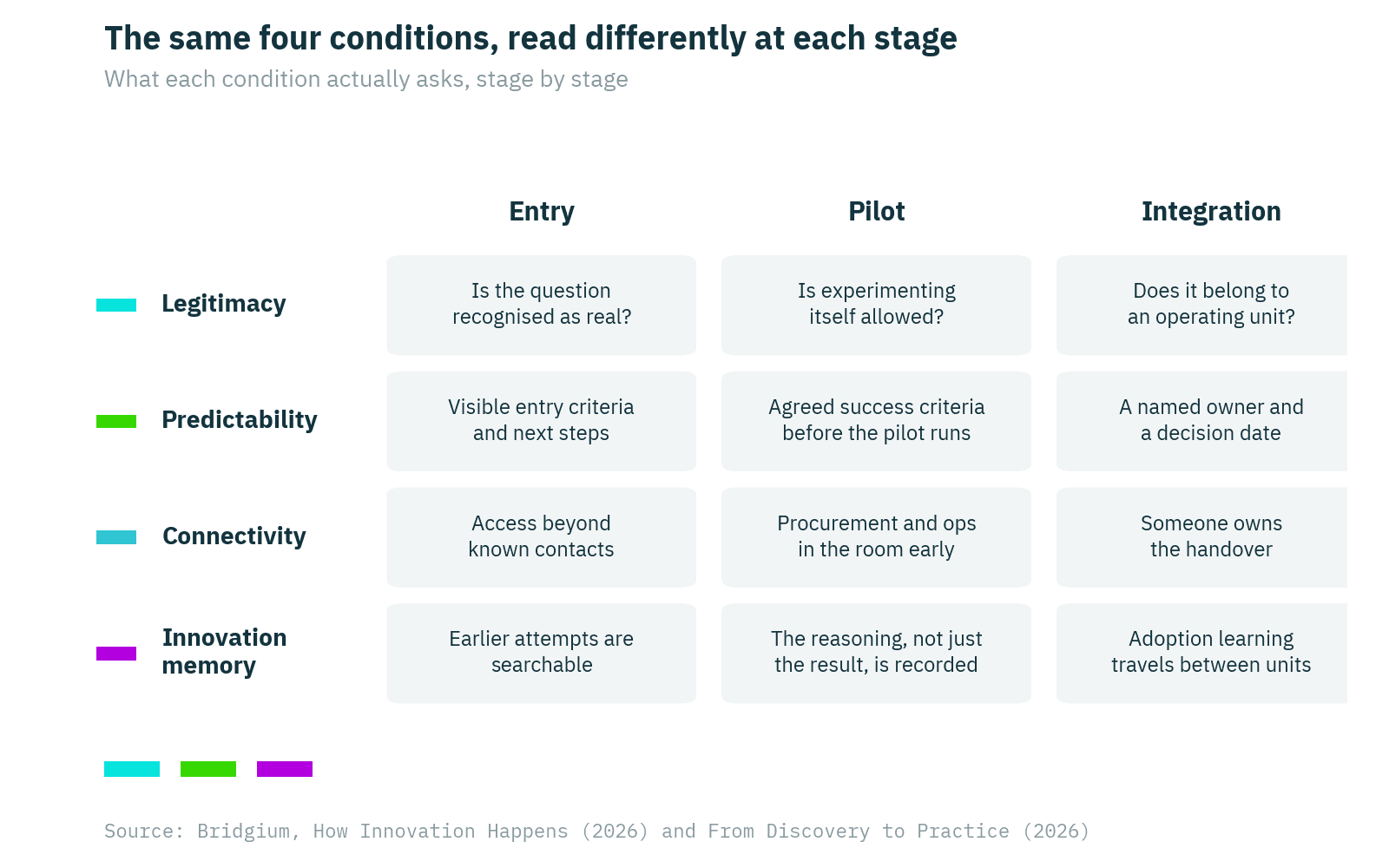
Figure 1. What each condition asks at each stage of the Innovation Flow. Source: Bridgium, How Innovation Happens (2026) and From Discovery to Practice (2026).
1. Legitimacy: is this expected of people, and how would they know?
Legitimacy answers a question every participant asks silently before spending an hour on anything: am I expected to do this, and will it be taken seriously? Our first study finds it established through visible rules rather than through encouragement: authorisation to speak, protected time, and the formal reassignment of ownership.
What to check: whose written objectives contain this initiative, how many people are formally assigned to it against how many are doing it on top of a full job, and whether anyone outside the initiative has been told it matters in a way that costs them something.
What a missing answer looks like: warm support in every forum and no line in any plan. Our interviews describe the condition that produces this.
“Innovation is often seen as extra work. People don’t really have time to think”
Director · Energy & Utilities · Finland
2. Predictability: does anyone know what happens after this?
Predictability is what makes participation rational. Innovation is uncertain by nature, so people continuously assess whether effort is justified by asking what happens next, and when the consequences are unclear, participation drops. It emerges when pipelines, transitions, ownership and decision points are explicit and consistent.
What to check: the date of the continuation decision, the name of the person who takes it, and the criteria written down somewhere both the team and the receiving unit can read.
What a missing answer looks like: an initiative that is never refused and never scheduled. The effort then goes into working out the decision rather than into the work.
“The biggest struggle is not the idea itself, but knowing who needs to be convinced.”
Innovation & Sales Leader · Technology & Enterprise Services · Finland
3. Connectivity: can this cross the next boundary, and who carries it?
Most failures occur at handovers between teams, functions or units, and the organisations that manage them well do so through horizontal structures: open peer communities, small autonomous groups, and cross-functional coordination groups that connect departments when a solution moves towards operational use.
What to check: which unit receives the result, who on each side is accountable for the handover working, and which existing forum brings those functions into the same conversation before the handover rather than at it.
What a missing answer looks like: knowledge crossing the interface while responsibility stays behind it. The symptom is a growing number of people copied on the same thread, because nobody is sure which of them is required.
4. Innovation memory: will the next team find what this one learned?
Innovation memory is the ability to retain and reuse learning from earlier discussions, pilots, failures and implementation attempts, so the organisation stops running the same learning process from the start each time. It is the condition that fails without producing an immediate symptom, which is why it is the one most often left out of a kickoff.
What to check: whether anyone has looked for a previous attempt at the same question, where the conclusion of this initiative will be stored, and whether the record will contain the reasoning or only the result.
What a missing answer looks like: a long-serving colleague who is asked about everything. That arrangement works until the week they change role.
| Condition | The question | What a missing answer looks like |
|---|---|---|
| Legitimacy | Is this expected of people, and how would they know? | Support in every forum and a line in no plan |
| Predictability | Does anyone know what happens after this? | Never refused, never scheduled |
| Connectivity | Can this cross the next boundary, and who carries it? | More people on the thread, no owner of the handover |
| Innovation memory | Will the next team find what this one learned? | One colleague who is asked about everything |
Table 1. The four questions and the shape of a missing answer. Source: Bridgium analysis based on How Innovation Happens (2026) and From Discovery to Practice (2026).
The academic reading
Peter Berger and Thomas Luckmann supply the frame our first study is built on, and it explains why the four questions belong at the start. In their account an idea becomes real through three movements: externalisation, where it is put into words; objectivation, where a group treats it as a shared object; and internalisation, where it becomes simply how things are done. Each movement is a handover between people, and the conditions above describe what has to be true for a handover to complete.
Karl Weick’s work on sensemaking adds the timing. People commit to an interpretation and then act as though it were the situation, which means the interpretations formed in the first week of an initiative govern behaviour for months. James March’s distinction between exploration and exploitation covers the drift: the returns from established work are nearer and easier to attribute, so an organisation under pressure will judge a new initiative by established criteria unless someone has written down, early, what it is supposed to be judged by.
When to ask them, and what they do not tell you
Three moments repay the questions, and they correspond to the three transitions our first study identifies.
Before the initiative starts. This is the cheapest moment, because every answer can still be changed. Fifteen minutes at the end of the kickoff covers all four.
At the handover between teams. The answers change here, and the one that changes most is connectivity. An initiative that passed the questions at the start can fail them at the transfer, because the receiving unit was never asked anything.
After the pilot ends. This is where the four questions stop being a precaution and become a decision. An initiative that has no answer to any of them at this point is not continuing, whatever the pilot result was.
What the four questions do not do
They are a check on conditions, and they say nothing about whether the idea is any good. An initiative can satisfy all four and still be the wrong thing to build. The questions also do not substitute for the specific diagnostics each condition deserves once an answer comes back missing, and they are not a governance instrument: the moment they are turned into a form that has to be completed before approval, they become the stage-gate this article argues against.
| What the four questions show | What they do not show |
|---|---|
| Whether the organisation is ready to receive this result | Whether the idea itself is worth pursuing |
| Which transition this initiative is most likely to stall at | How long any stage will take in your sector |
| Where a decision has been avoided rather than taken | Who should take the decision instead |
| Which conditions were assumed and never arranged | What it will cost to arrange them |
Table 2. The scope of the check, and its limits. Source: Bridgium analysis based on the Innovation Flow framework.
The Nordic dimension
The advantage is access. In organisations with low hierarchy and short internal distances, all four questions can be answered in a single round of conversations, usually within a day, and without anyone needing permission to ask. In a more formal setting the same enquiry would run through three layers and take a fortnight.
The risk is produced by the same quality. Where answers are obtained verbally and the relationships are good, writing them down feels like bureaucracy imposed on people who have just been helpful. An answer that exists only in a conversation has a short life, and in a quarter nobody will agree on what was said. The work is the same; what is missing is the line in the brief.
Noted as an inference. Our studies do not separate Nordic respondents into their own cut of the data, so the pairing above is read from the interview base as a whole rather than from a regional comparison.
The structural response
Four actions, one per condition, all of them available before the work starts.
- Put the initiative in one person’s written objectives. Not the team’s, and not the innovation function’s. One accountable individual whose own result improves if this works. Legitimacy is established by visible rules, and an objective is the most visible rule an organisation has.
- Write the decision date, the decision owner and the criteria into the brief. Three lines. They turn an open-ended effort into something people can plan around, and they give you a date on which the absence of a decision becomes visible.
- Name the receiving unit and get one person on that side to agree in writing. A unit that will not commit before the work starts will not commit afterwards. Learning that in week one is worth considerably more than learning it in month nine.
- Decide where the conclusion will live before there is a conclusion. One location, chosen at the start, that does not depend on any individual remaining in post. The record should carry what the team expected, what happened instead, and what they would check first next time.
None of the four needs budget, and none of them changes the initiative itself. They change the point at which the organisation finds out whether anyone intends to use the result.
Conclusion
A kickoff is organised around the work, which is reasonable, since the work is the part the room controls. The conditions that decide whether the work survives sit outside the room, with people who were not invited and who will be asked for something months from now, at a point when saying no costs them nothing.
What the four questions do is move that conversation forward in time. Some of the answers will be uncomfortable and a few initiatives will not survive them, which is the intended outcome: an initiative stopped in week one releases a team, and an initiative stopped in month fifteen releases nothing but a report. The organisations in our studies that move work successfully are not the ones with better ideas or stricter gates. They are the ones where somebody asked, early, who would be responsible for this when it stopped being interesting.
So there is one question to take into your next kickoff, and it fits on the whiteboard next to the timeline. Of the four conditions, which one does this initiative currently have no answer for?
The findings above come from two Bridgium studies: How Innovation Happens (2026), based on 28 interviews with innovation leaders in Northern Europe, and From Discovery to Practice (2026), based on a further 48 interviews with corporate innovation leaders and startup founders. Both reports set out the Innovation Flow framework in full and are available at bridgium-research.eu/startup-report-2026/
References
- Bridgium, How Innovation Happens: Insights from Leading Enterprises in Times of Change (2026), sections 5, 6 and 8.
- Bridgium, From Discovery to Practice: How Corporate–Startup Collaboration Becomes Usable (2026), sections 5 to 8.
- Berger, P. L. & Luckmann, T. (1966). The Social Construction of Reality. Penguin.
- Weick, K. E. (1995). Sensemaking in Organizations. Sage.
- March, J. G. (1991). Exploration and Exploitation in Organizational Learning. Organization Science, 2(1).
- Kerr, S. (1975). On the Folly of Rewarding A, While Hoping for B. Academy of Management Journal, 18(4).
- Cohen, W. M. & Levinthal, D. A. (1990). Absorptive Capacity: A New Perspective on Learning and Innovation. Administrative Science Quarterly, 35(1).
- Granovetter, M. S. (1973). The Strength of Weak Ties. American Journal of Sociology, 78(6).
- Burt, R. S. (1992). Structural Holes: The Social Structure of Competition. Harvard University Press.
- Nonaka, I. & Takeuchi, H. (1995). The Knowledge-Creating Company. Oxford University Press.
- Knowledge loss and employee turnover, Part I. The Learning Organization, 30(2).
- Stinchcombe, A. L. (1965). Social Structure and Organizations. In J. G. March (ed.), Handbook of Organizations.