

Every idea gets a business case before anyone understands it
- The symptom: the first question is about money
- The usual explanation, and why it does not hold
- What breaks: four mechanisms
- Where the decision point belongs
- How to check this in your own organisation
- The structural response
- Conclusion
- References
When the first question about an idea is what it will save, the ideas that survive are the ones easiest to count, and the decision is taken on something that does not yet exist.
The symptom: the first question is about money
A process engineer notices that two plants handle the same supplier defect in opposite ways, and that one of them loses most of a shift each time it happens. She mentions it to her manager, who likes the observation and asks her to put it forward. The intake form asks for expected savings, required investment, payback period and strategic fit. She has a hunch and one worked example. She fills in the numbers anyway, because the form will not submit without them, and three weeks later the review group declines the proposal for an unconvincing business case.
Nobody in this story behaved badly. The manager was supportive, the form was the standard one and the review group applied the criteria it had been given. The organisation has still just taken a decision about an idea that nobody, including the person who raised it, yet understood.
Where this happens regularly, three things tend to be visible from outside. Proposals arrive at review already shaped as solutions, with a price attached. The ideas that pass are mostly incremental: a cheaper supplier, a shorter approval route, an upgrade to a tool already in use, because their value can be stated on the first day. And the people who bring ideas gradually bring fewer of them, or bring only the kind that will survive the template.
Our first study, How Innovation Happens, is based on 28 in-depth interviews with innovation leaders in large Nordic and European organisations. Its respondents consistently described early evaluation as one of the main reasons why ideas, once voiced, fail to move forward. This article looks at why that happens and what changes when the decision point moves.
The usual explanation, and why it does not hold
The usual explanation is that the ideas were weak. A review exists to filter, a filter rejects most of what enters it, and a high rejection rate shows that the filter is working. On this reading the remedy is better ideas: training in writing business cases, an innovation challenge with clearer criteria, a template with guidance notes.
The interviews describe a different mechanism. When ideas are assessed immediately through delivery metrics, efficiency logic or investment criteria, they are judged before their meaning has stabilised. At that point an idea is still ambiguous. It needs clarification, reframing and an interpretation that more than one person shares, and premature evaluation interrupts this process by asking the idea to perform before anyone understands it.
“If you go too fast to decision-making, you kill half of the ideas before they even make sense.”
Innovation Lead · Industrial Manufacturing · Finland
The declined ideas were never compared with good ideas. They were compared with a standard built for things that already exist: a project with a scope, a product with a market, an investment with a cash flow. An idea in its first weeks has none of these, and the review records their absence as weakness.
There is a second reason the usual explanation fails. A filter applied too early fails selectively. It removes the ideas whose value is hardest to state in advance, which are often the ones that would change how the work is done, and it keeps those whose value is obvious, which are often improvements to work that is already being done. James March described this tension in 1991 as the balance between exploration and exploitation. Returns from exploitation are close, certain and measurable; returns from exploration are distant and uncertain. An organisation that judges both by the same yardstick drifts towards exploitation without ever deciding to.
Wesley Cohen and Daniel Levinthal added a further layer in their work on absorptive capacity (1990): an organisation’s ability to recognise the value of new information depends on related knowledge it already holds. Reviewers read an unfamiliar idea through what they know, and the less it resembles current practice, the harder its value is to see from the review table.
Our second study, From Discovery to Practice, found the same pattern at the edge of the organisation. Corporates assess startups through two logics at the same time: an innovation logic that values novelty, experimentation and emerging potential, and an operational logic that values stability, accountability, continuity and integration. One procurement lead summarised the result in a sentence.
“We tend to evaluate startups as if they were already established vendors.”
Procurement Lead · Telecommunications · Sweden
The internal idea and the external startup run into the same problem. Each is asked to show the properties of something mature in order to be given the time it needs to mature.
What breaks: four mechanisms
Early evaluation is a single decision point placed in the wrong spot. The damage it does runs through four mechanisms, each of which appears in the interviews.
Routine logic applied to something unfinished. Section 5.3.1 of the report describes innovation reduced to routine logic. When efficiency, delivery and short-term performance dominate, incomplete ideas fail routine criteria before they are even voiced. An intake template that asks for savings and payback is one concrete form of this: it asks the questions a project manager needs answered at kick-off, and asks them of an observation. Steven Kerr’s 1975 paper on rewarding A while hoping for B describes the wider pattern, in which an organisation says it wants one kind of behaviour and its systems reward another. The intake form says it wants new ideas and rewards the measurable ones.
Defending replaces understanding. Once an idea has a number attached, the conversation about it changes.
“People start defending or rejecting ideas instead of understanding what problem they actually solve”
Strategy & Transformation Lead · Energy · Finland
The author defends the estimate, the reviewers test it, and the question of whether the underlying problem is real and shared goes unasked. Barry Staw’s research on escalation of commitment (1976) showed that people who are responsible for an earlier decision tend to commit further to it; a business case written in week one turns its author into the owner of an estimate. Amy Edmondson’s study of work teams (1999) points the other way: learning behaviour, such as asking questions and admitting what is not yet known, is associated with a shared belief that the team is safe for that kind of interpersonal risk. A review built around challenge does little to create it.
The idea arrives as a solution. Section 6.2.1 describes the first transition of the second stage of our framework. An idea moves from a personal observation to a shared framing of a problem and a possible solution, and it survives when it is anchored to a problem that others already recognise as relevant.
“Often the first idea is not the solution – it’s just a signal that something is wrong.”
Product & Innovation Manager · Digital Services · Finland
A business case template skips this step. It asks for the solution and its value, and the signal underneath, the thing that is actually wrong, is examined by nobody except the person who first noticed it.
Tools before talk. The report is specific about timing. Digital tools help ideas persist once meaning has begun to form; used too early, they fragment the discussion.
“If everything goes straight into tools, you lose the discussion.”
Innovation Manager · ICT & Digital Platforms · Finland
An idea portal with mandatory fields is a tool used at the earliest possible moment. Ikujiro Nonaka and Hirotaka Takeuchi’s account of knowledge creation (1995) explains why this costs so much: knowledge that a person holds tacitly becomes explicit through dialogue, metaphor and repeated conversation, and a form with fixed fields leaves no room for any of these.
| Mechanism | What it looks like in practice | Where it is described |
|---|---|---|
| Routine logic applied early | Savings and payback requested for an observation | How Innovation Happens, 5.3.1 |
| Defending replaces understanding | The review discusses the estimate, and nobody discusses the problem | How Innovation Happens, 6.3 |
| Solution before problem | The proposal names a fix; nobody checks what is wrong | How Innovation Happens, 6.2.1 |
| Tools before talk | The idea enters a portal with mandatory fields before anyone has discussed it | How Innovation Happens, 6.4 |
Table 1. Four mechanisms of premature evaluation. Source: Bridgium, How Innovation Happens (2026), sections 5.3.1, 6.2.1, 6.3 and 6.4.
Teresa Amabile’s work on creativity in organisations (1998) reaches the same point from another direction: the systems managers build to support coordination, productivity and control can undermine creativity without anyone intending it. The intake process is one of those systems.
Where the decision point belongs
In the Innovation Flow framework, predictability is the condition that makes participation rational. Innovation is uncertain, so people keep asking whether their effort is justified and what happens next. Section 8.1 of the report describes predictability as emerging when pipelines, transitions, ownership and decision points are explicit and consistent.
Early evaluation is a predictability problem of a particular kind. The decision point is explicit, since everyone knows when the review group meets, but it sits where no meaningful decision can yet be made. People can predict what will happen to an unfinished idea, and what they predict is rejection, so the rational choice is to bring only finished ones, or none.
Peter Berger and Thomas Luckmann’s term for what the second stage of our framework describes is objectivation: the point at which a subjective meaning becomes something others can recognise and work with. The report draws the practical consequence. Objectivation is about stabilising meaning so that decisions can later be made on something real, and evaluation becomes productive only after an idea has taken a shared, recognisable form. Karl Weick’s work on sensemaking (1995) describes the same process from the inside: meaning in organisations is made through interaction, in conversation, and usually after the fact.
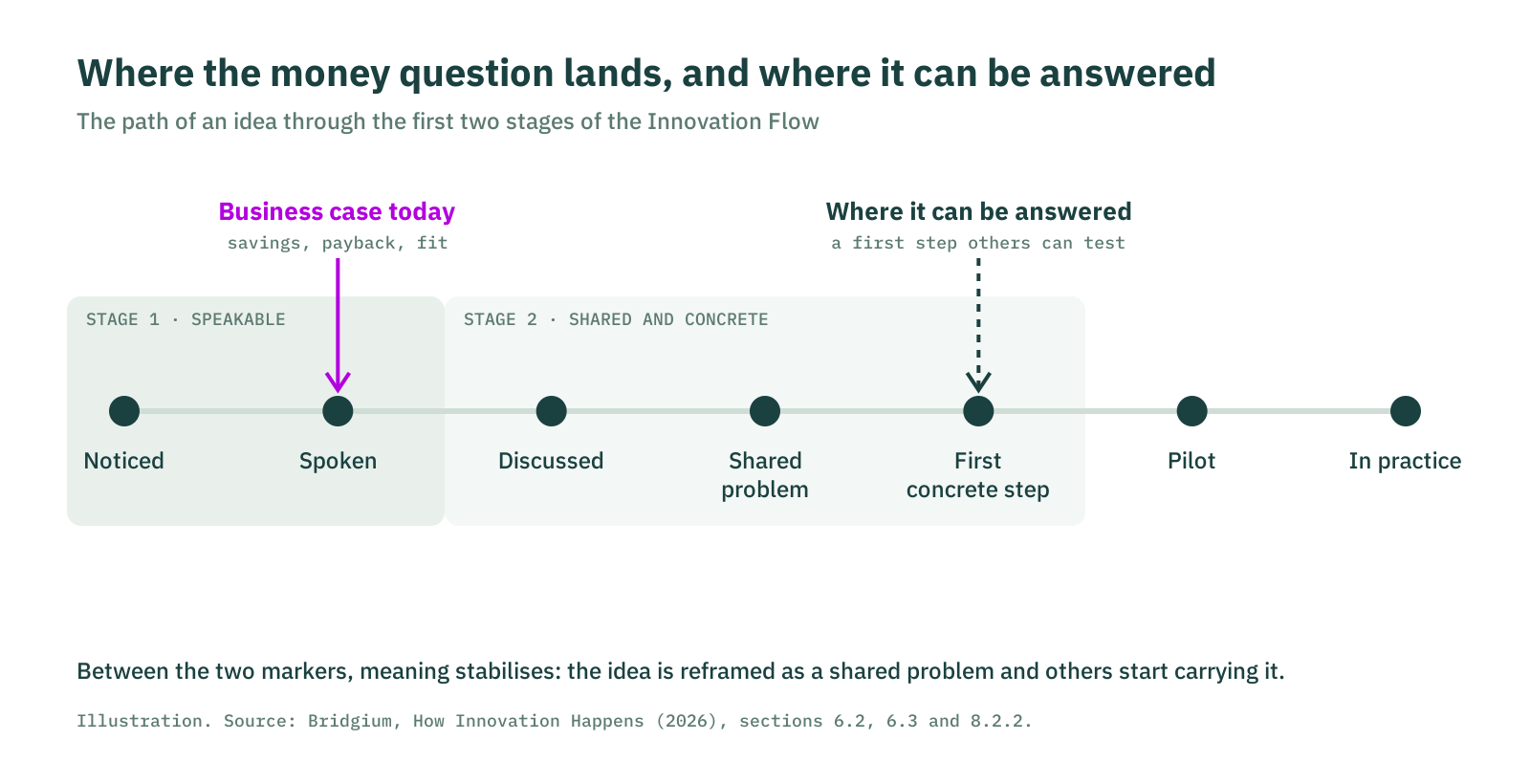
Where the money question lands on the path of an idea, and where it can be answered. Illustration based on Bridgium, How Innovation Happens (2026), sections 6.2, 6.3 and 8.2.2.
The report lists what the second stage needs in that slot. Its table of enablers for making ideas shared and stabilised includes a protected experimentation space separated from early evaluation, synchronised dialogue in small groups, and follow-up loops that allow an idea to return. Section 8.2.2 describes the leadership role at this stage as orchestrating spaces where ideas can live before they are forced to perform.
| What early evaluation asks | What an idea in its first weeks can answer |
|---|---|
| Expected savings and payback period | Where the problem shows up, and how often |
| Required investment | Who else has seen the same thing |
| Strategic fit | Which existing problem it might belong to |
| Implementation plan | What a first small test could look like |
Table 2. Questions an early-stage idea can and cannot answer. Source: derived from Bridgium, How Innovation Happens (2026), sections 6.2 and 6.3.
The right-hand column is a set of questions about the problem. The left-hand column is a set of questions about a solution. Both are legitimate. The trouble starts when the second set is asked first.
How to check this in your own organisation
Five questions show quickly whether evaluation in your organisation arrives before understanding:
- How many conversations does an idea have before someone asks what it will save?
- Of the last ten ideas that were declined, how many were declined on numbers, and could anyone have known those numbers at the time?
- When an idea is declined, does it have a place to come back to with more understanding, or is the decision final?
- Is there a forum where an observation can be discussed without being turned into a proposal?
- Do the ideas that pass today look much like the ones that passed three years ago?
| Signal | What it usually indicates |
|---|---|
| Most approved ideas are cost or efficiency improvements | Exploratory ideas are filtered out at intake |
| Proposals arrive fully priced | The template comes before the discussion |
| The same problem is resubmitted under different names | Ideas are declined without being understood |
| Few submissions come from frontline roles | People expect rejection and have stopped submitting |
Table 3. Signals that evaluation comes too early. Source: derived from Bridgium, How Innovation Happens (2026), sections 5.3 and 6.3.
The Nordic dimension
Nordic organisations start with an advantage that the interviews make visible. Respondents from Finland and Denmark repeatedly describe the second stage in terms of conversation: small, non-hierarchical groups, immediate reaction, and room to think aloud before anything is settled.
“You need a space where you can talk things through properly, without immediately deciding or judging”
Innovation Leader · Engineering & Consulting · Denmark
“You need a space where people can actually talk things through before anything is decided.”
Innovation Lead · Energy & Utilities · Finland
The same preference carries a risk. Our reading of the data, which goes beyond what the report states directly, is that consensus-seeking can act as early evaluation in a gentler form. When a group expects to agree before anything moves, an unfinished idea meets a soft version of the review group in its first meeting. Nobody rejects it, and it does not move until everyone is comfortable with it, which an ambiguous idea rarely makes people. The open conversation that protects ideas in one setting can hold them still in another, and the difference lies in whether the conversation is expected to end in agreement or in a better question.
The structural response
- Separate the conversation from the review. Give observations a regular forum, such as a community or a small cross-functional group, where they are discussed with no decision attached. The report describes this communication space as the crucial enabling condition of the second stage (section 6.1).
- Ask about the problem before the solution. The first gate checks whether other people recognise the problem, and leaves the cost of the fix for later (section 6.2.1).
- Move the money question back. Ask for a business case at the point where a first concrete step is proposed, when the idea behaves like something others can interact with (section 6.2.3).
- Give declined ideas a way back. Ideas survive when they can return for further discussion through feedback loops (section 6.4.1). A decline can name what would need to be understood for the idea to come back.
Conclusion
Early evaluation looks like rigour. It produces a record of decisions, a rejection rate and a pipeline of ideas with numbers attached. What it does not produce is understanding, because it asks for understanding before there has been time to build any.
The cost does not show up in any report: ideas that were never resubmitted, observations that never became proposals, and a slow narrowing of what people consider worth suggesting. Over time the intake process teaches people what kind of idea is wanted, and they learn the lesson well.
The change is small in form. It is a change of sequence, with talk before the template and the problem before the price, and a decision point that sits where a decision can actually be made. One question is worth asking before the next review meeting: of the ideas declined last year, how many did anyone in the room understand?
The full Innovation Flow framework, including the enablers for each stage, is set out in How Innovation Happens. You can download the report at bridgium-research.eu/innovation-report-2026
References
- Bridgium (2026). How Innovation Happens: Insights from Leading Enterprises in Times of Change
- Bridgium (2026). From Discovery to Practice: How Corporate–Startup Collaboration Becomes Usable.
- March, J. G. (1991). Exploration and exploitation in organizational learning. Organization Science, 2(1), 71–87.
- Cohen, W. M. and Levinthal, D. A. (1990). Absorptive capacity: A new perspective on learning and innovation. Administrative Science Quarterly, 35(1), 128–152.
- Kerr, S. (1975). On the folly of rewarding A, while hoping for B. Academy of Management Journal, 18(4), 769–783.
- Staw, B. M. (1976). Knee-deep in the big muddy: A study of escalating commitment to a chosen course of action. Organizational Behavior and Human Performance, 16(1), 27–44.
- Edmondson, A. (1999). Psychological safety and learning behavior in work teams. Administrative Science Quarterly, 44(2), 350–383.
- Nonaka, I. and Takeuchi, H. (1995). The Knowledge-Creating Company. Oxford University Press.
- Amabile, T. M. (1998). How to kill creativity. Harvard Business Review, September–October 1998.
- Berger, P. L. and Luckmann, T. (1966). The Social Construction of Reality
- Weick, K. E. (1995). Sensemaking in Organizations. Sage.