

Every project starts from zero, and a similar one already happened
- The symptom: somebody remembers, and nobody can retrieve it
- The usual explanation, and why it does not hold
- Where memory is lost: three points, not one
- How to check this in your own organisation
- The structural response
- Conclusion
- References
Organisational memory is produced by how teams talk to each other, and a repository added afterwards stores whatever survived that conversation.
The symptom: somebody remembers, and nobody can retrieve it
Ten minutes into the kickoff, a colleague who has been in the company longer than anyone else says she is fairly sure something like this was attempted about three years ago. The room pauses. Nobody can name the project, the outcome, the reason it stopped or the person who ran it. After a short search of a shared drive the meeting moves on and the work starts from the beginning, with the same assumptions that were tested and possibly disproved in 2023.
Our research calls the missing capability innovation memory, and defines it as the ability to retain and reuse learning from earlier discussions, pilots, failures, feedback and implementation attempts, so that the organisation stops running the same learning process from the start each time. It is one of the four conditions in the Innovation Flow framework, alongside legitimacy, predictability and connectivity, and it is the one that fails without producing any immediate symptom at all.
That last point is what makes it expensive. A legitimacy problem shows up as an empty budget line within a year. A memory problem shows up as effort that gets spent twice, and the second expenditure looks exactly like ordinary work. Nobody files a complaint about a project that is going fine, and nobody notices that it is retracing a route somebody else already walked.
There is also a version of the problem that never reaches the kickoff. An external partner approaches a corporate with the same solution a colleague declined two years earlier, receives a fresh evaluation from a team with no record of the first one, and either repeats the earlier outcome or, worse, gets a different answer for reasons nobody can reconstruct. Both sides experience this as randomness in the other organisation.
The organisations in our study that avoid this describe the opposite state in very plain language.
“Over time, examples and lessons accumulate. People don’t start from zero every time — they build on what has already been tried”
Innovation Strategy Lead · Chemicals & Materials · Finland
The usual explanation, and why it does not hold
The standard response to this symptom is a system. A knowledge base, a project repository, a wiki, a lessons-learned template attached to the project closure checklist, and more recently an assistant that can search all of it. The reasoning is intuitive: the information was not written down, so the fix is a place to write it down.
Our first study is direct about the limits of that move. Digital tools play a supportive and secondary role. They stabilise an idea after meaning has begun to form through coordination, visibility and follow-up. Introduced too early they fragment the discussion, and one respondent put the failure in a single sentence.
“If everything goes straight into tools, you lose the discussion.”
Innovation Manager · ICT & Digital Platforms · Finland
The order matters more than the tooling. In the cases where memory accumulated, the sequence ran from shared interpretation to a recorded artefact, and the artefact was a trace of a conversation that had already happened. Where the tool came first, teams filed documents that recorded a decision and omitted the reasoning behind it, which is the part a future team needs. A closure template captures what was concluded. It rarely captures what was believed at the start, which of those beliefs turned out to be wrong, and what the team would check first if they did it again.
There is a measurement problem underneath this as well. Retrieval cost is invisible in every reporting system an organisation runs, because it appears as hours rather than as a line item.
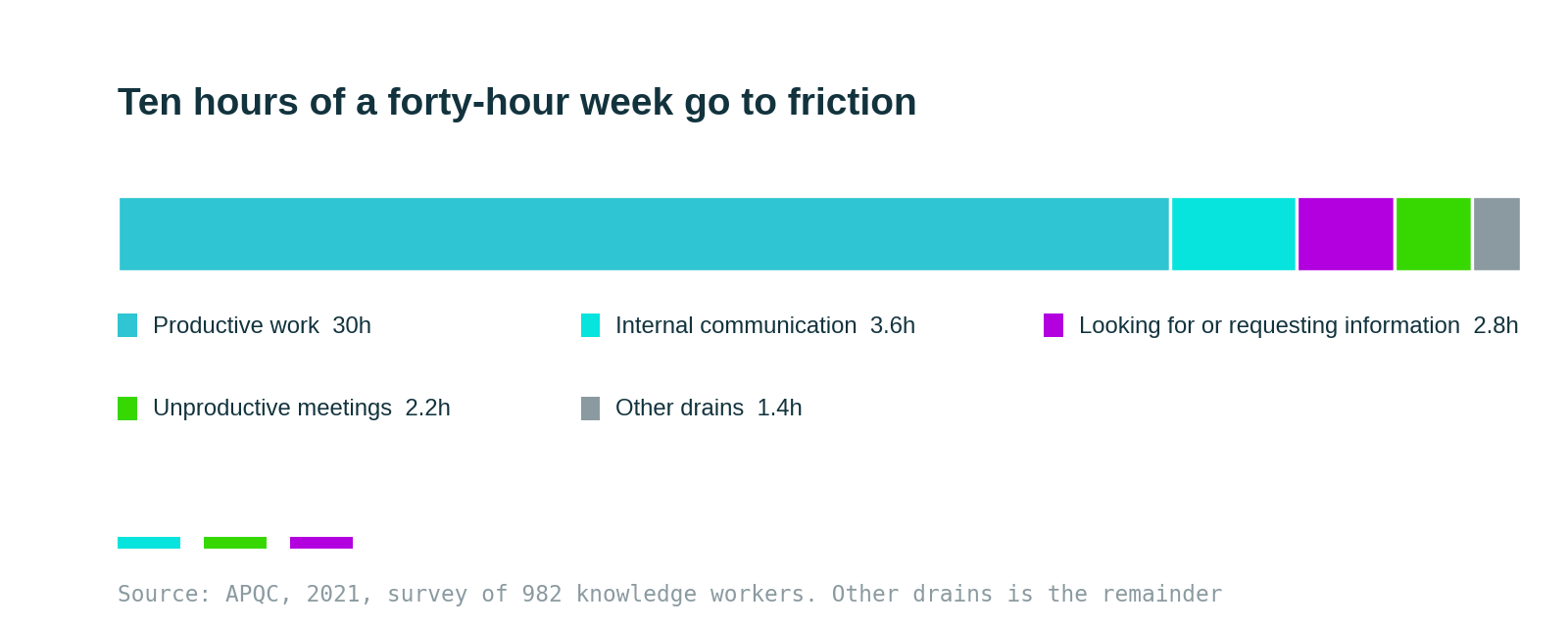
Figure 1. How a knowledge worker’s week divides, by self-report. Source: APQC, 2021, survey of 982 full-time knowledge workers.
That study measures the week of an individual employee and not the memory of a project, so it is cited here for scale rather than as evidence about innovation work specifically. The useful part is the shape. Roughly a quarter of a knowledge worker’s week goes to friction, and the single largest identified component of it is time spent looking for or requesting information that exists somewhere already. None of that appears in a project budget, which is why a memory problem can run for years without anyone proposing to fix it.
Where memory is lost: three points, not one
Our second study traces the same condition across all three stages of corporate and startup collaboration, and finds it failing differently at each one. This matters practically, because a repository designed for one of those failures does nothing for the other two.
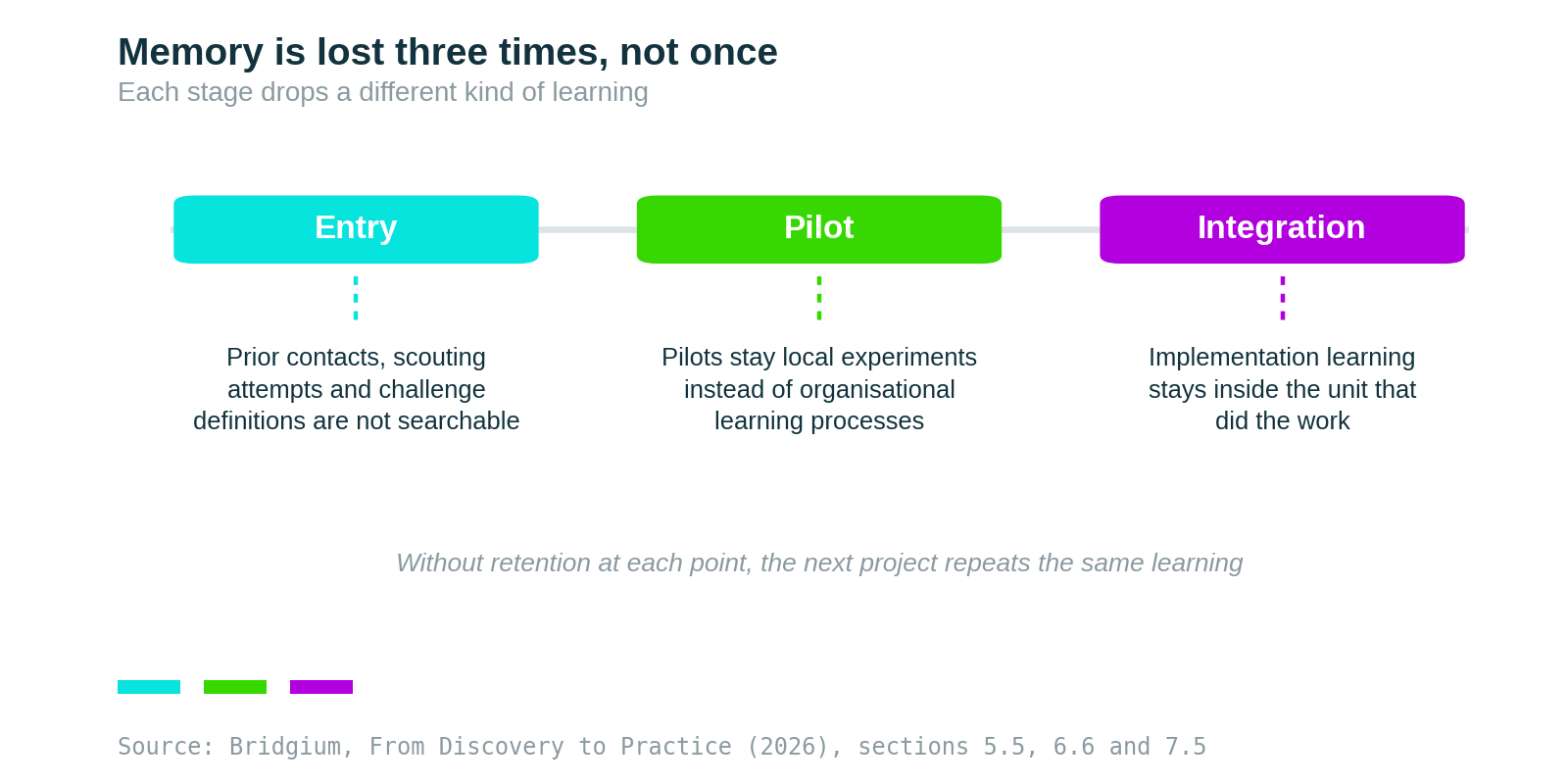
Figure 2. The three points at which innovation memory fails, and what each one drops. Source: Bridgium, From Discovery to Practice (2026), sections 5.5, 6.6 and 7.5.
At entry
Previous contacts, scouting attempts, challenge definitions and ecosystem learning are not retained in a form anyone can search. Both sides restart the matching process instead of building on what has already been established, and the same companies are assessed a second time by a team that has no record of the first assessment.
At the pilot stage
Pilots become localised experiments instead of coordinated organisational learning. Innovation teams, procurement, operational units and the external partner interpret the same collaboration through different institutional logics, with no stable mechanism for synchronisation. Each participant retains their own version of what happened, and no version is the organisation’s.
“It’s always about who has the authority, who needs to be convinced, and what is actually your responsibility.”
Enterprise Innovation Advisor · Enterprise Software · Finland
At integration
Implementation learning stays with the unit that did the work. Some units adapt quickly, others meet resistance or different operational constraints, and unless those experiences are translated across the organisation, the next unit to attempt the same adoption begins with nothing. Our study describes the consequence as organisations repeatedly restarting integration learning instead of accumulating capability for embedding.
The three failures are separate, and an organisation can be competent at one while losing everything at the others. A scouting team with a well-kept assessment log still hands its pilots to units that record nothing. A unit with excellent adoption notes still receives projects whose original success criteria were redefined halfway through without a note. Fixing one point makes the loss at the next point more visible, which is a good outcome and rarely feels like one.
The academic reading
Ikujiro Nonaka and Hirotaka Takeuchi’s account of knowledge creation explains why the tool-first reflex underperforms. Their model treats the conversion of tacit knowledge into explicit form as a social process that precedes documentation, and the documentation is the residue of it. An organisation that skips the social stage has nothing to make explicit, so its repository fills with outputs and stays empty of reasoning.
Wesley Cohen and Daniel Levinthal’s work on absorptive capacity supplies the compounding effect. The ability to recognise the value of new information depends on related knowledge already held, which means every cycle of lost learning lowers the organisation’s capacity to evaluate the next opportunity. A company that forgets its own pilots becomes measurably worse at assessing the ones that follow. Karl Weick’s treatment of sensemaking adds the timing: people understand what happened by looking back at it, so the window for capturing a project’s reasoning opens at the end and closes fast, usually when the team disperses.
How to check this in your own organisation
Five questions. The first one is the diagnostic.
First: take a project your organisation closed last year. Where does the conclusion physically live, and could a colleague who joined in March find it without asking you? A location that requires a person to act as the index is a person, not a memory.
Second: does the record contain the reasoning or only the outcome? Look for what the team expected at the start, which expectation proved wrong, and what they would test first next time. Most closure documents contain none of the three.
Third: when a pilot ends, who writes anything down, and is that work inside the project or after it? Anything scheduled after the project is scheduled after the people have moved on.
Fourth: for the external partners you assessed two years ago, is there a record of what you concluded and why? If scouting starts from a blank spreadsheet each cycle, the entry stage is losing memory whatever the rest of the organisation does.
Fifth: how many of the answers above depend on one long-serving colleague? That person is the organisation’s memory, which works until the week they take a new role.
| What you observe | What is usually assumed | What to check instead |
|---|---|---|
| A similar project already happened | Nobody wrote it down | Whether the reasoning was ever discussed before it was filed |
| The repository is full and unused | People need training on the tool | Whether the entries answer a question anyone actually asks |
| One colleague is asked about everything | She has been here the longest | How much of the record exists only in her replies |
| The same partner is assessed twice | Circumstances have changed | Where the first assessment was stored and by whom |
| Lessons-learned sessions produce nothing | The team was not engaged | Whether the session happened before the team dispersed |
Table 1. Memory symptoms and the checks that separate a storage problem from a process problem. Source: Bridgium analysis based on How Innovation Happens (2026) and From Discovery to Practice (2026).
None of the five requires a system to answer, and that is the point of asking them in this order. If the answers are uncomfortable, the gap is in what the organisation does at the end of a piece of work, and buying a tool at that stage records the same absence in a searchable format.
The Nordic dimension
This is one of the conditions where the Nordic starting position is genuinely strong, and the respondents describe the working version themselves.
“When something is used in a project, feedback comes immediately: what worked, what didn’t. And that learning is then shared and reused in the next projects”
Innovation Partnerships Lead · Energy · Finland
Flat structures, short internal distances and a norm of direct feedback produce exactly the loops that memory is made of. Learning travels between people without needing a process to carry it, and in the strongest cases our study documents cross-functional and cross-country communities acting as containers for that learning over time.
The risk sits in the same mechanism. When transmission works well through conversation, the incentive to record anything is weak, and the memory becomes personal. It lives in the people who were present, it moves at the speed of their availability, and it leaves the organisation when they do. Median tenure is falling across most European labour markets, so a memory system built on continuity of staff is depreciating at a rate nobody has budgeted for.
The structural response
Four changes, and the sequence between them is the substance.
- Record the reasoning, not only the result. A useful entry states what the team expected, what happened instead, and what they would examine first if the question returned. That is three sentences and it is the part with a shelf life. An outcome without its reasoning tells the next team what you decided and leaves them unable to judge whether your conditions still apply.
- Put the feedback loop inside the pilot. Our study describes the strongest practice as continuous exchange during use and adaptation rather than a transfer at the end. Scheduling the retrospective as a closing activity guarantees it competes with whatever the team has already started next, and the people with the relevant memory are the ones most likely to be gone.
- Introduce the tool after the discussion, never instead of it. A repository records what a group has already made sense of together. Used as the first step it collects documents whose meaning was never established, which is how organisations end up with a full system nobody consults. The order is interpretation first, artefact second.
- Name the storage location before the project starts. Deciding at the end where something should live means deciding it when nobody has time. Agreeing at the start costs one line in the brief and determines whether the output is retrievable by someone who does not know it exists.
| Stage | What has to be retained | Who is in a position to retain it |
|---|---|---|
| Entry | Challenge definitions, who was assessed, what was concluded and on what basis | The scouting or open innovation team, at the point of decline |
| Pilot | Success criteria as stated at the start, what changed during the pilot, and why | The pilot owner together with the external partner, during the pilot |
| Integration | Adoption experience by unit, including what failed and what was adapted | The receiving operational unit, in the first months of use |
| Across stages | A retrievable index of the above that does not depend on any individual | Whoever owns the innovation process end to end |
Table 2. What innovation memory consists of at each stage, and where it can realistically be captured. Source: Bridgium analysis based on From Discovery to Practice (2026), sections 5 to 7.
Conclusion
The cost of a memory failure is paid in a currency nobody tracks. It appears as a competent team doing solid work on a question that was answered eighteen months ago, and every individual measure on that project will look healthy right up to the point where somebody recognises the conclusion.
What the organisations in our study do differently is unglamorous and cheap. They talk about what happened while the people who were there are still in the room, they write down the reasoning rather than the summary, and they decide in advance where it goes. The tool arrives afterwards and does the job tools are good at, which is retrieval.
So the question for your next project brief is a small one that changes the shape of everything after it. Before this project starts, who is going to look for the last time we tried something like it?
The findings above come from two Bridgium studies: How Innovation Happens (2026), based on 28 interviews with innovation leaders in Northern Europe, and From Discovery to Practice (2026), based on a further 48 interviews with corporate innovation leaders and startup founders. Both are available at
https://bridgium-research.eu/startup-report-2026/
References
- Bridgium, From Discovery to Practice: How Corporate–Startup Collaboration Becomes Usable (2026), sections 5.5, 6.6 and 7.5.
- Bridgium, How Innovation Happens: Insights from Leading Enterprises in Times of Change (2026), sections 6.4, 7 and 8.1
- APQC, Survey Finds One Quarter of Knowledge Workers’ Time Is Lost Due to Productivity Drains (2021).
- Nonaka, I. & Takeuchi, H. (1995). The Knowledge-Creating Company. Oxford University Press.
- Cohen, W. M. & Levinthal, D. A. (1990). Absorptive Capacity: A New Perspective on Learning and Innovation. Administrative Science Quarterly, 35(1).
- Weick, K. E. (1995). Sensemaking in Organizations. Sage.
- March, J. G. (1991). Exploration and Exploitation in Organizational Learning. Organization Science, 2(1).
- Knowledge loss and employee turnover, Part I. The Learning Organization, 30(2).
- Berger, P. L. & Luckmann, T. (1966). The Social Construction of Reality. Penguin.
- Granovetter, M. S. (1973). The Strength of Weak Ties. American Journal of Sociology, 78(6).
- Burt, R. S. (1992). Structural Holes: The Social Structure of Competition. Harvard University Press
- Kerr, S. (1975). On the Folly of Rewarding A, While Hoping for B. Academy of Management Journal, 18(4).