

The tool was rolled out. People work the old way
- The symptom: usage decays at the same rate as attention
- The usual explanation, and why it does not hold
- What failed: legitimacy at the level of the job
- How to check this in your own organisation
- The structural response
- Conclusion
- References
A rollout changes what is available to people. Whether the work itself changes depends on whose numbers move when they use it.
The symptom: usage decays at the same rate as attention
The programme closed on schedule. Licences provisioned, training delivered, adoption reported at a respectable figure, a slide circulated with a green status. Two quarters later the old spreadsheet is still the working document, the new system is opened the morning before a meeting where somebody might ask about it, and the team that ran the rollout has moved to the next initiative. Nobody refused anything. The work simply went back to its previous shape as soon as the attention left.
The measurement that produced the green status is part of the problem. Logins, licences activated and completed training modules all record exposure to a tool. The thing an organisation wanted was a change in how work is done, and those two quantities can move independently for a long time without anyone noticing the gap between them.
The pattern has a recognisable timing. Usage holds while the programme still has a steering group, a dashboard and someone whose job it is to chase the numbers. It falls at the first quarter-end, recovers briefly when an audit or a review is announced, and settles at whatever level the work itself requires. That final level is the honest measurement, and it is usually available about nine months after the launch, by which point nobody is looking at it.
Our first study found this pattern across sectors and described it in terms respondents used themselves.
“If innovation is not embedded in the frontline, it either becomes ignored or fizzles out.”
Director, Growth & Development · Energy & Industrial Systems · Finland / Global
Two words in that sentence carry the finding. Ignored and fizzles are both descriptions of an absence, and neither of them is refusal. An organisation prepared for resistance is prepared for the wrong event.
The usual explanation, and why it does not hold
The standard reading is resistance to change, and the standard remedy follows from it: more communication, another round of training, champions in each department, a stronger message from leadership about why this matters. All of that assumes the obstacle is understanding or willingness.
Our interviews point somewhere else. Respondents describe departmental separation as a matter of misaligned logics rather than hostility.
“It’s still happening in silos… there are synergies, but not too much happening between divisions.”
Innovation Partnerships Lead · Energy · Finland
The important detail in our findings is that silos are not dissolved by communication. Knowledge does cross unit boundaries reasonably well. Responsibility and decision-making do not travel with it, and it is responsibility that determines whether a new practice survives the first busy week.
External survey data shows the same split at scale. McKinsey’s 2026 global survey on artificial intelligence reports that eight in ten respondents say the technology has improved their own productivity, while the share of organisations attributing any contribution to EBIT sits at 37 per cent and has not moved from the previous year.
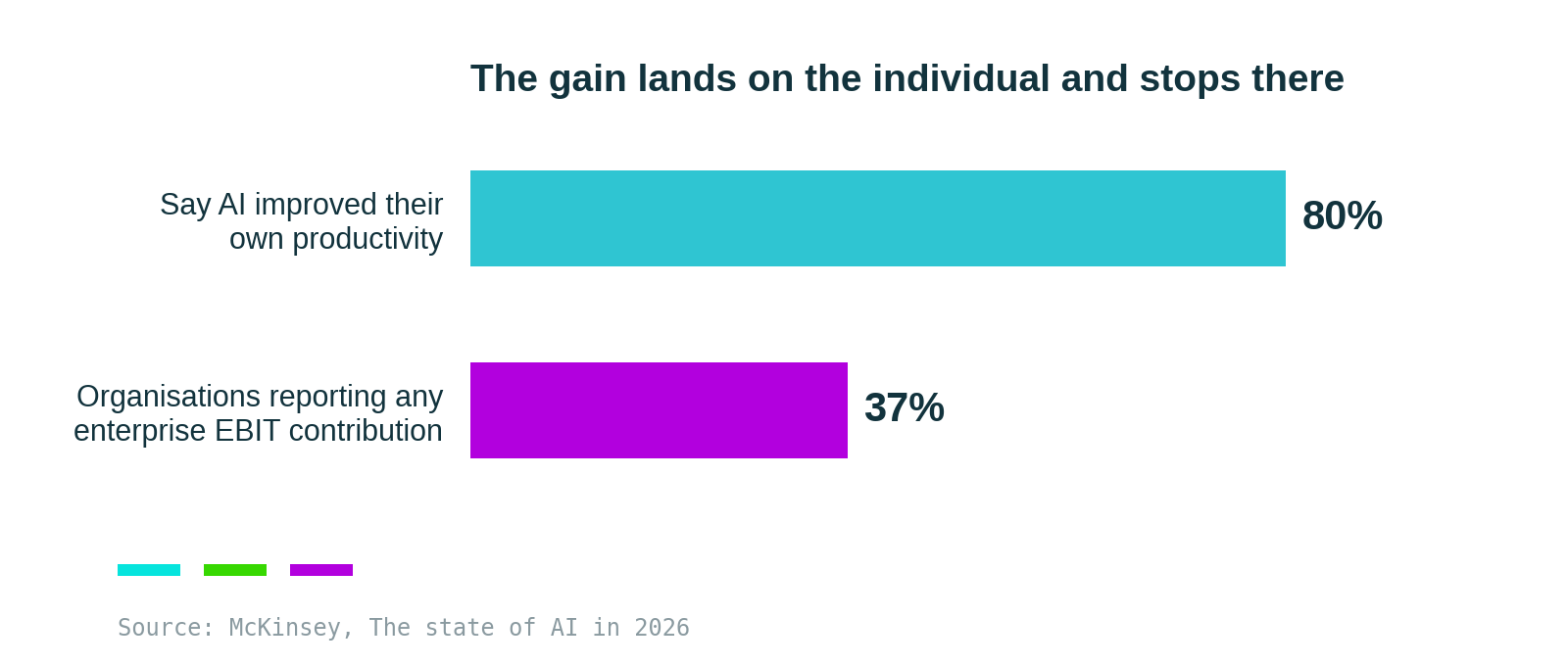
Figure 1. Individual benefit and organisational benefit reported side by side. Source: McKinsey, The state of AI in 2026
That survey covers internal technology deployment rather than the embedding of an external solution, so it is cited here for the pattern. The pattern is that a tool can be genuinely useful to the person holding it and still change nothing about how the organisation works, because the unit of change was never the individual. The same survey finds that the organisations capturing real value are the ones redesigning workflows around the technology, with roughly three-quarters of high performers doing so against a quarter of everyone else. Redesigning a workflow is a decision about responsibility and sequence. Training is not a substitute for it.
What failed: legitimacy at the level of the job
The Innovation Flow framework names four conditions: legitimacy, predictability, connectivity and innovation memory. At the adoption stage the condition that fails is legitimacy, and it is worth being precise about which legitimacy, because it operates at two different levels and the distinction changes the remedy.
An innovation function can hold legitimacy with executives and still leave a frontline employee with no answer to a simpler question: is this now part of my job, and will anyone notice whether I do it? Our first study puts the consequence in one line. Without translation into KPIs, innovation remains morally supported and operationally optional.
“People already have their KPIs. Innovation is always something extra.”
Enterprise Innovation Advisor · Technology & Enterprise Software · Finland
Three recurring breakdowns produce that state, and our study found them together rather than separately.
| Breakdown | How it appears | What it costs |
|---|---|---|
| Ownership after handover | Innovation teams step back, the business unit inherits something it did not initiate | No one owns the next operational step, so adoption stalls without a decision |
| Pipeline and KPI alignment | Unclear stages after piloting, no visible decision points, no operational landing zone | Participation declines because people cannot predict what happens next |
| Silos between units | Innovation units and business units operate under different rules and measures | Knowledge crosses the interface, accountability does not |
Table 1. The three breakdowns our first study found at the embedding and adoption stage. Source: Bridgium, How Innovation Happens (2026), section 7.4.
“People are very good at their own roles, but innovation usually sits between functions and that space is not owned by anyone”
People & Business Developer · Financial Services · Finland
Our study is explicit that a clear pipeline works as a legitimation signal. It reduces personal risk and moves the activity from extra work into expected work, which is the transition that decides whether a rollout survives its own launch.
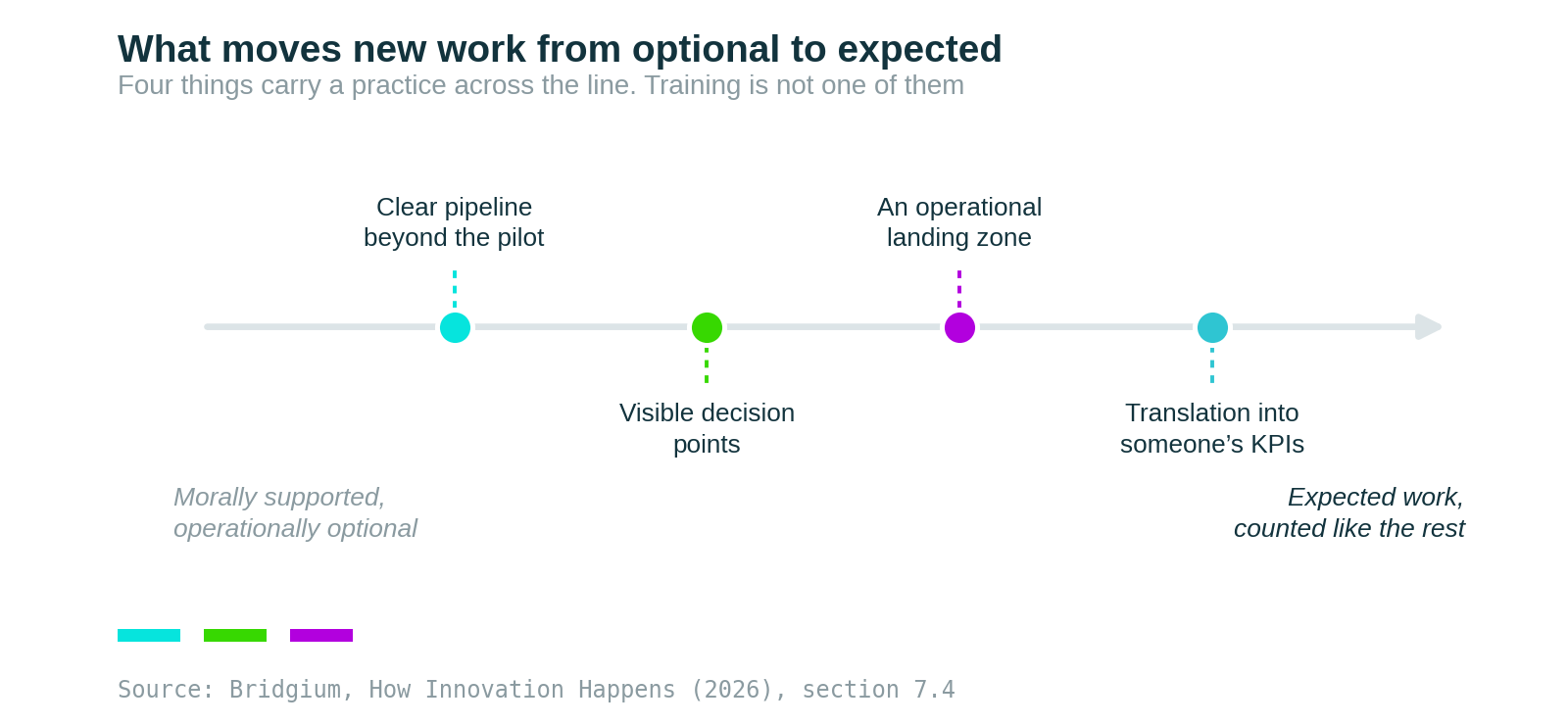
Figure 2. What carries a new practice from optional to expected. Source: Bridgium, How Innovation Happens (2026), section 7.4.
These three compound rather than add. Ambiguous ownership means nobody can authorise the workflow change that would make the tool worth using. An invisible pipeline means the frontline cannot tell whether the change is permanent, so the rational response is to wait. Misaligned measures mean that waiting carries no cost. A rollout arriving into that combination does not fail at any single point, and the people involved will describe it afterwards as something that simply lost momentum.
The academic reading
Peter Berger and Thomas Luckmann described how a practice becomes real inside a group. Repeated action becomes habit, habit becomes a shared expectation, and the expectation eventually gets treated as simply how things are done here. That last stage is what a rollout is trying to reach, and it cannot be reached by instruction, because the mechanism is repetition under a shared expectation rather than persuasion.
Steven Kerr’s 1975 paper on rewarding one behaviour while hoping for another supplies the rest of the explanation. An employee with a measured target and an unmeasured request will produce the measured target under any pressure, and will do so without any attitude towards the request at all. James March’s work on exploration and exploitation explains why this intensifies under load: the returns from the established way of working are nearer, more certain and easier to attribute, so the old method wins every time the week gets busy. None of these three mechanisms has anything to do with willingness, which is why communication aimed at willingness leaves them untouched.
How to check this in your own organisation
Five questions. The first is the one that settles the matter.
First: whose KPI card changed when the tool was rolled out? If the answer is nobody’s, no adoption was required of anyone, and what happened was an installation.
Second: who owns the new way of working now that the project team has dispersed, and is that person in the receiving unit? An owner who sits in the change function owns a project, and the project has ended.
Third: is the old route still available? Where the previous spreadsheet, form or inbox still works, it will be used under time pressure, and no message from leadership outranks a deadline.
Fourth: what are the visible decision points after the pilot, and can someone in the frontline name them? Our study connects participation directly to whether people can anticipate what happens next.
Fifth: in the last performance review cycle, did the new practice appear in anyone’s written objectives? This is the same question as the first one, asked of the system that actually allocates attention in most organisations.
| What you observe | What is usually assumed | What to check instead |
|---|---|---|
| Usage drops after the launch period | People need more training | Whether anyone’s measured objectives changed |
| The old spreadsheet is still in use | Habit and resistance | Whether the old route was ever closed |
| Adoption varies sharply by unit | Some managers are more supportive | Which units have the practice in their delivery measures |
| People ask who owns this now | A communication gap | Whether ownership was formally reassigned at handover |
| Champions carry the whole thing | Culture takes time | What happens to usage when a champion changes role |
Table 2. Adoption symptoms and the checks that separate a willingness problem from a structural one. Source: Bridgium analysis based on How Innovation Happens (2026), section 7.4.
None of the five is about attitude, and that is deliberate. Each one has a documentary answer that exists somewhere in the organisation already: an objective card, a handover note, a process map, a decommissioning plan. If those documents do not exist, the answer to every question is the same, and it is not a question of how people feel about the change.
The Nordic dimension
Nordic organisations start this stage well. Low hierarchy and direct access mean a pilot can be arranged quickly, people try things without waiting for permission, and early usage figures often look excellent. The first half of an adoption curve is easier here than almost anywhere.
The same qualities work against the second half. Voluntariness is the default setting, mandates feel alien, and managers are reluctant to make anything compulsory when the culture treats professional autonomy as the basis of good work. A practice that depends on people choosing it every week will hold for as long as it is interesting and will lose to the quarter-end every time after that. One respondent describes the destination with some precision.
“At some point it should just be part of operations, otherwise people stop going there.”
Former Innovation Director · Engineering & Consultancy · Denmark
The Nordic version of making something compulsory rarely looks like a mandate. It looks like the old route being closed, the new step appearing in the standard process, and the measure appearing on a card that someone reviews. That is available to a consensus culture and produces the same result.
The structural response
Four changes, in this order.
- Translate the practice into a measure before the rollout, not after it. One existing KPI, owned by an existing manager, that moves when the new way of working is used. This is the step most often deferred on the grounds that it can be added once adoption is established, which reverses the actual causality.
- Reassign ownership formally at handover. The receiving unit needs a named owner with the authority to change how work is sequenced in that unit. Our study finds the loss of ownership at handover to be the most frequently mentioned embedding problem, and it is structural rather than motivational.
- Publish the pipeline beyond the pilot. Stages, decision points and the operational landing zone, written where the frontline can see them. This is what turns an initiative from something being tried into something with a destination, and our study identifies it as a legitimation signal in its own right.
- Close the old route on a date. As long as both paths are open, the established one wins under pressure. Announcing the date well in advance and holding it does more for adoption than any further round of communication, and it converts a request into an expectation without requiring anyone to issue a mandate.
The sequence matters. A closure date announced without a named owner produces escalations that nobody can resolve. A measure introduced without a landing zone measures an activity with no destination. Taken together the four make the new practice ordinary, which is the only stable state available.
Conclusion
Rollouts are reported on the day they finish, and adoption is decided in the weeks after everyone stops looking. That asymmetry explains most of what goes wrong here. The project has a completion date and the change has none, so the organisation books the result at the moment when the least evidence is available.
What the organisations in our study do differently is modest and slightly unpopular. They decide whose numbers move before anyone is asked to change anything, they hand the practice to a named owner inside the unit that will live with it, and they close the alternative on a date they publish. None of it is a message, and all of it changes the calculation a person makes on a busy Thursday.
So there is a better question to ask about your last rollout than whether people liked it. Six months on, whose written objectives would be harder to meet if the new way of working stopped tomorrow?
The findings above come from How Innovation Happens: Insights from Leading Enterprises in Times of Change (2026), a Bridgium study based on 28 interviews with innovation and transformation leaders in Northern Europe. Section 7 covers the embedding and adoption stage in full. The report is available at bridgium-research.eu/startup-report-2026/
References
- Bridgium, How Innovation Happens: Insights from Leading Enterprises in Times of Change (2026), section 7.4
- Bridgium, From Discovery to Practice: How Corporate–Startup Collaboration Becomes Usable (2026), section 7.
- McKinsey & Company, The state of AI in 2026: On the road to ROI (2026).
- McKinsey & Company, The state of AI in 2025: Agents, innovation, and transformation (2025).
- Berger, P. L. & Luckmann, T. (1966). The Social Construction of Reality. Penguin.
- Kerr, S. (1975). On the Folly of Rewarding A, While Hoping for B. Academy of Management Journal, 18(4).
- March, J. G. (1991). Exploration and Exploitation in Organizational Learning. Organization Science, 2(1).
- Cohen, W. M. & Levinthal, D. A. (1990). Absorptive Capacity: A New Perspective on Learning and Innovation. Administrative Science Quarterly, 35(1).
- Weick, K. E. (1995). Sensemaking in Organizations. Sage.
- Nonaka, I. & Takeuchi, H. (1995). The Knowledge-Creating Company. Oxford University Press.
- Granovetter, M. S. (1973). The Strength of Weak Ties. American Journal of Sociology, 78(6).
- Knowledge loss and employee turnover, Part I. The Learning Organization, 30(2).